
Designer Metal Sheets: A Complete Guide to Premium Architectural Fencing and Privacy Screens
Learn how Designer Metal Sheets can improve security, privacy, ventilation and architectural appeal for homes, villas, apartments, commercial buildings, institutions and landscape projects in Hyderabad.
A property boundary has a much bigger role than simply marking where a plot begins and ends. It affects privacy, security, airflow, exterior appearance and the first impression created by the building. Traditional compound walls and standard fencing systems remain useful, but many modern property owners want something more visually refined. This has created strong interest in Designer Metal Sheets for boundary fencing, entrance gates, privacy partitions, balcony screens and landscape features.
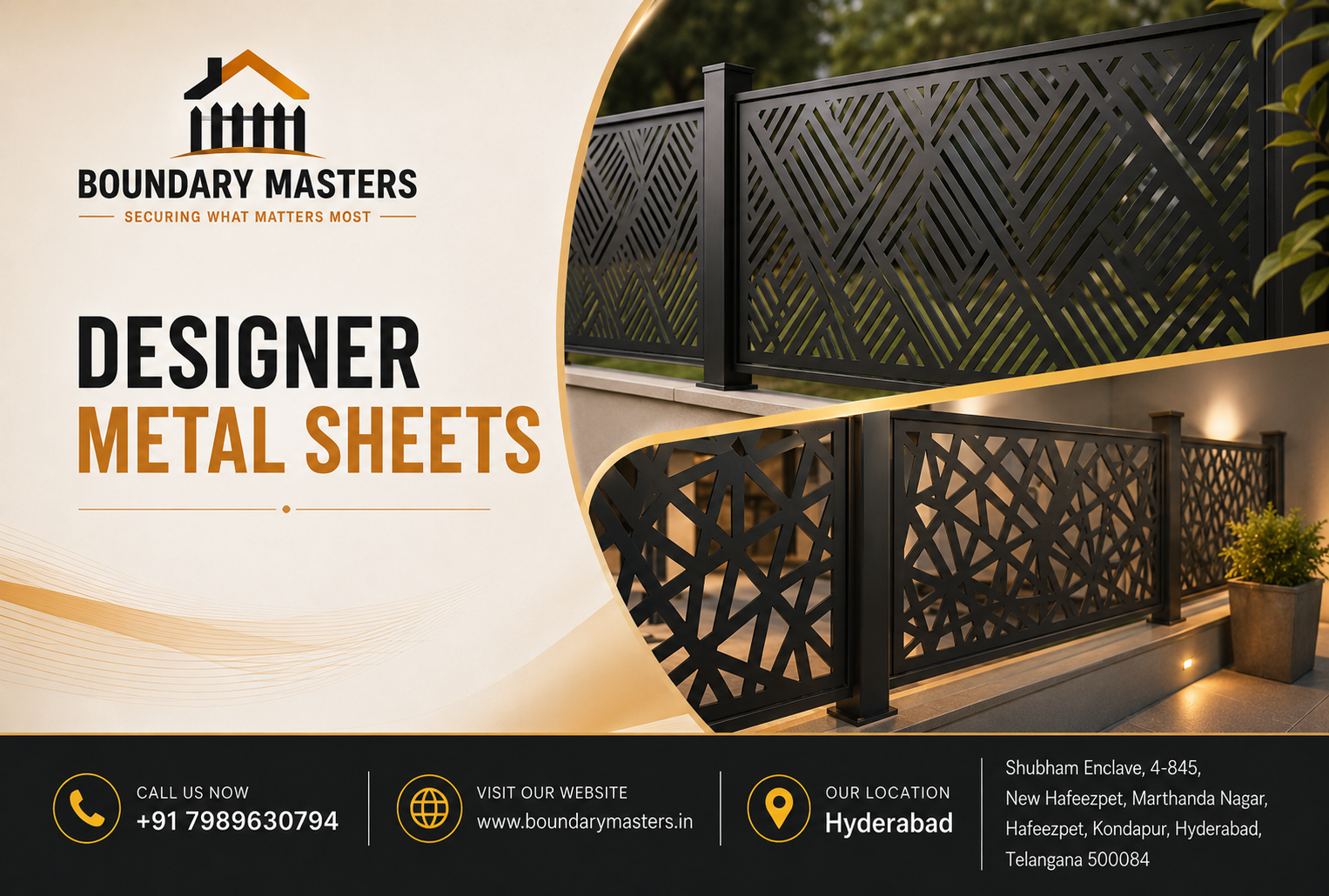
Designer Metal Sheets are metal panels that are laser-cut, perforated, folded or fabricated with decorative patterns. Unlike plain solid sheets, these panels can include carefully planned openings that allow light and air to pass through while limiting direct visibility. Depending on the chosen pattern, they can look bold, minimal, traditional, botanical, geometric or completely customised.
In Hyderabad, architectural styles range from contemporary villas and luxury apartments to commercial complexes, educational institutions, warehouses and independent houses. Each property requires a different balance of appearance, safety and privacy. Properly planned Designer Metal Sheets can be adapted to these varied requirements without making the boundary look excessively heavy or industrial.
However, choosing a pattern from a catalogue is only one part of the process. The metal type, sheet thickness, panel dimensions, structural frame, post spacing, fixing method, wind exposure, coating system and maintenance access must all be considered. A decorative panel may look attractive in a computer image but perform poorly if it is too thin, inadequately supported or installed without sufficient corrosion protection.
This guide explains the practical and visual aspects of Designer Metal Sheets, including materials, pattern styles, applications, cost factors, installation methods, maintenance requirements, advantages, limitations and frequently asked questions. It is intended to help property owners, builders, architects and facility managers make a more informed decision before starting a fencing or screening project.
What Are Designer Metal Sheets?
Designer Metal Sheets are flat or formed metal panels produced with decorative openings, repeated patterns, logos, lines or custom shapes. The design can be created through laser cutting, CNC punching, perforation, stamping or fabrication. The finished panel is usually fixed inside a supporting metal frame or mounted between structural posts and masonry columns.
The term covers a broad range of products. Some Designer Metal Sheets have large decorative openings and are primarily used for visual effect. Others have closely spaced cut-outs that provide a high degree of privacy. Certain panels are designed mainly for ventilation, while thicker framed panels may form part of a secure perimeter fence.
A complete installation generally includes more than the decorative sheet itself. It may involve:
- Laser-cut mild steel, galvanized steel, aluminium or stainless-steel panels.
- Rectangular, square or custom structural frames around the panels.
- Vertical posts installed in concrete or fixed to existing foundations.
- Base plates, anchor bolts, brackets, spacers and joining components.
- Powder coating, painting, galvanization or another corrosion-control system.
- Matching pedestrian gates, sliding gates or swing gates.
- Optional lighting, branding, house-number or name-board integration.
The final performance of Designer Metal Sheets depends on how these components work together. A good decorative panel attached to a weak frame will not provide a reliable boundary. Similarly, a strong frame with poor coating preparation may suffer early corrosion. For this reason, the entire system should be specified rather than treating the sheet as an isolated product.
Why Designer Metal Sheets Are Popular in Hyderabad
Hyderabad has experienced rapid residential and commercial development. Areas such as Kondapur, Gachibowli, Madhapur, Narsingi, Manikonda, Kokapet, Jubilee Hills, Banjara Hills, Miyapur and surrounding locations contain a growing number of properties with contemporary architecture. Standard fencing can provide basic protection, but it may not match the facade or landscaping of these buildings.
Designer Metal Sheets offer an opportunity to turn the boundary into an architectural feature. Their shape, colour, pattern and opening ratio can be coordinated with gates, railings, stone cladding, exterior paint, windows, balconies and landscape elements. This helps the boundary feel like an intentional part of the building rather than an addition installed after construction.
1. Premium Exterior Appearance
The strongest visual advantage of Designer Metal Sheets is their ability to create a distinctive facade. Clean horizontal lines can complement modern villas, while geometric cut-outs can suit commercial buildings. Leaf and branch patterns may work well around gardens, resorts and landscaped properties.
A coordinated design can also be carried across the entrance gate, pedestrian gate and balcony screens. Using the same style of Designer Metal Sheets across selected exterior elements creates consistency and can make the property look professionally planned.
2. Customisable Privacy
Privacy requirements differ from one section of a property to another. The front entrance may need moderate visibility so that the building remains welcoming, while a swimming pool, garden or private seating area may require stronger screening. The opening ratio of Designer Metal Sheets can be adjusted to suit each location.
Smaller openings and denser patterns reduce direct views. Wider openings allow greater visibility and airflow. In some projects, multiple pattern densities are used across the same boundary. This allows the fence to respond to the actual use of the space rather than applying one level of privacy everywhere.
3. Ventilation and Natural Light
A completely solid wall can make outdoor spaces feel dark and enclosed. It may also reduce natural air movement. Designer Metal Sheets provide an alternative by allowing controlled ventilation and filtered daylight through decorative openings.
This feature can be valuable for gardens, terraces, balconies, utility areas, equipment enclosures and outdoor seating spaces. The pattern should still be selected carefully because very dense panels behave more like solid barriers and may attract greater wind pressure.
4. Coordination with Landscaping
Plants, paving, outdoor lights and decorative walls can look more organised when they are supported by a suitable visual background. Dark-coloured Designer Metal Sheets can create contrast against green plants and colourful flowers. At night, lighting placed behind or in front of the panels can reveal the cut-out pattern.
Botanical designs can visually connect the fence with nearby planting, while minimal geometric designs create a cleaner architectural contrast. The choice should consider both daytime and nighttime appearance.
5. Flexible Use in Different Projects
The same concept can be adapted for an independent home, luxury villa, office, café, hospital, school, apartment complex or industrial property. Designer Metal Sheets can function as perimeter fencing, decorative screening, equipment concealment, garden partitioning or entrance features.
This flexibility allows property owners to use the material selectively. For example, decorative panels may be installed only at the visible front elevation, while chain-link or welded-mesh fencing is used along less visible sections of the perimeter.
Materials Used to Manufacture Designer Metal Sheets
Material selection affects weight, strength, corrosion resistance, fabrication method, maintenance and project cost. No single metal is automatically suitable for every application. The most appropriate material for Designer Metal Sheets should be chosen after considering the panel dimensions, exposure, budget and desired appearance.
Mild Steel
Mild steel is one of the most commonly selected materials for Designer Metal Sheets. It is strong, easy to cut and weld, and suitable for detailed laser-cut patterns. Mild steel can be incorporated into substantial frames and used for both fencing panels and matching gates.
The main consideration is corrosion protection. Untreated mild steel can rust when exposed to moisture. Proper surface preparation, primer, topcoat or powder coating is therefore essential. Cut edges and welded areas must receive the same attention as the visible panel faces.
Galvanized Steel
Galvanized steel has a zinc layer that offers additional protection against corrosion. It may be selected for outdoor Designer Metal Sheets where improved durability is required.
Fabrication must be planned carefully because cutting and welding can disturb the zinc coating. Exposed edges and weld zones may need suitable repair treatment. The finished system should be specified as a complete combination of material preparation and coating.
Aluminium
Aluminium is lighter than steel and naturally resistant to many forms of corrosion. Aluminium Designer Metal Sheets are often used for privacy screens, decorative partitions, facade panels and applications where lower weight is important.
Aluminium has different strength and stiffness characteristics from steel. Panel thickness and framing cannot simply be copied from a steel design. Larger aluminium panels may require folds, returns or stronger frames to control movement.
Stainless Steel
Stainless steel may be selected for premium projects, specialised environments and properties seeking a distinctive metallic appearance. Stainless-steel Designer Metal Sheets can be produced with brushed, satin or polished finishes.
The grade of stainless steel should match the exposure conditions. Fabrication quality, welding, contamination control and finishing all affect appearance and performance. Stainless steel usually involves a higher investment than standard painted mild steel.
Popular Pattern Styles
Geometric Patterns
Geometric Designer Metal Sheets use repeated squares, diamonds, triangles, intersecting lines, polygons or abstract mathematical forms. They are especially suitable for contemporary homes, office buildings and commercial frontages.
The pattern can be symmetrical and formal or deliberately irregular. Larger geometric openings create a bold visual effect, while smaller repeated shapes provide greater privacy. The amount of remaining metal between openings must be sufficient to maintain panel stability.
Horizontal Linear Patterns
Horizontal Designer Metal Sheets can visually widen a property frontage and complement modern architecture. Closely spaced horizontal openings create a slatted appearance while controlling direct visibility.
Security must be considered because repeated horizontal elements may provide climbing points in some applications. Where greater anti-climb performance is required, the pattern may need to be modified or combined with additional security measures.
Vertical Linear Patterns
Vertical patterns can make a boundary appear taller and more formal. Vertical Designer Metal Sheets are often selected for entrance fencing, commercial properties, schools and residential developments.
The spacing and width of openings determine privacy. A consistent vertical rhythm can also align visually with columns, windows and gate elements.
Leaf and Botanical Patterns
Leaf, flower, tree and branch-inspired Designer Metal Sheets are frequently used around gardens, villas, resorts, cafés and landscape areas. These patterns soften the visual character of the metal and connect it with surrounding vegetation.
Botanical patterns may be highly detailed or simplified into large organic shapes. More intricate designs require additional cutting time and may create small corners where dust collects, so maintenance should be considered during design selection.
Abstract Contemporary Patterns
Abstract Designer Metal Sheets use non-representational lines, cut-outs and shapes to create a unique feature. They may be suitable for creative offices, hospitality venues, luxury residences and architectural statement areas.
Because abstract patterns can be visually strong, they should be coordinated carefully with the building facade. A complex building may benefit from a simpler boundary, while a minimal facade can support a more expressive panel.
Traditional and Lattice-Inspired Patterns
Lattice-style Designer Metal Sheets can complement courtyards, heritage-influenced homes, religious buildings and traditional architectural elements. These patterns may draw inspiration from screens, jaali work or regional decorative forms.
The design should be adapted for metal fabrication rather than copied without structural consideration. Narrow metal connections and sharp internal corners may need modification to improve strength and finishing quality.
Custom Logos and Brand Patterns
Businesses may incorporate a logo, initials or brand-inspired shapes into selected Designer Metal Sheets. This approach can turn a boundary or entrance screen into a subtle branding element.
Logo placement should remain readable from the expected viewing distance. Excessive branding across every panel may look repetitive, so many projects use identity elements only near the main entrance.
Applications of Designer Metal Sheets
Residential Boundary Fencing
Independent houses and villas use Designer Metal Sheets above compound walls, between masonry columns or as full-height framed fencing. The panels can increase privacy while maintaining a more open appearance than a solid concrete wall.
Matching pedestrian and vehicle gates can be fabricated using the same pattern. This creates a unified entrance and avoids the disconnected appearance that can result when the fence and gate use unrelated designs.
Villa and Farmhouse Entrances
Large entrance areas can use Designer Metal Sheets as feature panels beside gates, within entrance walls or along landscaped driveways. Wider panel modules can create a strong premium appearance when the frame and post proportions are carefully planned.
Farmhouse projects may combine decorative panels near the main entrance with more economical fencing around the wider property. This hybrid approach can help control project cost while maintaining a premium arrival experience.
Apartment and Gated Community Areas
Apartment developments may use Designer Metal Sheets around clubhouses, swimming pools, garden areas, children’s zones, utility spaces and entrance structures. The pattern can be repeated across the site to establish a consistent architectural language.
In shared residential areas, safety requires additional attention. Panel openings should avoid entrapment risks, sharp edges and projections, especially where children may come into contact with the fencing.
Commercial Buildings
Offices, showrooms, clinics, retail premises and mixed-use buildings can use Designer Metal Sheets to create a professional boundary without completely blocking the property from view. The pattern can be customised to support the brand image of the business.
A more open design may suit a showroom where visibility is valuable, while a denser design may be preferred around staff areas, parking spaces or service zones.
Hotels, Restaurants and Cafés
Hospitality properties use Designer Metal Sheets as outdoor partitions, roadside screens, terrace dividers and decorative backdrops. They can define seating areas while allowing airflow and creating attractive light-and-shadow effects.
Outdoor lighting can emphasise the pattern at night. However, electrical fittings should be suitable for exterior use and placed where they remain accessible for maintenance.
Schools and Educational Institutions
Schools may install Designer Metal Sheets around entrances, landscaped courtyards, activity zones and selected security boundaries. Simple patterns with smooth edges are generally easier to inspect and maintain in high-contact areas.
The design should not create easy footholds or gaps that could present safety concerns. The appropriate fence height and opening size should be decided according to the actual location and intended users.
Hospitals and Healthcare Properties
Healthcare buildings may use Designer Metal Sheets for privacy around service areas, air-conditioning installations, outdoor seating zones and pedestrian approaches. Panels can screen equipment without completely preventing ventilation.
Easy cleaning, safe edges and access for maintenance technicians are especially important in these settings.
Industrial and Utility Screening
Factories, warehouses and commercial facilities often need to conceal generators, transformers, waste-storage zones, water-treatment equipment or mechanical systems. Designer Metal Sheets can improve the appearance of these areas while maintaining planned airflow.
The openings must be sized according to the ventilation needs of the equipment. Removable or hinged sections may be required so technicians can access the installation safely.
Garden and Landscape Screens
Landscape designers use Designer Metal Sheets to create garden partitions, decorative backdrops, pergola inserts and visual separation between outdoor zones. The panels may also support controlled climbing plants if the structure is designed for the additional load.
Plants should not be allowed to trap continuous moisture against coated metal surfaces. Regular pruning helps maintain airflow and keeps the panels accessible for inspection.
Balcony and Terrace Screens
Designer Metal Sheets can provide privacy along balconies and terraces. These locations require careful structural planning because panels installed at height may experience considerable wind force.
The supporting balcony structure, anchors, panel openness and frame design should be evaluated before installation. Rooftop applications should not be treated in the same way as low-level garden screens.
Internal Guides for Planning a Complete Fencing Project
A decorative panel system may be only one part of a property’s overall security plan. Boundary Masters has additional resources that explain other fencing options for different environments. These internal guides can help property owners compare decorative, construction and high-security solutions.
Related Boundary Masters Resources
Barbed Wire Hyderabad: Understanding High-Security Perimeter Fencing Fencing for Ongoing Construction Sites: Site Safety and Access Control Fencing Contractors in Hyderabad: How to Choose the Right Boundary Solution Boundary Masters Hyderabad: Residential, Commercial and Industrial Fencing ServicesDesigner Metal Sheets Compared with Other Fencing Options
| Fencing Option | Appearance | Privacy | Ventilation | Customisation | Common Applications |
|---|---|---|---|---|---|
| Designer Metal Sheets | Premium and architectural | Adjustable from low to high | Adjustable through cut-outs | Very high | Villas, homes, offices, hospitality and landscape projects |
| Chain-Link Fencing | Open and practical | Low without privacy mesh | Very high | Limited | Plots, sports grounds, industries and large perimeters |
| Welded-Mesh Fencing | Neat and functional | Low | High | Limited | Schools, factories, utilities and commercial sites |
| Barbed-Wire Fencing | Security-focused | Very low | Very high | Low | Agricultural land, industrial plots and restricted areas |
| Masonry Compound Wall | Solid and permanent | Very high | Very low | Moderate through finishes | Homes, institutions, commercial and high-privacy properties |
| Metal Picket Fencing | Formal and open | Low | High | Moderate | Residential, parks, schools and commercial boundaries |
The table shows why Designer Metal Sheets occupy a unique position. They provide greater visual customisation and privacy than open mesh fencing while allowing more ventilation and design flexibility than a completely solid wall. They can also be coordinated with other architectural elements more easily than standard fencing products.
However, they normally require more design, fabrication and finishing work than chain-link or welded-mesh fencing. Customers should therefore select them where architectural appearance, controlled privacy or customisation provides meaningful value.
Key Design Considerations
Sheet Thickness
The thickness of Designer Metal Sheets affects rigidity, weight, fabrication and cost. A thin panel may be suitable for a small decorative screen with close framing, but the same thickness may not work for a large boundary panel exposed to wind.
The amount of metal removed by the pattern also matters. A highly perforated sheet can behave differently from a sheet with fewer openings. Thickness should therefore be selected together with panel size, frame dimensions and post spacing.
Panel Dimensions
Large panels reduce the number of visible joints but may be more difficult to transport, coat and install. Smaller Designer Metal Sheets are easier to handle but create more frames and connections.
The ideal panel size should match the architectural proportions of the property and the practical limitations of fabrication. Existing masonry columns often determine the available width.
Frame Specification
The decorative sheet is commonly attached to a perimeter frame. This frame supports the sheet, controls distortion and transfers loads to the posts. The frame for Designer Metal Sheets should not be selected only for appearance.
Its section size, wall thickness, connection details and corrosion protection should suit the weight and exposure of the panel. Poor welding sequences can distort thin sheets, so fabrication technique is also important.
Post Spacing
Posts support the complete fencing system. Increasing the distance between posts may reduce the number of foundations but also increases the span of each panel. The spacing for Designer Metal Sheets should be determined according to height, weight, openness and wind conditions.
Wind Pressure
Panels with a high solid area can experience significant wind pressure. This is especially important on terraces, rooftops, corner plots and exposed boundaries. Dense Designer Metal Sheets should be treated more like solid screens than open mesh.
The posts, base plates, anchors and supporting wall must be capable of resisting these forces. In critical or high-level applications, professional structural review may be appropriate.
Open-Area Percentage
The open-area percentage describes how much material is removed from the panel. It affects privacy, ventilation, wind response and visual transparency. The customer should understand this percentage before approving Designer Metal Sheets.
A sample panel or full-scale mock-up can provide a clearer understanding than a small digital image. Visibility can also change at night when the property is brightly lit from behind.
Edge and Corner Safety
Laser cutting can leave sharp edges or small burrs if the panel is not finished properly. All accessible edges of Designer Metal Sheets should be cleaned, deburred and inspected.
Sharp projections should be avoided in areas used by children, pedestrians or pets. Corners may require folds, frames or protective returns.
Ground Clearance
The lower edge of Designer Metal Sheets should not remain in constant contact with wet soil, standing water or damp vegetation. Suitable ground clearance and drainage can reduce corrosion risk.
Where panels are installed above a masonry wall, the fixing method should prevent water from collecting inside frames or around base plates.
Maintenance Access
A decorative screen should not permanently block drains, utility valves, electrical panels or mechanical equipment. Removable sections may be incorporated into Designer Metal Sheets where maintenance access is required.
Access panels should follow the same visual design while remaining easy for authorised technicians to open.
Protective Finishes for Designer Metal Sheets
Surface Preparation
Surface preparation strongly influences the durability of any coating. Oil, rust, mill scale, dust, welding residue and contamination can reduce paint adhesion. Before finishing, fabricated Designer Metal Sheets should be cleaned and inspected.
The appropriate preparation method depends on the metal and coating system. Customers should ask whether preparation is included rather than comparing quotations based only on the final colour.
Primer and Exterior Paint
A compatible primer and topcoat system can protect mild-steel Designer Metal Sheets. The number of coats, application method and paint type should suit outdoor exposure.
Welds, cut edges and concealed corners require careful coverage. These locations are often more vulnerable than the centre of the sheet.
Powder Coating
Powder coating provides a uniform decorative finish and is available in many colours and textures. Powder-coated Designer Metal Sheets can have a smooth, matte, textured or satin appearance.
Performance depends on pretreatment, coating thickness, curing conditions, transport and installation handling. Damage caused during drilling or fixing should be addressed using an appropriate repair method.
Galvanization
Hot-dip galvanization may be considered for projects requiring stronger corrosion protection. The fabrication of Designer Metal Sheets must be compatible with the galvanizing process.
Venting, drainage, panel distortion and the appearance of the zinc finish should be discussed before production. Highly intricate or thin panels may require special consideration.
Duplex Coating Systems
A duplex system combines galvanization with paint or powder coating. This provides a protective zinc layer together with the desired decorative colour. Duplex-finished Designer Metal Sheets may be suitable for demanding outdoor environments when all layers are correctly specified.
Stainless-Steel Finishes
Stainless-steel Designer Metal Sheets may be supplied with brushed, satin or polished finishes. The surface direction and consistency should be controlled across adjoining panels.
Stainless steel can still show tea staining, fingerprints or contamination depending on the grade and environment. Periodic cleaning may be required to maintain its appearance.
Popular Colour Choices
Colour has a significant effect on the final appearance of Designer Metal Sheets. It should be selected by comparing the panel with the building facade, gate, paving, stone, windows and landscape.
- Matte black: Suitable for contemporary architecture and strong pattern definition.
- Charcoal grey: Creates a modern appearance without the intensity of pure black.
- Dark bronze: Works well with stone, wood-look finishes and warm exterior colours.
- Textured brown: Complements gardens, resorts and farmhouse-style properties.
- Light grey: Suitable for minimal facades and selected commercial buildings.
- White or off-white: Can create a clean appearance but may show dust more easily.
- Custom brand colours: May be used for selected commercial or institutional projects.
Dark-coloured Designer Metal Sheets are popular because they create clear shadows and coordinate with many modern exterior materials. However, colour selection should not ignore maintenance. Dust, water marks and scratches may be more visible on certain finishes.
Step-by-Step Installation Process
Site Inspection and Measurement
The contractor inspects the boundary line, existing wall, ground conditions, access, corners, gate openings and level changes. Measurements for Designer Metal Sheets should be taken after confirming the actual construction rather than relying only on old drawings.
Understanding the Requirement
Privacy, security, pattern style, colour, height, material and budget are discussed. The intended function of Designer Metal Sheets must be clear so the design responds to the real need.
Pattern Selection
A standard pattern may be selected or a customised design may be developed. The contractor reviews the opening size, structural connections and visual scale of the proposed Designer Metal Sheets.
Shop Drawings
Drawings may show panel dimensions, frame sections, posts, base plates, fixing details, gate integration and finish. Approval helps ensure that all parties understand the final appearance and construction of the Designer Metal Sheets.
Laser Cutting or Perforation
The approved design is transferred to cutting equipment. The quality of the cutting process affects the accuracy and edge condition of Designer Metal Sheets.
Frame Fabrication
Frames are cut, assembled and welded to the required dimensions. The sheets are then attached using welding, fasteners or another approved method. Distortion must be controlled so the Designer Metal Sheets remain flat and aligned.
Surface Preparation and Finishing
The panels and frames are cleaned and prepared for the specified coating. Finished Designer Metal Sheets should be stored and transported with protection against scratches and impact.
Foundation and Post Installation
Posts are embedded into concrete or installed using base plates and anchors. Correct spacing, level and alignment are essential before fitting the Designer Metal Sheets.
Panel Fixing
Panels are placed between posts or columns and carefully levelled. Gaps should remain consistent. Installation methods should avoid unnecessary drilling or coating damage to the Designer Metal Sheets.
Final Inspection
The completed installation is checked for sharp edges, loose fasteners, coating damage, inconsistent alignment and unwanted movement. Any approved touch-up work on the Designer Metal Sheets is completed before handover.
Cost Factors for Designer Metal Sheets
There is no single rate that applies to every project involving Designer Metal Sheets. Costs depend on design, material, dimensions, framing, finishing and site conditions. A professional quotation should clearly describe what is included.
Metal Type
Mild steel, galvanized steel, aluminium and stainless steel have different purchase and fabrication costs. The selected metal can significantly affect the price of Designer Metal Sheets.
Sheet Thickness
Thicker panels use more material and may require stronger frames and heavier posts. However, reducing thickness only to lower the price may result in distortion or vibration. The thickness of Designer Metal Sheets should match the design and exposure.
Pattern Complexity
Simple repeated patterns may be faster to cut and finish. Highly detailed Designer Metal Sheets can require more design time, machine time, cleaning and inspection.
Open-Area Percentage
The amount of metal removed influences panel weight, strength and cutting time. A pattern with many small openings may take longer to produce than one with a few large openings.
Total Quantity
The number of panels and total square area influence material, machine setup, transport and installation. Larger quantities of repeated Designer Metal Sheets may offer manufacturing efficiencies, while one-off custom panels can involve higher design cost per unit.
Frame and Post Dimensions
The decorative sheet represents only one part of the project. Frames, posts, base plates, brackets and anchors may form a significant portion of the total cost. These elements should be clearly specified in quotations for Designer Metal Sheets.
Coating System
Basic exterior paint, premium paint, powder coating, galvanization and duplex coating have different prices and expected maintenance cycles. Quotations for Designer Metal Sheets should be compared using equivalent coating specifications.
Civil Foundations
New concrete foundations, masonry repairs, column construction and wall modifications add to the project scope. Customers should confirm whether civil work is included.
Site Access
Difficult access, restricted working hours, rooftop installation, narrow roads and manual material handling can increase labour. These conditions affect the installed cost of Designer Metal Sheets.
Matching Gates
Sliding gates, swing gates, pedestrian gates, automation provisions and locking hardware should be listed separately. A gate built with matching Designer Metal Sheets requires additional structural design because it moves and carries its own weight.
Advantages and Limitations
Advantages
- Creates a premium and customised property appearance.
- Provides adjustable privacy through pattern selection.
- Allows ventilation and filtered natural light.
- Can complement gates, balconies and exterior architecture.
- Suitable for homes, offices, hotels and institutions.
- Available in geometric, botanical and custom designs.
- Can screen equipment while allowing airflow.
- Supports decorative outdoor lighting concepts.
- Can be integrated with existing compound walls.
- Well-finished Designer Metal Sheets can provide long-term outdoor use.
Limitations
- Usually costs more than standard chain-link fencing.
- Custom fabrication requires additional production time.
- Dense panels can attract considerable wind pressure.
- Coating damage requires timely repair.
- Intricate patterns may collect more dust.
- Poorly designed openings may create climbing points.
- Very open patterns may not provide enough privacy.
- Thin panels may vibrate or distort.
- Large sections can be difficult to transport.
- Poor fabrication can reduce the quality of Designer Metal Sheets.
Security Considerations
Architectural appearance should not replace practical security planning. The height, pattern, top edge and surrounding environment of Designer Metal Sheets should be reviewed according to the risk level of the property.
Large horizontal cut-outs can create footholds. For properties where climbing resistance is important, smaller openings or vertically oriented patterns may be more appropriate. The gap beneath the panels and beside masonry columns should also be controlled.
Gate security deserves equal attention. Strong panels do not provide effective protection if hinges, locks, rollers or gate frames are weak. Matching gates made with Designer Metal Sheets should include suitable structural members and reliable hardware.
Some properties may require a combination of decorative and high-security fencing. For example, Designer Metal Sheets can be installed at the visible entrance while barbed wire, welded mesh or chain-link fencing protects less visible boundaries. This balanced approach can improve both presentation and security.
Maintenance Guide
Regular Cleaning
Dust, bird droppings, plant residue and pollution should be removed periodically. A soft cloth, clean water and a suitable mild detergent can be used for many coated Designer Metal Sheets.
Abrasive pads, metal brushes and strong chemicals may damage the finish. Cleaning products should always be compatible with the coating.
Inspect Scratches and Chips
Coating damage can expose the metal beneath. Small scratches on steel Designer Metal Sheets should be repaired before corrosion spreads beyond the affected area.
The correct repair material depends on whether the original finish is paint, powder coating, galvanization or a duplex system.
Check Connections
Fasteners, welds, brackets and anchors should be inspected periodically. Loose connections can allow Designer Metal Sheets to vibrate, create noise or move out of alignment.
Inspections are particularly important after severe weather, accidental impact or nearby construction work.
Maintain Drainage
Water should not remain trapped around posts, base plates or the lower edge of Designer Metal Sheets. Blocked drains and accumulated soil should be cleared.
Irrigation sprinklers should not continuously direct water against coated panels.
Control Vegetation
Dense plants can trap moisture and hide corrosion. Climbing plants may also add weight to Designer Metal Sheets. Vegetation should be trimmed so the panels remain visible and accessible.
Protect During Nearby Work
Painting, welding, stone cutting and civil construction near the fence can damage the finish. Sparks, cement splashes and abrasive dust should be prevented from contacting Designer Metal Sheets.
How to Choose the Right Pattern
Match the Building Style
A minimal facade often works well with simple linear or geometric Designer Metal Sheets. A landscaped villa may suit botanical patterns, while a traditional home may benefit from lattice-inspired designs.
The fence should support the architecture rather than compete with it.
Determine Privacy Requirements
Identify areas where direct views must be blocked. Different sections may use different opening ratios. Denser Designer Metal Sheets can be used near private gardens, while more open panels can be installed near entrances.
Consider Viewing Distance
Fine patterns may disappear when viewed from a road. Oversized patterns may appear too bold at close range. The scale of Designer Metal Sheets should be tested from the distance at which people normally see the fence.
Evaluate Nighttime Appearance
A panel that provides privacy during daylight may become more transparent when bright lights are placed behind it at night. Customers should consider both daytime and nighttime visibility before approving Designer Metal Sheets.
Consider Cleaning
Highly detailed designs have more corners and edges where dust can settle. Simpler Designer Metal Sheets may be easier to maintain in dusty or high-traffic locations.
Avoid Too Many Patterns
Using several unrelated designs can make a property appear visually crowded. Repeating one refined pattern across Designer Metal Sheets, gates and selected screens usually creates a more premium result.
Common Mistakes to Avoid
Selecting a Pattern Only from a Small Image
A thumbnail cannot fully communicate scale, privacy or structural behaviour. Customers should review a larger drawing or sample of the proposed Designer Metal Sheets.
Choosing the Thinnest Available Sheet
Reducing thickness may lower the initial quotation but can lead to vibration, bending and poor appearance. Thickness should be selected according to the complete panel design.
Ignoring Wind Exposure
Dense Designer Metal Sheets can behave like solid walls during strong winds. Posts, foundations and anchors must be sized accordingly.
Focusing Only on the Final Colour
The appearance of the coating is important, but surface preparation and pretreatment determine how well it adheres. Customers should ask what happens before the colour is applied.
Using Weak Gate Frames
A gate carries moving loads and requires a stronger frame than a fixed panel. Matching Designer Metal Sheets should not be attached to an inadequately designed gate.
Allowing Panels to Touch Wet Soil
Continuous moisture increases corrosion risk. Suitable ground clearance and drainage should be maintained.
Blocking Utility Access
Decorative screening should not prevent technicians from reaching electrical panels, drains, valves or equipment. Removable or hinged sections can be incorporated where necessary.
Questions to Ask Before Hiring a Contractor
- Which metal type and grade are included?
- What is the proposed sheet thickness?
- What are the frame and post dimensions?
- How will the posts be anchored?
- What is the approximate open-area percentage?
- How has wind exposure been considered?
- What surface preparation will be completed?
- Which primer, paint or powder-coating system is included?
- Will shop drawings be provided for approval?
- Are civil foundations included?
- How will welds and cut edges be protected?
- Are matching gates and hardware included?
- What maintenance is recommended for the Designer Metal Sheets?
A written scope helps customers compare quotations fairly. One quotation may appear cheaper because it excludes foundations, frames, transport, coating preparation or installation accessories. Comparing only the total amount can therefore be misleading.
Authoritative External Resources
The following organisations provide useful general information about materials, protective coatings, standards and workplace safety. Project-specific requirements should still be confirmed with qualified professionals and the selected manufacturer or contractor.
External Technical and Safety References
Bureau of Indian Standards – Indian Standards and Certification Information International Organization for Standardization – International Standards ASTM International – Material and Testing Standards Occupational Safety and Health Administration – Workplace Safety Guidance American Galvanizers Association – Galvanized Steel Resources Powder Coating Institute – Powder-Coating Information World Steel Association – Steel Industry and Material ResourcesThese links are supplied for general educational reference. Material selection, fabrication, structural design and coating requirements should be based on the actual site and applicable standards.
Why Choose Boundary Masters Hyderabad?
Boundary Masters provides fencing solutions for residential, commercial, industrial, institutional and agricultural requirements. Our approach to Designer Metal Sheets begins by understanding the property, privacy expectations, visual preferences and installation environment.
Every site is different. An independent home may need decorative panels above an existing compound wall, while a commercial building may require full-height frames between columns. A villa may need matching gates, and an industrial site may use decorative panels only around the entrance.
Boundary Masters can help customers evaluate:
- Appropriate pattern styles and privacy levels.
- Suitable metal and sheet thickness.
- Panel, frame and post dimensions.
- Installation above walls or between columns.
- Powder-coated and painted finish options.
- Matching pedestrian and vehicle gates.
- Combination fencing for large properties.
- Practical maintenance requirements.
The objective is to provide Designer Metal Sheets that look appropriate for the property while remaining practical to fabricate, install and maintain. A site-specific discussion also allows customers to understand the scope before committing to production.
Frequently Asked Questions
1. What are Designer Metal Sheets?
Designer Metal Sheets are decorative metal panels produced with laser-cut, perforated or fabricated patterns. They can be used for fencing, gates, privacy screens, balcony panels, partitions and architectural features.
2. Are Designer Metal Sheets suitable for outdoor fencing?
Yes. Designer Metal Sheets can be used outdoors when the metal, thickness, structural support and coating system are selected for the site conditions. Drainage and periodic maintenance are also important.
3. Which material is best for Designer Metal Sheets?
The best material depends on the project. Mild steel offers strength and fabrication flexibility, while galvanized steel, aluminium and stainless steel may suit specific environments. The material for Designer Metal Sheets should be selected according to exposure, design, weight and budget.
4. Can the pattern be customised?
Yes. Designer Metal Sheets can include geometric, botanical, abstract, linear, lattice-inspired or custom patterns. A design should be reviewed to ensure it retains sufficient structural connections.
5. Do Designer Metal Sheets provide privacy?
Privacy depends on the size and spacing of the cut-outs. Dense Designer Metal Sheets reduce direct visibility, while open patterns provide greater airflow and visual connection.
6. Can Designer Metal Sheets be installed above a compound wall?
In many properties, Designer Metal Sheets can be fixed above an existing wall. The wall, columns and foundation should first be inspected to determine whether they can support the added load and wind pressure.
7. Can matching gates be manufactured?
Yes. Swing gates, sliding gates and pedestrian gates can use the same pattern as the fencing. Gates containing Designer Metal Sheets require suitable frames, hinges, rollers, locks and automation provisions.
8. Is powder coating available?
Powder coating is commonly used for Designer Metal Sheets. The quality and durability of the finish depend on surface preparation, pretreatment, powder quality, curing and installation handling.
9. Will mild-steel Designer Metal Sheets rust?
Untreated mild steel can rust. Correct surface preparation, primer, paint or powder coating helps protect mild-steel Designer Metal Sheets. Scratches and coating damage should be repaired promptly.
10. How much do Designer Metal Sheets cost in Hyderabad?
The cost depends on metal type, thickness, pattern complexity, panel dimensions, frame sections, coating, foundation work, quantity and access. A site-specific quotation provides a more useful estimate for Designer Metal Sheets.
11. How long does fabrication take?
Production time depends on design approval, quantity, material availability, pattern complexity and coating. Custom Designer Metal Sheets generally require more time than standard ready-made fencing.
12. Can Designer Metal Sheets be used around gardens?
Yes. Designer Metal Sheets can serve as garden screens, outdoor partitions, decorative backdrops and perimeter fencing. Vegetation should be maintained so it does not trap moisture against the panels.
13. Can lighting be installed behind the panels?
Yes. Outdoor lighting can highlight the patterns in Designer Metal Sheets after sunset. Electrical fittings should be designed for exterior use and remain accessible for servicing.
14. Are Designer Metal Sheets suitable for balconies?
They can be used on balconies when the design meets safety and structural requirements. Balcony Designer Metal Sheets require careful anchoring, safe opening sizes and consideration of wind exposure.
15. Can old fencing be replaced with Designer Metal Sheets?
Existing fencing can often be removed and replaced. Before installing Designer Metal Sheets, the contractor should inspect the current posts, wall, foundations and alignment to determine whether any components can be reused.
16. How are Designer Metal Sheets cleaned?
Most coated panels can be cleaned using water, a soft cloth and a suitable mild detergent. Abrasive brushes and unapproved chemicals should be avoided because they can damage Designer Metal Sheets.
17. Can they be used to hide generators and equipment?
Yes. Designer Metal Sheets can conceal generators, air-conditioning systems and utility equipment. The pattern must provide sufficient ventilation, and removable sections may be needed for maintenance.
18. Are custom colours available?
Custom colours may be available depending on the selected paint or powder-coating system. The colour of Designer Metal Sheets can be coordinated with gates, railings, windows and exterior finishes.
19. Are Designer Metal Sheets secure?
Security depends on the panel thickness, pattern, height, framing, posts and fixing method. Properly designed Designer Metal Sheets can form a strong boundary, but the complete system must be considered.
20. Can Designer Metal Sheets be combined with chain-link fencing?
Yes. Decorative panels may be used around entrances and visible areas, while chain-link fencing protects larger or less visible sections. This combination can balance appearance, security and cost.
Final Thoughts
A modern boundary should protect a property while contributing to its overall design. Designer Metal Sheets offer a practical combination of privacy, ventilation, security and architectural appearance. They can be adapted to homes, villas, apartments, commercial buildings, hotels, institutions, gardens and utility areas.
The best results come from planning the complete system rather than selecting a decorative pattern alone. Metal type, thickness, frame dimensions, post spacing, foundations, wind exposure, coating and maintenance access all influence performance.
Customers should request detailed specifications and review the proposed pattern at an appropriate scale. A carefully designed panel should look balanced from a distance, feel safe at close range and remain stable in outdoor conditions.
When correctly fabricated and installed, Designer Metal Sheets can transform an ordinary boundary into a distinctive architectural feature. They can improve the street-facing appearance of a property, create private outdoor spaces and provide controlled airflow without the heaviness of a completely solid wall.
Boundary Masters Hyderabad can help property owners evaluate decorative panel options alongside other practical fencing systems. The right solution may involve full decorative fencing, panels above an existing wall or a combination of Designer Metal Sheets and standard perimeter fencing.
Contact Boundary Masters Hyderabad
Discuss your fencing measurements, preferred pattern, privacy requirement, material choice and installation location with Boundary Masters. Our team can help you explore suitable Designer Metal Sheets for residential, commercial, institutional and architectural applications.
Address:
Boundary Masters Hyderabad
Shubham Enclave, 4-845,
New Hafeezpet, Marthanda Nagar,
Hafeezpet, Kondapur,
Hyderabad, Telangana 500084