
Designer Metal Sheets Fencing: A Complete Guide to Premium, Secure and Modern Boundaries
Discover how Designer Metal Sheets Fencing combines architectural beauty, privacy, security and long-lasting performance for homes, villas, commercial properties, institutions and landscape projects in Bangalore.
A property boundary is often the first architectural feature noticed by visitors, customers and passers-by. It influences how secure a building feels, how private its outdoor spaces remain and how professionally the entire property is presented. Conventional fences can provide a practical barrier, but many property owners now want a solution that contributes to the design of the building as well. This growing requirement has made Designer Metal Sheets Fencing an increasingly preferred choice for modern properties.
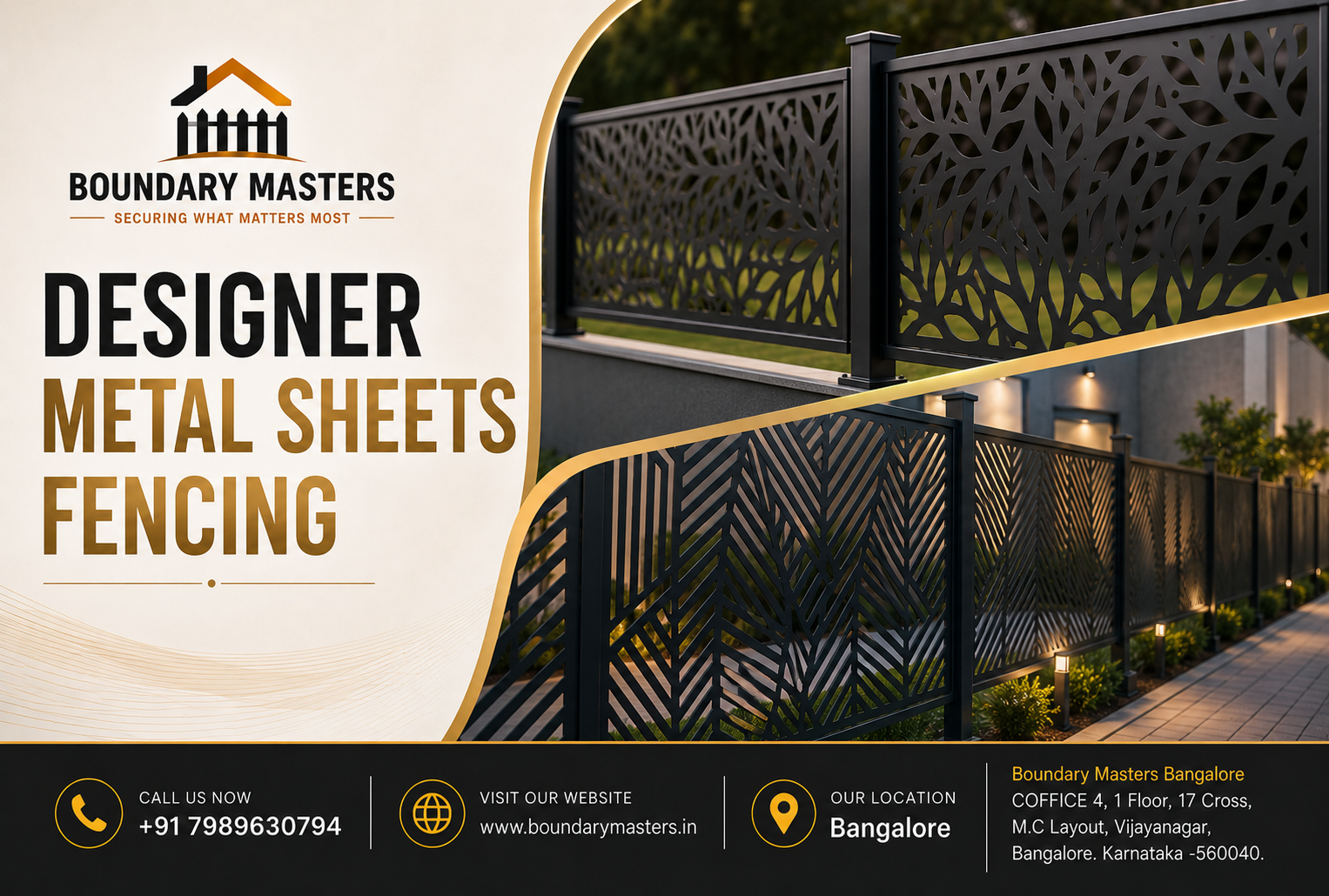
Unlike an ordinary wire fence or a completely solid wall, Designer Metal Sheets Fencing uses precision-cut metal panels to create controlled openings, decorative patterns and visually attractive screening. These panels can feature geometric lines, leaf-inspired motifs, abstract forms, traditional patterns, minimal slats or a design developed specifically for the property. The result is a boundary system that can deliver privacy and protection without making the site appear heavy or closed.
At Boundary Masters Bangalore, every fencing requirement is approached as a combination of site security, structural practicality and architectural appearance. A suitable Designer Metal Sheets Fencing project should not be selected from appearance alone. Panel thickness, frame dimensions, post spacing, fixing systems, drainage, wind exposure, coating quality and maintenance access must all be considered before fabrication begins.
This detailed guide explains how decorative metal sheet fencing works, the available materials and patterns, suitable applications, installation considerations, cost factors, maintenance requirements and questions to ask before selecting a fencing contractor in Bangalore.
What Is Designer Metal Sheets Fencing?
Designer Metal Sheets Fencing is a boundary or screening system constructed using metal sheets that have been cut, perforated, folded or formed into decorative panels. The metal sheets are normally installed inside fabricated frames and supported by steel posts, masonry columns or an existing compound wall.
The pattern may be created through laser cutting, CNC punching, perforation, slitting or a combination of fabrication methods. Laser-cut panels are particularly popular because the cutting process can produce detailed shapes, clean edges and repeated patterns with a high degree of consistency.
A completed Designer Metal Sheets Fencing system generally includes:
- Decorative mild steel, galvanized steel, aluminium or stainless-steel panels.
- Structural frames that hold the sheets securely and reduce panel movement.
- Vertical posts anchored to concrete foundations, walls or structural columns.
- Base plates, anchor fasteners, brackets and concealed or visible connections.
- Protective paint, powder coating, galvanization or another corrosion-control finish.
- Matching gates, pedestrian entrances or service-access panels when required.
The amount of visibility through the fence depends on the selected design. A closely cut pattern can create strong privacy, while a more open design allows airflow, daylight and visual connection with the surroundings. This flexibility is one of the reasons Designer Metal Sheets Fencing can be adapted to residential, commercial and institutional architecture.
Why Designer Metal Sheets Fencing Is Becoming Popular in Bangalore
Bangalore contains a wide mix of contemporary villas, gated communities, independent homes, office buildings, technology campuses, schools, hospitals, hotels and redeveloped urban properties. Many of these buildings have clean architectural lines and carefully planned exterior finishes. A standard fence may provide security but may not complement the building’s visual character.
Designer Metal Sheets Fencing gives architects and property owners greater control over the appearance of the boundary. The panel pattern, finish, height, frame profile and opening ratio can be selected to coordinate with the facade, gate, balcony railings, landscape design and outdoor lighting.
1. A Premium Architectural Appearance
The most visible advantage of Designer Metal Sheets Fencing is its ability to transform a practical boundary into an architectural element. Well-proportioned panels can make an entrance look more organised, improve the street-facing elevation and create a strong visual identity for the property.
Minimal horizontal patterns suit modern villas and offices, while botanical or organic patterns can blend with landscaped gardens. Repeated geometric patterns can create a formal appearance for institutions and commercial sites. The design can also be coordinated with a matching sliding gate or pedestrian gate.
2. Adjustable Privacy
Privacy is not identical for every property. A home may require greater screening around a garden or swimming pool, while an office may need a more open frontage that remains welcoming. Designer Metal Sheets Fencing allows the pattern density to be altered according to these requirements.
Panels with smaller openings can limit direct views from roads and neighbouring plots. More open patterns can be used where airflow, visibility and natural light are important. Different privacy levels can also be used along different sections of the same boundary.
3. Controlled Ventilation and Daylight
A full masonry wall blocks most airflow and may create dark or enclosed external spaces. Properly designed Designer Metal Sheets Fencing provides screening while allowing air and filtered daylight to pass through its openings.
This can be useful for gardens, terraces, outdoor seating areas, apartment utility zones, equipment enclosures and locations where ventilation is required. The pattern should still be selected carefully because extremely dense sheets may behave more like solid wind barriers.
4. Better Integration with Landscaping
Decorative panels can act as a background for shrubs, flowering plants, lawns and outdoor lighting. Dark-coloured Designer Metal Sheets Fencing can visually recede behind vegetation, allowing the landscape to become more prominent.
Botanical cut-outs can reinforce a garden theme, while simple vertical or diagonal patterns can provide contrast against natural planting. Panels may also be used as independent garden screens, pergola inserts or partitions between outdoor areas.
5. A Customisable Boundary Solution
Property owners are not restricted to one standard mesh size or fence appearance. Designer Metal Sheets Fencing can be adjusted in terms of panel size, frame depth, pattern type, finish, colour, fence height and mounting arrangement.
This customisation is valuable when a property has unusual wall levels, existing columns, sloping ground, limited fixing space or a specific architectural theme. Custom fabrication also allows the fencing to be coordinated with gates, name boards and building features.
Common Materials Used for Decorative Metal Sheet Fencing
Material selection affects appearance, structural strength, corrosion resistance, panel weight, fabrication method, maintenance and overall project cost. The right material for Designer Metal Sheets Fencing depends on the site rather than on appearance alone.
Mild Steel
Mild steel is widely selected for Designer Metal Sheets Fencing because it is strong, readily fabricated and suitable for detailed laser-cut patterns. It can be welded into frames and produced in a wide variety of panel sizes.
Because untreated mild steel can corrode, correct surface preparation and a suitable protective coating are important. Fabricated edges, welds and concealed joints should receive proper attention before the final finish is applied.
Galvanized Steel
Galvanized steel has a protective zinc coating that improves its resistance to corrosion. It may be considered for Designer Metal Sheets Fencing in exposed outdoor locations, provided the fabrication and coating process is planned correctly.
Cut edges and welded areas may require additional treatment because fabrication can disturb the original zinc layer. The compatibility of galvanization, primer and topcoat should be considered as one complete protective system.
Aluminium
Aluminium is lighter than steel and has useful natural resistance to corrosion. It is suitable for decorative privacy screens, facade elements and certain Designer Metal Sheets Fencing projects where reduced weight is valuable.
Because aluminium has different structural behaviour from steel, panel thickness, framing and post spacing should be properly designed. It should not automatically be treated as a direct replacement for a steel panel of the same thickness.
Stainless Steel
Stainless steel may be chosen for premium projects, selected coastal or chemically exposed environments and applications requiring a distinctive metallic finish. Stainless-steel Designer Metal Sheets Fencing can offer an elegant appearance when fabrication and finishing are completed correctly.
The stainless-steel grade, surface finish, welding method and exposure conditions all influence performance and price. Material selection should be based on the actual environment rather than the word “stainless” alone.
Popular Pattern Options
Geometric Patterns
Squares, triangles, diamonds, intersecting lines and repeated polygons are common choices for Designer Metal Sheets Fencing. Geometric patterns complement modern architecture and can be designed with either a balanced arrangement or an irregular contemporary composition.
Horizontal and Vertical Slat Designs
Slat-style Designer Metal Sheets Fencing creates a clean and orderly appearance. Horizontal patterns can make a frontage look wider, while vertical patterns can visually increase height. The spacing between slats determines privacy and visibility.
Botanical and Leaf Patterns
Leaf, branch, flower and tree-inspired cut-outs are suitable for garden boundaries, resorts, villas, parks and landscape projects. Botanical Designer Metal Sheets Fencing can soften the appearance of a metal structure and connect it visually with nearby greenery.
Abstract Patterns
Abstract patterns can create a distinctive feature without following a recognisable shape. This type of Designer Metal Sheets Fencing is often selected for creative offices, hospitality properties, luxury homes and architectural entrance areas.
Traditional and Regional Motifs
Decorative metal panels can include lattice-inspired forms and culturally influenced patterns. When used with restraint, traditional Designer Metal Sheets Fencing can complement heritage-style homes, courtyards and buildings with classical architectural details.
Custom Logos and Identity Elements
Commercial premises may include a company emblem, name or brand-inspired pattern within selected panels. Custom identity elements can make Designer Metal Sheets Fencing distinctive, although the design should not weaken the panel or become difficult to maintain.
Where Designer Metal Sheets Fencing Can Be Used
The adaptability of Designer Metal Sheets Fencing makes it suitable for more than the front boundary of a house. It can function as a perimeter fence, privacy screen, architectural partition or equipment enclosure.
Residential Homes and Villas
Independent houses and villas use Designer Metal Sheets Fencing along front boundaries, compound walls, balconies, terraces, side passages and garden areas. A coordinated fence and gate can make the entire entrance appear more complete.
Gated Communities and Apartment Projects
Residential developments may install Designer Metal Sheets Fencing around clubhouses, gardens, utility zones, swimming-pool surroundings and selected boundary sections. Repeated panels can create a consistent design language throughout the property.
Commercial Properties
Shops, offices, showrooms and mixed-use buildings can use Designer Metal Sheets Fencing to define their sites without creating an unwelcoming appearance. The design can reflect a professional, contemporary or luxury brand identity.
Hotels, Cafés and Restaurants
Hospitality businesses often require attractive partitions between seating areas, roads, parking spaces and service zones. Designer Metal Sheets Fencing can provide separation while supporting ambience, ventilation and decorative lighting.
Schools and Institutions
Institutions may use Designer Metal Sheets Fencing at entrances, landscaped areas and controlled-access zones. The pattern should be selected with safety in mind, avoiding sharp projections, unsafe footholds and openings that may create entrapment risks.
Industrial and Utility Areas
Decorative fencing is not limited to luxury sites. Designer Metal Sheets Fencing can screen generators, air-conditioning equipment, waste-storage areas and utility installations from public view while maintaining planned ventilation and maintenance access.
Terrace and Rooftop Screens
Rooftop applications require particular attention to wind pressure and structural anchoring. A lightweight-looking Designer Metal Sheets Fencing panel may still experience significant wind force when installed at height. Engineering review may therefore be required.
Internal Resources for Planning a Complete Boundary
Explore Related Boundary Masters Fencing Guides
Barbed Wire Hyderabad: Security Fencing Options for High-Risk Boundaries Fencing for Ongoing Construction Sites: Safety, Access Control and Material Protection Fencing Contractors in Hyderabad: Understanding Available Perimeter Solutions Visit Boundary Masters for Residential, Commercial and Industrial Fencing SolutionsDesigner Metal Sheets Fencing Compared with Other Boundary Options
| Boundary Type | Appearance | Privacy | Airflow | Customisation | Typical Use |
|---|---|---|---|---|---|
| Designer Metal Sheets Fencing | Premium and architectural | Low to high, depending on pattern | Adjustable | Very high | Villas, offices, hospitality, gardens and premium boundaries |
| Chain-Link Fencing | Functional and open | Low without additional screening | Very high | Limited | Plots, sports areas, industries and practical perimeter security |
| Barbed-Wire Fencing | Security-focused | Low | Very high | Limited | Agriculture, industrial land and high-security perimeter topping |
| Masonry Compound Wall | Solid and permanent | Very high | Very low | Moderate through finishes | Residential, institutional and commercial boundaries |
| Wood-Style Fencing | Warm and natural | Medium to high | Depends on spacing | Moderate | Gardens, villas and landscape partitions |
| Welded-Mesh Fencing | Neat and functional | Low | High | Limited | Institutions, industries, utilities and sports areas |
The comparison shows why Designer Metal Sheets Fencing occupies a unique position. It offers more privacy and visual customisation than open mesh while appearing lighter and more decorative than a completely solid wall. However, it generally involves more design and fabrication work than standard fencing.
Important Design Considerations
Panel Thickness
Sheet thickness should be selected according to the panel dimensions, pattern, framing arrangement and exposure. A highly perforated panel may require a different thickness from a panel with fewer cut-outs. Choosing Designer Metal Sheets Fencing only by the lowest available sheet thickness can result in vibration, distortion and reduced durability.
Structural Frame
The decorative sheet is normally supported by a frame that helps distribute loads and keeps the panel aligned. The frame for Designer Metal Sheets Fencing should be proportioned to suit the panel width, fence height and post spacing.
The connection between the sheet and frame must also accommodate fabrication tolerances and thermal movement. Poor welding sequences can distort thin sheets, while inadequate connections may create noise or movement during windy conditions.
Post Spacing
Posts transfer the forces acting on the fence into the base or foundation. Wider spacing may reduce the number of posts but can increase the unsupported span of each Designer Metal Sheets Fencing panel. The correct spacing depends on panel weight, openness, height and local site conditions.
Wind Exposure
Decorative sheets with a high solid area can attract considerable wind pressure. This issue is especially important on rooftops, exposed corners, open plots and taller boundaries. The opening ratio of Designer Metal Sheets Fencing should be considered together with the strength of the posts, frames, anchors and supporting structure.
Ground Level and Drainage
The bottom of the metal panel should not continuously sit in soil, stagnant water or damp organic material. Appropriate clearance and drainage can improve the service life of Designer Metal Sheets Fencing. The lower edge should also be detailed so that it does not create a dangerous sharp projection.
Privacy Percentage
The visual openness of Designer Metal Sheets Fencing should be agreed before production. A useful approach is to review a physical sample or a full-scale drawing from the approximate viewing distance. Privacy may change between daytime and nighttime, particularly when strong lighting is placed behind the panel.
Edge Safety
Laser-cut sheets must be deburred and finished correctly. Accessible edges and corners of Designer Metal Sheets Fencing should be smooth and should not create cutting or snagging hazards. This is particularly important in homes, schools, parks and pedestrian areas.
Access for Maintenance
A fence should not block access to drains, electrical systems, water lines or landscape-maintenance points. Removable sections may be incorporated into Designer Metal Sheets Fencing when technicians require periodic access to equipment behind the screen.
Finishing and Corrosion Protection
A premium pattern alone does not guarantee long-term performance. Outdoor metal is exposed to moisture, dust, pollutants, scratches, cleaning chemicals and changing temperatures. The protective finish is therefore a critical part of Designer Metal Sheets Fencing.
Surface Preparation
Paint and powder coating perform best when the substrate is prepared correctly. Oil, mill scale, welding residue, rust and surface contamination can reduce coating adhesion. Fabricated Designer Metal Sheets Fencing panels should be inspected before finishing because defects may become more difficult to correct after coating.
Primer and Paint Systems
A compatible primer and topcoat system may be applied to fabricated mild-steel panels. The appropriate system for Designer Metal Sheets Fencing depends on the environmental exposure, surface preparation and expected maintenance cycle.
Powder Coating
Powder coating can provide a smooth and uniform decorative finish in a range of colours and textures. Proper pretreatment, curing and handling are important for powder-coated Designer Metal Sheets Fencing. Panels should be transported and installed carefully to avoid damage at edges and fixing points.
Galvanization
Galvanization may be considered where enhanced corrosion protection is required. The component design and fabrication method must be compatible with the galvanizing process. Venting, drainage, distortion and final appearance should be considered before selecting galvanization for Designer Metal Sheets Fencing.
Duplex Protection
A duplex system combines galvanization with a compatible paint or powder finish. It can provide corrosion protection together with a selected decorative colour. The detailed specification for duplex-coated Designer Metal Sheets Fencing should be confirmed with the coating provider and fabricator.
Recommended Colour Options
Colour affects how strongly the boundary stands out and how easily dust or minor marks are noticed. Popular finishes for Designer Metal Sheets Fencing include:
- Matte black for contemporary homes and commercial buildings.
- Charcoal grey for a softer modern appearance.
- Dark bronze for premium villas and warm-toned facades.
- Textured brown for landscaped and natural-looking spaces.
- Off-white or light grey for selected minimalist properties.
- Custom colours coordinated with gates, railings or corporate branding.
Dark shades are commonly used because they create strong pattern definition and coordinate with many exterior materials. However, the best colour for Designer Metal Sheets Fencing should be chosen by comparing it with the building facade, stonework, paving, gate and surrounding landscape.
The Step-by-Step Installation Process
Step 1: Site Inspection
The process should begin with an inspection of the boundary line, wall condition, ground levels, access restrictions and existing services. Measurements for Designer Metal Sheets Fencing must account for columns, slopes, corners, gates and level changes.
Step 2: Requirement Discussion
The contractor and customer should discuss privacy, preferred pattern, height, colour, material, security needs and budget. The intended purpose of Designer Metal Sheets Fencing should be clearly defined so that the panel design supports the actual requirement.
Step 3: Pattern Selection
A pattern may be chosen from an existing catalogue or developed for the project. During this stage, the opening ratio and minimum widths between cut-outs should be reviewed. A visually attractive Designer Metal Sheets Fencing pattern must also remain practical to fabricate and sufficiently robust.
Step 4: Shop Drawings and Approval
Shop drawings can show panel sizes, frame profiles, posts, connections, elevations and finishes. Approval of these details reduces misunderstandings during production. Dimensions for Designer Metal Sheets Fencing should be checked against verified site measurements.
Step 5: Fabrication
Sheets are cut according to the approved design and then cleaned, deburred and fitted into structural frames. Welding should be controlled to limit heat distortion. Fabricated Designer Metal Sheets Fencing sections should be checked for squareness, alignment and surface defects.
Step 6: Protective Finishing
The prepared panels receive the specified coating system. The finish should cover visible faces, cut edges, weld zones and difficult-to-reach areas. Finished Designer Metal Sheets Fencing panels should be protected during storage and transport.
Step 7: Post and Foundation Installation
Posts may be embedded into concrete or fixed using base plates and anchors, depending on the site. Alignment and spacing must be checked before the panels are mounted. Supporting elements for Designer Metal Sheets Fencing should be adequately anchored to stable construction.
Step 8: Panel Installation
Panels are lifted into position, levelled and fixed to their posts or columns. Consistent gaps are important for a premium appearance. The installer should avoid damaging the coating of Designer Metal Sheets Fencing while tightening fasteners or making site adjustments.
Step 9: Touch-Up and Inspection
After installation, connections, edges, coating damage, alignment and movement should be inspected. Approved touch-up materials may be applied where necessary. The completed Designer Metal Sheets Fencing system should also be checked for sharp edges and loose components.
Cost Factors
There is no universal rate that applies to every Designer Metal Sheets Fencing project. A quotation should be based on the actual drawings, measurements, material specification and installation conditions.
Type and Grade of Metal
Mild steel, galvanized steel, aluminium and stainless steel have different material and fabrication costs. The grade selected for Designer Metal Sheets Fencing can significantly influence the total project price.
Sheet Thickness
Thicker sheets generally use more material and can require heavier frames. However, thickness should not be reduced without evaluating structural behaviour. The most economical Designer Metal Sheets Fencing solution is one that meets the required performance without unnecessary weight.
Pattern Complexity
Simple repeated designs may be more efficient to cut and fabricate than highly intricate custom patterns. Complex Designer Metal Sheets Fencing may involve additional design time, machine time, cleaning and finishing.
Fence Height and Total Area
The total number and size of panels directly affect material use, labour and transport. Taller Designer Metal Sheets Fencing may also require stronger supports and more substantial foundations.
Frame and Post Specification
A decorative sheet requires a suitable structural support system. Larger sections, closer post spacing or special anchoring will influence the price of Designer Metal Sheets Fencing.
Coating System
Basic paint, premium exterior coating, powder coating, galvanization and duplex protection have different costs and expected maintenance requirements. Customers should compare Designer Metal Sheets Fencing quotations based on complete coating specifications rather than colour alone.
Site Conditions
Difficult access, working at height, sloping boundaries, demolition, night work and restrictions on equipment can increase installation effort. Accurate site inspection helps produce a more realistic quotation for Designer Metal Sheets Fencing.
Matching Gates and Accessories
A matching swing gate, sliding gate, pedestrian gate, automation provision or custom name panel can add value but also changes the scope. These items should be listed separately in a Designer Metal Sheets Fencing proposal.
Advantages of Designer Metal Sheets Fencing
- Distinctive appearance: The pattern can enhance the overall exterior design.
- Flexible privacy: Openings can be adjusted to control visibility.
- Natural ventilation: Cut-outs can allow airflow through the boundary.
- Custom patterns: Designs can be coordinated with the building architecture.
- Multiple applications: Panels can function as fences, screens and partitions.
- Matching elements: The same style can be used for gates and utility screens.
- Modern property value: Well-executed Designer Metal Sheets Fencing can improve visual presentation.
- Durable construction: Correctly specified metal, framing and coatings can provide dependable outdoor service.
Possible Limitations to Consider
Although Designer Metal Sheets Fencing offers many benefits, customers should understand the practical limitations before making a decision.
- Custom fabrication may take longer than purchasing standard mesh fencing.
- Intricate patterns can cost more to design, cut and finish.
- Dense panels require careful consideration of wind pressure.
- Damaged protective coatings should be repaired before corrosion spreads.
- Some patterns may provide footholds if security is not considered during design.
- Very open designs may not provide sufficient privacy.
- Very dense designs may reduce airflow and daylight.
- Poor fabrication can cause warped panels or inconsistent pattern alignment.
These limitations can generally be managed through proper planning. A professional Designer Metal Sheets Fencing proposal should balance design ambition with security, structure, maintenance and budget.
Security Considerations
Decorative appearance should never replace basic security planning. The height, openings, top profile and surrounding environment of Designer Metal Sheets Fencing should be reviewed according to the risk level of the property.
Patterns with large horizontal openings may unintentionally create climbing points. For higher-security properties, smaller openings, vertical arrangements and carefully designed top sections may be more suitable. Gate hinges, locking points and gaps beside columns should receive the same attention as the decorative panels.
A property may also combine Designer Metal Sheets Fencing at visible entrance sections with chain-link, welded mesh or another practical security system along less visible boundaries. This hybrid approach can balance appearance and budget.
Maintenance Guide
Routine Cleaning
Dust, bird droppings, plant residue and airborne contamination should be removed periodically using water, a soft cloth or a suitable mild cleaning solution. Abrasive tools should not be used on coated Designer Metal Sheets Fencing unless approved for the finish.
Inspect Coating Damage
Scratches, chips and exposed weld areas should be examined during routine maintenance. Early repair can prevent small defects from developing into visible corrosion. The appropriate repair method for Designer Metal Sheets Fencing depends on the original coating system.
Check Fasteners and Connections
Loose fasteners may allow panels to vibrate, produce noise or move out of alignment. Connections supporting Designer Metal Sheets Fencing should be checked periodically, particularly after severe weather or nearby construction activity.
Control Vegetation
Plants should not trap constant moisture against metal surfaces. Climbing plants may also hide corrosion or add unexpected load. Landscaping around Designer Metal Sheets Fencing should be maintained so that panels remain inspectable.
Prevent Water Collection
Blocked drains, irrigation overspray and soil accumulation can expose the bottom of the fence to prolonged dampness. Maintaining proper drainage helps protect Designer Metal Sheets Fencing and its supporting posts.
Avoid Unapproved Chemical Cleaners
Strong acids, alkaline chemicals and solvents may damage some coatings. Cleaning products used near Designer Metal Sheets Fencing should be compatible with the specified finish.
How to Select the Right Pattern for Your Property
Study the Building Architecture
The fence should complement the proportions and style of the building. A minimal facade may suit simple linear Designer Metal Sheets Fencing, while a landscaped villa may support a more organic pattern.
Decide the Required Privacy
Identify which views should be blocked and which areas can remain open. The front entrance may use more open Designer Metal Sheets Fencing, while side gardens or private outdoor seating areas may require denser panels.
Consider the Viewing Distance
Fine details may disappear when seen from a road, while oversized patterns may appear too bold at close range. A successful Designer Metal Sheets Fencing pattern should be evaluated from the distances at which people will normally see it.
Coordinate with Lighting
Backlighting can make decorative cut-outs more visible after sunset. Lighting should be positioned to reveal the pattern without creating glare. Evening illumination can make Designer Metal Sheets Fencing a strong landscape feature.
Limit Excessive Design Elements
A boundary does not need multiple competing patterns to look premium. Repeating one refined Designer Metal Sheets Fencing design usually creates a more organised appearance than using many unrelated motifs.
Questions to Ask a Fencing Contractor
- Which metal and thickness are included in the quotation?
- What are the dimensions of the posts and supporting frames?
- How has wind exposure been considered?
- What is the approximate open-area percentage of the selected pattern?
- What surface-preparation and coating system will be used?
- How will cut edges and welded areas be protected?
- Are foundations, anchor fasteners and civil work included?
- Will shop drawings be provided for approval?
- Are gates, handles, locks and automation provisions included?
- How should the completed Designer Metal Sheets Fencing be cleaned and maintained?
A detailed quotation makes it easier to compare contractors fairly. A lower amount may exclude frame thickness, civil foundations, coating preparation, transport or installation accessories. Customers should compare like-for-like specifications for Designer Metal Sheets Fencing.
Authoritative Resources for Metal Design, Safety and Corrosion Awareness
Useful External References
ISO – Corrosion Protection of Steel Structures by Protective Paint Systems ASTM International – Standards for Materials, Coatings and Testing Occupational Safety and Health Administration – Workplace Safety Resources National Institute of Standards and Technology – Engineering and Material Resources American Galvanizers Association – Galvanized Steel Information Powder Coating Institute – Powder-Coating Technical Information Bureau of Indian Standards – Indian Standards and Product InformationExternal resources are provided for general educational reference. Final material, structural and coating specifications should be selected according to the actual site, applicable requirements and professional advice.
Why Choose Boundary Masters Bangalore?
Boundary Masters provides fencing solutions for residential, commercial, industrial, agricultural and institutional properties. Our approach to Designer Metal Sheets Fencing begins with understanding the function of the boundary rather than selecting a pattern without considering the site.
We assess the preferred appearance, privacy requirement, available supporting structure, property layout and installation conditions. The aim is to develop Designer Metal Sheets Fencing that complements the property while remaining practical to fabricate, install and maintain.
Customers can discuss panel patterns, frame arrangements, finish colours, fence heights, matching gates and integration with existing walls. Each Designer Metal Sheets Fencing requirement may differ, which is why a site-specific quotation and clear scope are important.
Boundary Masters can also help customers consider alternative or complementary fencing systems. Some sites benefit from decorative panels at the entrance and economical chain-link or security fencing along the remaining perimeter. Selecting the right combination can improve both project value and overall boundary performance.
Frequently Asked Questions
1. What is Designer Metal Sheets Fencing?
Designer Metal Sheets Fencing is a fabricated boundary system made from decorative metal panels. Patterns are cut or perforated into sheets, which are then supported by frames and posts. The system can provide privacy, security, airflow and an architectural appearance.
2. Is Designer Metal Sheets Fencing suitable for Bangalore weather?
Yes, Designer Metal Sheets Fencing can be used in Bangalore when the material, surface preparation, protective coating, drainage and installation details are selected for outdoor exposure. Periodic inspection and maintenance are also important.
3. Which material is best for Designer Metal Sheets Fencing?
There is no single material that is best for every site. Mild steel is widely used for strength and fabrication flexibility, while galvanized steel, aluminium and stainless steel may suit specific requirements. Material for Designer Metal Sheets Fencing should be selected according to exposure, design, weight and budget.
4. Can the pattern be customised?
Yes. Designer Metal Sheets Fencing can use geometric, botanical, abstract, traditional, linear or custom patterns. The design should maintain sufficient metal between openings and should be reviewed for structural practicality and safety.
5. Does decorative metal sheet fencing provide privacy?
Privacy depends on the size, spacing and arrangement of the cut-outs. A dense Designer Metal Sheets Fencing pattern can significantly reduce direct visibility, while an open pattern provides more airflow and visual connection.
6. Can it be installed above an existing compound wall?
In many cases, Designer Metal Sheets Fencing can be installed above an existing wall. However, the wall and columns must be checked to determine whether they can safely support the additional fence and wind loads.
7. Can matching gates be manufactured?
Yes. A sliding gate, swing gate or pedestrian gate can be designed to match the selected Designer Metal Sheets Fencing pattern. Gate weight, hinges, rollers, guides, locks and automation requirements should be considered during design.
8. Is powder coating available?
Powder coating is a common finishing option for Designer Metal Sheets Fencing. Performance depends on surface preparation, pretreatment, powder quality, curing, transportation and careful installation.
9. How much does Designer Metal Sheets Fencing cost?
The cost of Designer Metal Sheets Fencing depends on metal type, sheet thickness, pattern complexity, panel size, frame specification, post spacing, coating, foundations, site access and total quantity. A site-specific quotation provides the most useful estimate.
10. How long does fabrication take?
The duration depends on design approval, quantity, material availability, pattern complexity, fabrication and finishing. Custom Designer Metal Sheets Fencing usually requires more planning than standard ready-made fencing.
11. Can these panels be used as garden privacy screens?
Yes. Designer Metal Sheets Fencing panels can be installed as garden screens, outdoor partitions and decorative landscape features. The supporting frame and foundations should suit the panel size and wind exposure.
12. Can lighting be added behind the panels?
Yes. Carefully positioned lighting can highlight the pattern of Designer Metal Sheets Fencing at night. Electrical components should be suitable for outdoor use and installed with safe access for maintenance.
13. Will the metal sheets rust?
Unprotected steel can corrode when exposed to moisture. Correct surface preparation, protective coating, drainage and maintenance help protect steel Designer Metal Sheets Fencing. Any coating damage should be repaired promptly.
14. Is Designer Metal Sheets Fencing difficult to clean?
Most panels can be cleaned using water, a soft cloth and an appropriate mild cleaner. Highly intricate Designer Metal Sheets Fencing may collect more dust in corners than a simple linear pattern, so maintenance preferences should be considered during pattern selection.
15. Can old fencing be replaced with decorative metal panels?
Existing fencing can often be removed and replaced with Designer Metal Sheets Fencing. The current posts, wall, foundations and boundary alignment should first be inspected to determine which components can be safely reused.
Final Thoughts
A boundary should protect a property, but it can also improve the way the property looks and functions. Designer Metal Sheets Fencing offers a practical balance between privacy, ventilation, security and architectural design. Its greatest strength is flexibility: the panels can be tailored to modern villas, commercial frontages, hospitality spaces, institutions, gardens and utility enclosures.
A successful installation depends on more than selecting an attractive pattern. The metal type, sheet thickness, frame strength, post spacing, wind exposure, fixing method, coating system and maintenance access must work together. When these elements are properly considered, Designer Metal Sheets Fencing can become a durable and distinctive part of the property.
Property owners should request clear specifications, verify what is included in the quotation and review the selected design at an appropriate scale before production. This careful approach helps ensure that the completed Designer Metal Sheets Fencing looks refined from a distance, remains safe at close range and performs reliably in its installed environment.
Contact Boundary Masters Bangalore
Discuss your property measurements, preferred design, privacy requirement and installation location with Boundary Masters. Our team can help you explore a suitable Designer Metal Sheets Fencing solution for your residential, commercial or architectural project.
Address:
Boundary Masters Bangalore
COFFICE 4, 1 Floor, 17 Cross,
M.C Layout, Vijayanagar,
Bangalore, Karnataka – 560040.