
Electric Fencing vs Barbed Wire Fencing: Which Security Option Is Better?
Electric Fencing vs Barbed Wire Fencing is an important comparison for property owners who want dependable perimeter protection without choosing a system that is unsuitable for their land, budget, security risk or maintenance capability. Farms, industrial plots, warehouses, construction sites, vacant land, residential compounds and commercial properties can have very different fencing requirements, which is why understanding how both systems work is essential before installation.
When considering Electric Fencing vs Barbed Wire Fencing, the biggest difference is the way each option discourages entry. Barbed wire creates a visible physical obstacle using sharp metal barbs, while a professionally designed electric fencing system uses an approved energizer to send controlled electrical pulses through conductive fence wires. The correct option therefore depends on whether your priority is physical restriction, active deterrence or a combination of both.
Property owners comparing Electric Fencing vs Barbed Wire Fencing should begin by evaluating the perimeter instead of focusing only on installation price. The length of the boundary, surrounding population, livestock movement, vegetation, availability of electricity or solar power, theft risk, neighbouring properties and expected maintenance all influence which fencing method will provide the best long-term result.
The decision between Electric Fencing vs Barbed Wire Fencing is also affected by the type of threat you want to control. A rural agricultural property may need to manage animals and casual trespassing, whereas an industrial compound may require a stronger visual and psychological deterrent. Construction sites may have temporary requirements, while permanent residential or commercial boundaries generally need better appearance and controlled access.
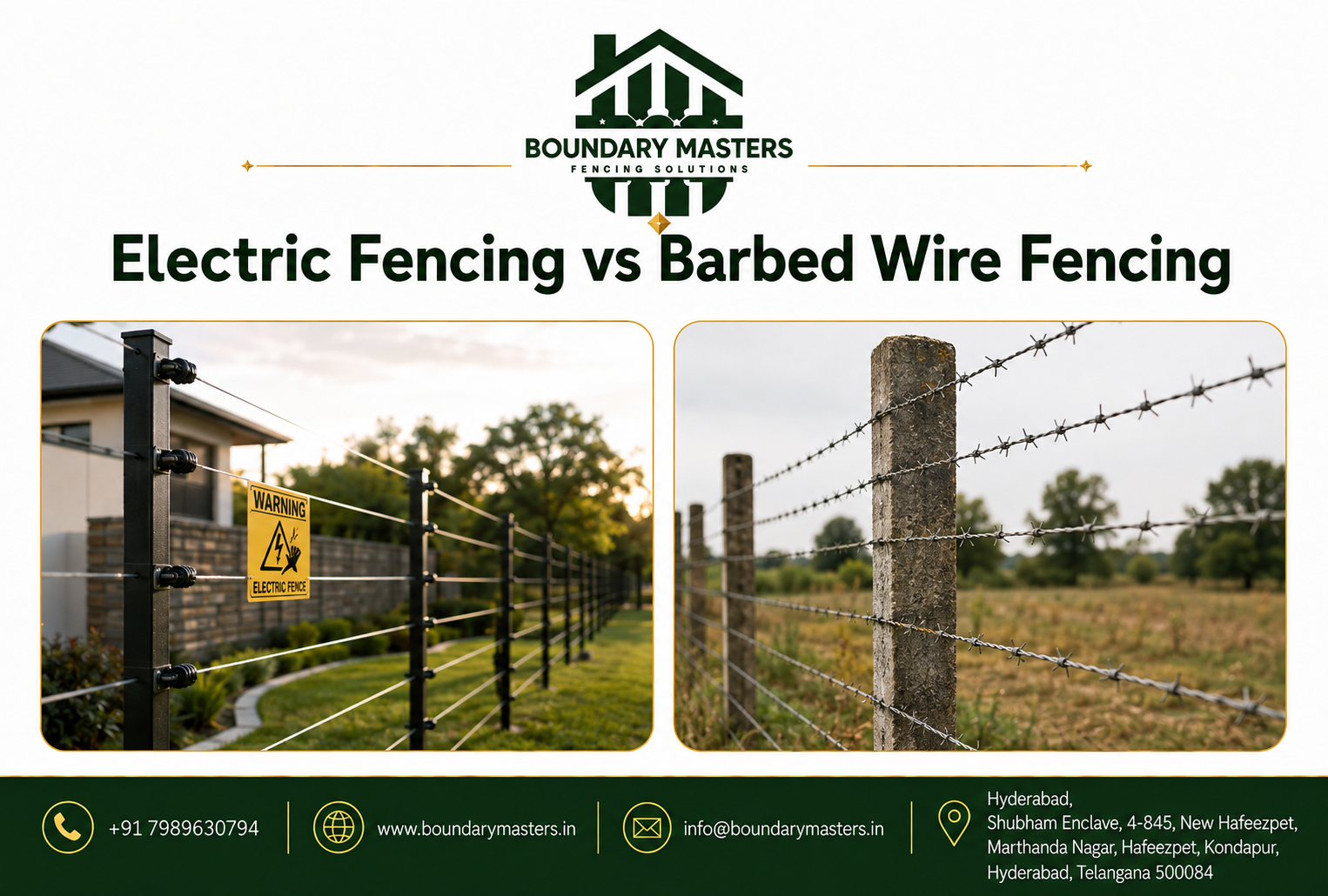
A professional assessment of Electric Fencing vs Barbed Wire Fencing should include security effectiveness, initial investment, maintenance, durability and operational requirements. Neither fencing type is automatically superior for every site. Barbed wire remains practical for many large and economical perimeter projects, whereas electric fencing can provide a stronger active deterrent when engineered and maintained correctly.
Understanding Electric Security Fencing
In the discussion of Electric Fencing vs Barbed Wire Fencing, electric fencing is the technologically advanced option. A proper system generally contains an approved fence energizer, conductive wires, insulators, posts, earthing components and warning signage. Depending on the design, monitoring and alarm integration may also be included. Electric security fencing should always be installed according to applicable safety standards and manufacturer requirements.
Understanding Electric Fencing vs Barbed Wire Fencing requires separating professionally designed electric fencing from unsafe improvised electrical arrangements. A security fence should never be connected directly to ordinary mains electricity. Purpose-built energizers are designed to produce controlled pulses, and the selection, grounding, wiring, warning signs and installation configuration should be handled by competent professionals familiar with relevant regulations.
One reason customers researching Electric Fencing vs Barbed Wire Fencing consider electric systems is their psychological deterrence. Warning boards and visible conductive wires indicate that the perimeter is actively protected. A potential intruder may therefore decide against approaching or climbing the boundary before actual contact occurs, particularly when the system is installed above an existing compound wall or perimeter fence.
Another advantage in Electric Fencing vs Barbed Wire Fencing is that an electric security system may be combined with monitoring equipment. Depending on the chosen technology, attempts to cut, short or interfere with a protected fence can potentially be detected and linked to alarms or security arrangements. This makes electric fencing particularly attractive for facilities where perimeter awareness is important.
From a property-management perspective, Electric Fencing vs Barbed Wire Fencing is not simply a choice between modern and traditional technology. Electric fencing requires an operating system, regular inspection and appropriate vegetation management. Barbed wire is passive and remains functional without electricity. Consequently, owners should consider whether they have the resources required to maintain an active security fence consistently.
Understanding Barbed Wire Fencing
The traditional side of Electric Fencing vs Barbed Wire Fencing is barbed wire, which has been widely used for agricultural boundaries, vacant plots, industrial areas and large land parcels. It normally consists of steel wire with regularly spaced barbs stretched between posts. The barrier is inexpensive compared with many sophisticated security solutions and does not require electrical power to remain operational.
For large boundaries, Electric Fencing vs Barbed Wire Fencing often becomes a budget-driven discussion. Barbed wire is popular because long distances can generally be secured using relatively simple materials and installation methods. When a landowner mainly needs clear boundary demarcation and basic resistance against casual crossing, the simplicity of barbed wire can make it an economical option.
In evaluating Electric Fencing vs Barbed Wire Fencing, barbed wire also has the benefit of straightforward visual inspection. Loose strands, damaged posts, corrosion or cut sections can normally be identified during perimeter inspection. Repairs are usually mechanical rather than electrical, although correct tensioning and safe handling are important because the sharp barbs can cause injury.
However, Electric Fencing vs Barbed Wire Fencing highlights an important limitation of conventional barbed wire: it is primarily a passive obstacle. Determined intruders may attempt to cut, spread or bypass ordinary wire strands. Increasing the number of strands, improving post spacing or integrating other security barriers can strengthen the perimeter, but every property should be designed according to actual risk.
For many agricultural and open-land projects, Electric Fencing vs Barbed Wire Fencing may still favour barbed wire when the principal requirement is affordable boundary control rather than sophisticated intrusion detection. It is particularly useful when the fencing distance is extensive and the owner wants a durable, easy-to-understand system without electrical equipment.
Electric Fence and Barbed Wire Fence Comparison Table
| Factor | Electric Security Fence | Barbed Wire Fence |
|---|---|---|
| Security Method | Active deterrence using controlled electrical pulses from an approved energizer | Passive physical deterrence through sharp barbed strands |
| Initial Investment | Generally higher | Generally lower |
| Power Requirement | Requires a suitable energizer and power arrangement | No electrical power required |
| Monitoring Potential | Can potentially support alarms and monitoring depending on the system | Normally requires separate monitoring equipment |
| Maintenance | Electrical and physical inspection required | Mostly physical inspection and tension repairs |
| Large Rural Boundaries | Suitable when properly designed | Often highly economical |
| High-Security Perimeters | Strong deterrence when professionally engineered | Often used as a supporting physical barrier |
| Vegetation Management | Important to avoid interference with conductive wires | Usually less electrically sensitive to vegetation |
| Installation Complexity | Requires specialised design and commissioning | Generally simpler |
The table makes Electric Fencing vs Barbed Wire Fencing easier to understand because the systems solve perimeter problems differently. An electric fence is generally chosen when active deterrence is important, while barbed wire is often selected when owners want affordable physical boundary protection. Security-sensitive locations can also use layered perimeter designs rather than depending on one component alone.
1. Security and Intrusion Deterrence
Security performance is usually the first consideration in Electric Fencing vs Barbed Wire Fencing. Electric systems can offer a strong psychological deterrent because intruders understand that touching or attempting to climb a properly marked security fence can result in an unpleasant controlled pulse. Barbed wire communicates danger as well, although it relies entirely on its physical form rather than an active system.
For sites with valuable equipment, Electric Fencing vs Barbed Wire Fencing may favour a professional electric security fence because it can discourage direct perimeter contact. Warehouses, equipment yards, industrial facilities, solar installations and certain commercial properties often require more than simple boundary identification. Their security plan may include fencing, CCTV, lighting, access control and guards working together.
Nevertheless, the outcome of Electric Fencing vs Barbed Wire Fencing should never be interpreted as meaning electric fencing alone guarantees security. Intrusion risk should be managed using layered protection. Gate strength, surveillance, lighting, security response, wall design and visibility around the property remain important regardless of the perimeter fencing technology selected.
Barbed wire remains competitive in Electric Fencing vs Barbed Wire Fencing when a property primarily needs an inexpensive physical barrier. Multiple properly tensioned strands installed on strong posts can discourage casual trespassers and help keep animals within or outside a designated area. It is a practical solution for agricultural fields and broad rural boundaries where advanced monitoring may not be necessary.
For high-value properties, professionals considering Electric Fencing vs Barbed Wire Fencing often examine whether the new security system can complement an existing compound wall. Electric wires can be positioned as part of an approved security design, while barbed-wire arms or additional strands may also be fitted where appropriate. Site-specific engineering is always preferable to copying another property's layout.
2. Installation Cost
The initial budget can strongly influence Electric Fencing vs Barbed Wire Fencing. Conventional barbed wire typically involves posts, wire, supports, fasteners and labour, whereas electric fencing also requires specialised energizing, insulation, grounding and related safety components. Consequently, an electric system commonly has a higher upfront cost, although project-specific pricing depends on perimeter length and design complexity.
When comparing quotations for Electric Fencing vs Barbed Wire Fencing, property owners should avoid comparing only the cost per running foot or metre. Post specifications, foundation depth, wire quality, galvanization, energizer capacity, insulation quality, gate arrangements, earthing, warning signage, warranty and workmanship can substantially affect the durability and reliability of a fencing project.
Long agricultural boundaries can change the economics of Electric Fencing vs Barbed Wire Fencing. A simple barbed-wire boundary can be attractive when hundreds or thousands of metres must be fenced economically. Electric installations may still be practical for certain farms, but the system should be designed for the actual perimeter, environmental conditions and intended animal or security application.
A sensible financial analysis of Electric Fencing vs Barbed Wire Fencing also considers future repair expenses. Very cheap components can create recurring problems, whether they are rust-prone barbed wire, weak posts, poor insulators or an unsuitable energizer. Investing in quality materials and professional installation can reduce operational problems and improve service life.
Another cost factor in Electric Fencing vs Barbed Wire Fencing is infrastructure already available at the property. Existing walls, posts or fencing may sometimes support an upgraded security design if structurally suitable. A professional contractor should inspect existing components before reuse because attaching new security fencing to unstable or poorly constructed structures can compromise the overall installation.
3. Running and Operating Costs
Operating expenses distinguish Electric Fencing vs Barbed Wire Fencing over the long term. Barbed wire consumes no electricity, while an electric security fence depends on a properly selected energizer and suitable power source. The electricity consumed by a purpose-built system may not be the largest expense, but monitoring, servicing and replacement components should still be included in ownership calculations.
Solar power is sometimes discussed during Electric Fencing vs Barbed Wire Fencing planning for agricultural or remote sites. Properly designed solar-powered energizer arrangements can provide an option where reliable mains electricity is unavailable. Battery condition, solar exposure, energy demand and system compatibility must be assessed by professionals rather than assuming that any solar panel and battery combination will work safely.
By contrast, Electric Fencing vs Barbed Wire Fencing demonstrates why barbed wire remains attractive for remote land. Once correctly installed, it can continue functioning as a physical perimeter without electrical supply, batteries or electronics. The major recurring requirements are inspection, vegetation clearance where necessary, post repairs, wire tensioning and replacement of damaged or corroded sections.
Operating-cost discussions about Electric Fencing vs Barbed Wire Fencing should also include the cost of neglected maintenance. An electric fence covered by vegetation or damaged insulation may not perform as intended. Similarly, a barbed-wire fence with sagging strands or broken posts can quickly lose effectiveness. Preventive inspection is usually cheaper than allowing widespread deterioration.
The realistic lifetime cost of Electric Fencing vs Barbed Wire Fencing therefore includes materials, installation, energy requirements, inspection, repairs and potential upgrades. Property owners should request clear quotations specifying what is included so that competing fencing proposals can be evaluated using the same scope instead of selecting the cheapest headline figure.
4. Maintenance Requirements
Maintenance is one of the most practical aspects of Electric Fencing vs Barbed Wire Fencing. Electric security fencing requires regular checks of wires, insulators, posts, connections, vegetation clearance, grounding arrangements and the energizer system. Any alarms or monitoring functions should also be tested according to manufacturer recommendations and the site's security procedures.
Barbed-wire maintenance makes Electric Fencing vs Barbed Wire Fencing comparatively simple from a technical standpoint. Owners mainly inspect wire tension, corrosion, physical cuts, posts, supports and attachments. Because barbed wire can be hazardous to handle, workers should use suitable protective equipment and repair techniques rather than grabbing or tensioning damaged wire without appropriate tools.
Seasonal weather can influence Electric Fencing vs Barbed Wire Fencing maintenance in Hyderabad and surrounding areas. Strong rain, wind, vegetation growth and prolonged exposure can affect posts, foundations and wires. Regular inspection after severe weather helps identify leaning supports, fallen branches, damaged insulation or loose fencing before a small problem becomes a major perimeter weakness.
Vegetation management is particularly significant in Electric Fencing vs Barbed Wire Fencing. Plants touching conductive electric-fence wires can interfere with performance depending on system design. Barbed wire can become hidden inside uncontrolled vegetation as well, reducing visibility and complicating inspections. Maintaining a clear perimeter improves security, accessibility and the ability to detect damage.
Maintenance planning should therefore be included before deciding Electric Fencing vs Barbed Wire Fencing. A property owner who has no plan for electrical inspection may be better served by a simpler barrier or a professional maintenance contract. Conversely, organisations with scheduled security maintenance can obtain greater value from advanced electric-fencing features.
5. Durability and Weather Resistance
Material quality strongly affects the durability comparison of Electric Fencing vs Barbed Wire Fencing. Galvanized or otherwise appropriately protected metal components generally resist corrosion better than untreated materials. Post quality, coating, foundations, wire specification and workmanship influence both systems, particularly in outdoor environments where fencing remains continuously exposed to weather.
In Electric Fencing vs Barbed Wire Fencing, barbed wire has the advantage of having relatively few technical components. Nevertheless, corrosion can weaken wire, damaged posts can reduce tension and animals or machinery may physically impact the fence. Scheduled inspections remain essential even when a barrier appears mechanically simple.
Electric systems add another consideration to Electric Fencing vs Barbed Wire Fencing: insulation and electrical components must remain suitable for outdoor use. Cracked insulators, incorrect connections and damaged wires can compromise performance. Quality components designed for fencing applications are therefore important for dependable long-term operation.
The service life in Electric Fencing vs Barbed Wire Fencing cannot be predicted from fencing type alone. Two visually similar fences can have dramatically different durability because of different wire gauges, coatings, posts, concrete foundations, installation quality and maintenance routines. Property owners should ask contractors for detailed material specifications instead of relying only on photographs.
For long-lasting results, Electric Fencing vs Barbed Wire Fencing should be assessed alongside local environmental exposure. Areas close to industrial emissions, water accumulation or corrosive conditions may require additional consideration. Drainage around posts, appropriate coatings and suitable materials can be as important as the choice of security system itself.
6. Suitability for Farms and Agricultural Land
Farm owners frequently research Electric Fencing vs Barbed Wire Fencing because protecting crops, animals and equipment can require kilometres of perimeter fencing. Barbed wire has traditionally been common because it provides economical physical separation. Electric fencing can also serve agricultural purposes, but its design should suit the species being managed and applicable safety requirements.
Livestock behaviour matters in Electric Fencing vs Barbed Wire Fencing. Different animals respond differently to physical barriers and electric deterrence, and certain fence configurations may pose injury risks if poorly designed. Agricultural owners should therefore obtain advice suited to their animals instead of choosing wire spacing or fence height using a generic online diagram.
Wildlife movement can complicate Electric Fencing vs Barbed Wire Fencing decisions as well. Properties near natural habitats should consider local wildlife, environmental requirements and applicable regulations before constructing barriers. A fencing design intended only to prevent human trespassing may not be appropriate where large animals regularly cross the surrounding landscape.
For large farms, the economic argument in Electric Fencing vs Barbed Wire Fencing may still favour barbed wire where the main requirement is boundary demarcation. However, higher-risk areas such as machinery storage, farmhouses, utility installations or equipment yards can potentially benefit from more advanced perimeter protection as part of a layered security plan.
A useful approach to Electric Fencing vs Barbed Wire Fencing on agricultural property is to divide the land into security zones. Outer agricultural boundaries may use an economical physical fence, while particularly sensitive assets can receive stronger protection. This approach can allocate security spending according to risk instead of applying the most expensive option uniformly across the entire property.
7. Suitability for Construction Sites
Temporary and ongoing construction projects present another important use case for Electric Fencing vs Barbed Wire Fencing. Construction sites contain machinery, building materials, cables and equipment that may attract theft while also needing controlled access for workers and vehicles. The fencing solution must therefore balance security, site movement, public safety and the temporary or changing nature of the perimeter.
If you are specifically planning perimeter protection during building work, the Electric Fencing vs Barbed Wire Fencing decision should be considered alongside professional fencing for an ongoing construction site. Construction boundaries often change as work progresses, making installation flexibility and safe access points particularly important.
For construction managers evaluating Electric Fencing vs Barbed Wire Fencing, barbed wire can provide economical protection around suitable boundaries, while electric security fencing may be considered for higher-risk facilities where approved installation can be maintained safely. Public access, worker safety, signage and site-specific hazards should always be part of the planning process.
The choice of Electric Fencing vs Barbed Wire Fencing can also depend on the duration of construction. A temporary project may not justify extensive permanent infrastructure, whereas a long-duration development could benefit from a stronger security system that later becomes part of the finished property's perimeter protection.
Professional contractors assessing Electric Fencing vs Barbed Wire Fencing should also inspect gate locations. Construction gates often experience frequent movement of heavy vehicles, which can damage poorly positioned posts and fencing. Strong corners, appropriate setbacks and controlled entry points can improve the durability of the perimeter throughout the construction phase.
8. Suitability for Vacant Plots
Vacant-land owners often compare Electric Fencing vs Barbed Wire Fencing to discourage unauthorised access, dumping or encroachment. Where the main objective is to mark ownership visibly and create a basic physical perimeter, barbed wire can be an efficient solution. Clear boundary markers and appropriate signage can strengthen the message that the property is privately controlled.
Electric security may become relevant in Electric Fencing vs Barbed Wire Fencing for vacant plots containing valuable assets or infrastructure, but an unattended active system still requires inspection and maintenance. Owners should not install technology they cannot monitor. A simple, well-built physical barrier can sometimes outperform an advanced system that is neglected.
Legal boundary accuracy is important before installing either option in Electric Fencing vs Barbed Wire Fencing. Property owners should confirm the correct property line and any local requirements before constructing a fence. Disputes become more difficult when permanent posts or electrical security equipment have already been installed in the wrong position.
For a vacant site located near residential development, Electric Fencing vs Barbed Wire Fencing requires additional attention to public safety and visibility. Children, pedestrians and neighbouring properties can influence what is appropriate. Professional installers can recommend safer placement, barriers and warning arrangements while considering applicable local rules.
Where the vacant land is expected to be developed soon, Electric Fencing vs Barbed Wire Fencing should also account for future construction. Owners may choose fencing that can be relocated or integrated into the eventual site plan, reducing unnecessary demolition and duplicate expenditure when development begins.
9. Hyderabad Property Conditions
Local conditions make Electric Fencing vs Barbed Wire Fencing particularly relevant for Hyderabad properties ranging from residential compounds and warehouses to agricultural plots around the expanding metropolitan region. Plot size, surrounding development, access roads and security exposure can vary greatly, so fencing recommendations should be based on a physical site inspection.
Customers researching local solutions for Electric Fencing vs Barbed Wire Fencing can also review information about barbed wire fencing in Hyderabad. Understanding available barbed-wire solutions helps owners compare the simpler physical option with active electric-security alternatives on a more realistic basis.
Professional workmanship plays an important role in Electric Fencing vs Barbed Wire Fencing because even premium wire cannot compensate for weak supports or poor foundations. Hyderabad projects can involve rocky soil, open fields, existing concrete walls or developed urban sites, each requiring different fixing and structural approaches.
Property owners unsure about Electric Fencing vs Barbed Wire Fencing can consult experienced fencing contractors in Hyderabad to obtain a site-specific recommendation. An inspection allows contractors to calculate perimeter length, identify corners and gates, examine existing structures and propose suitable materials.
For owners starting their research into Electric Fencing vs Barbed Wire Fencing, the Boundary Masters website provides information about multiple perimeter solutions. Comparing several fencing technologies can prevent an owner from choosing a system simply because it is familiar rather than because it fits the property's actual risk profile.
10. Safety Considerations
Safety must have priority in Electric Fencing vs Barbed Wire Fencing. Both systems can create hazards when incorrectly designed. Barbed wire can cause cuts and entanglement, while electric fencing involves electrical equipment that must comply with relevant standards. Installation should therefore be carried out using suitable components, warning signage and professional procedures.
International guidance is relevant to Electric Fencing vs Barbed Wire Fencing because the International Electrotechnical Commission IEC 60335-2-76 standard addresses particular safety requirements for electric-fence energizers used for agricultural, animal-control and security applications. Property owners should select equipment intended for its stated application rather than improvising electrical connections.
Indian property owners considering Electric Fencing vs Barbed Wire Fencing should also consult applicable electrical and product requirements. The Bureau of Indian Standards publishes information about Indian standards, while local professionals can help identify standards relevant to specific equipment and installations.
Electricity-safety requirements influence Electric Fencing vs Barbed Wire Fencing, particularly where installations are close to existing power systems. The Central Electricity Authority provides regulations and technical information concerning electrical safety in India. Qualified professionals should be consulted where fencing interacts with electrical infrastructure.
Public safety is another key part of Electric Fencing vs Barbed Wire Fencing. A perimeter adjoining public walkways, roads, schools or residential areas may require different treatment from an isolated agricultural boundary. Warning signs, setbacks, fence positioning and controlled access should be planned so that security objectives do not create unnecessary risks.
11. Electric Fence Energizer Quality
The energizer is central to Electric Fencing vs Barbed Wire Fencing because electric fencing relies on specialised equipment to operate correctly. Energizers should be chosen according to manufacturer specifications and the intended fencing application. Capacity, fence length, grounding, power source and environmental exposure all need consideration during professional system design.
Cheap or inappropriate equipment can distort the outcome of Electric Fencing vs Barbed Wire Fencing. An unreliable electric system may perform worse than a properly constructed conventional fence. Buyers should therefore compare equipment specifications, manufacturer support, warranty, installation workmanship and service availability rather than purchasing solely on the lowest quoted price.
Correct earthing is also significant when assessing Electric Fencing vs Barbed Wire Fencing. Electric-fence performance depends on the system being installed according to its design and manufacturer instructions. Grounding arrangements should not be improvised, and professional installers should verify system operation with suitable testing equipment after commissioning.
Battery-backed or solar-powered installations add flexibility to Electric Fencing vs Barbed Wire Fencing, especially in remote areas, but they also add components requiring maintenance. Batteries deteriorate over time, solar panels require suitable exposure and electronic equipment needs protection from environmental damage. Owners should understand these responsibilities before choosing the technology.
Documentation is valuable in Electric Fencing vs Barbed Wire Fencing projects. Electric-fence customers should receive relevant equipment information, operating guidance, warranty details and maintenance recommendations. Having clear records makes future servicing easier and helps a new maintenance technician understand the originally installed system.
12. Barbed Wire Material Quality
Wire quality can determine whether Electric Fencing vs Barbed Wire Fencing remains cost-effective over several years. Barbed wire should be selected according to the project's exposure and security requirements. Wire thickness, coating quality, barb spacing and overall manufacturing consistency influence strength, corrosion resistance and installation performance.
Posts are equally important in Electric Fencing vs Barbed Wire Fencing. Strong wire attached to weak or poorly anchored posts will not create a dependable perimeter. Corner and gate posts typically experience higher loads from wire tension, which means contractors should design them appropriately rather than using identical support arrangements everywhere.
Correct tension is another consideration in Electric Fencing vs Barbed Wire Fencing. Barbed wire that is too loose can sag and become easier to bypass, while excessive tension can stress supports and components. Professional installation aims for stable alignment and appropriate tension across changes in direction and ground level.
Rust protection influences the long-term value of Electric Fencing vs Barbed Wire Fencing. Galvanized products are commonly selected for outdoor applications because the protective coating helps resist corrosion. Nevertheless, coating quality varies, and exposed cut points or damaged sections should be inspected throughout the life of the fence.
Owners comparing material quotations for Electric Fencing vs Barbed Wire Fencing should request clear specifications instead of accepting descriptions such as "heavy duty" without measurements. Transparent information on wire type, post dimensions, spacing, coating and foundations makes quotations easier to compare and reduces misunderstandings after installation.
13. Appearance and Property Value
Appearance can affect Electric Fencing vs Barbed Wire Fencing for villas, commercial properties and high-visibility sites. Conventional barbed wire has an unmistakably utilitarian appearance that suits farms and industrial zones but may not complement premium architecture. Electric security wires can sometimes create a more organised linear appearance when professionally installed above a suitable wall.
For residential applications, Electric Fencing vs Barbed Wire Fencing should be evaluated alongside gates, compound walls, landscaping and neighbouring homes. A property owner may want effective protection without making the exterior appear excessively industrial. Alternative fencing designs may sometimes provide a better balance between aesthetics and security.
Commercial premises approaching Electric Fencing vs Barbed Wire Fencing may also consider brand image. Customer-facing businesses often want a secure perimeter that still appears professional and welcoming near the main entrance. Security intensity can be concentrated around vulnerable boundaries while entrance landscaping and access-control design maintain a polished appearance.
Industrial facilities usually place different priorities on Electric Fencing vs Barbed Wire Fencing. Function, durability and access control may matter more than decorative appearance. Nevertheless, neat alignment, consistent post spacing, controlled vegetation and high-quality installation make even utilitarian fencing look more professional and easier to inspect.
The visual component of Electric Fencing vs Barbed Wire Fencing should not override security performance. A beautiful perimeter with weak gates or climbable structures can still leave a property vulnerable. Good security design combines appropriate fencing with architecture rather than treating the fence as an isolated decorative element.
14. Security for Warehouses and Industrial Properties
Warehouses frequently examine Electric Fencing vs Barbed Wire Fencing because stored inventory and equipment can represent significant financial value. Perimeter protection helps create distance between public areas and loading, storage or service zones. Electric security fencing can provide active deterrence, while barbed wire can strengthen suitable physical boundaries economically.
Industrial security planning around Electric Fencing vs Barbed Wire Fencing should identify vulnerable sections such as dark rear boundaries, low compound walls, neighbouring vacant land, utility corridors and rarely used gates. Spending the same amount on every metre is not always efficient; risk-based design can strengthen the locations most likely to be targeted.
CCTV integration also influences Electric Fencing vs Barbed Wire Fencing. Cameras can provide visual verification, but vegetation, poor lighting and blind spots may reduce effectiveness. A strong perimeter limits casual access, while surveillance and alarm systems help security staff understand what is happening near the fence.
Access control remains essential regardless of Electric Fencing vs Barbed Wire Fencing. A secure boundary loses value if vehicle gates are routinely left open or pedestrian entrances are weak. Gate hardware, locks, guard procedures, visitor controls and lighting should therefore be included in the overall security assessment.
For higher-risk warehouses, the conclusion of Electric Fencing vs Barbed Wire Fencing may be a layered system rather than one technology. A strong compound wall or mesh barrier, professionally installed electric deterrent, surveillance, lighting and controlled gates can work together to create multiple obstacles to unauthorised entry.
15. Animal Control and Agricultural Guidance
Animal-control considerations make Electric Fencing vs Barbed Wire Fencing more complex than simple property security. Fence design should account for the animals being contained or excluded, terrain and welfare considerations. Professional agricultural recommendations can help prevent arrangements that create unnecessary entanglement or injury risks.
For broader agricultural information relevant to Electric Fencing vs Barbed Wire Fencing, property owners can consult the Food and Agriculture Organization of the United Nations. Agricultural authorities and local professionals should also be consulted for recommendations specific to livestock, wildlife and regional farming conditions.
Technical conservation practices can also inform Electric Fencing vs Barbed Wire Fencing. The USDA Natural Resources Conservation Service publishes conservation practice information, including fencing-related technical resources. These references can help illustrate why fence design varies according to land management objectives.
Wildlife-sensitive areas require careful treatment of Electric Fencing vs Barbed Wire Fencing. A fence designed solely to stop people may interfere with animal movement or create entanglement concerns. Owners near protected or ecologically sensitive areas should consult the relevant local authorities before finalising boundary design.
The agricultural conclusion for Electric Fencing vs Barbed Wire Fencing is therefore highly site-specific. Large farms may use different fence types for outer boundaries, paddocks, crop protection and equipment compounds. Matching each section to its actual function can provide better performance and lower cost than using one universal fencing specification.
16. Reliability During Power Failures
Power availability is an unavoidable factor in Electric Fencing vs Barbed Wire Fencing. Barbed wire remains a physical barrier regardless of power conditions. An electric security fence, however, depends on its energizer and power arrangement, making suitable backup solutions important where continuous active deterrence is required.
Battery backup can strengthen the electric side of Electric Fencing vs Barbed Wire Fencing, but a backup system is useful only when batteries are healthy and regularly checked. Organisations should include backup testing in scheduled maintenance rather than discovering a failed battery during an actual electricity outage.
Solar-powered designs may influence Electric Fencing vs Barbed Wire Fencing on remote plots. Properly engineered systems can reduce dependence on grid electricity, but solar generation, battery storage and energizer requirements must be matched correctly. Shading, seasonal conditions and battery ageing should be considered during design.
If uninterrupted operation cannot be maintained, Electric Fencing vs Barbed Wire Fencing may favour a combined approach in which a physical barrier remains effective even when electronic components are unavailable. This illustrates the value of defence in depth rather than relying completely on one active security technology.
Security teams comparing Electric Fencing vs Barbed Wire Fencing should document what happens during an electrical failure. Alarm behaviour, backup duration, guard response and system restoration should be understood in advance. Operational procedures can be just as important as hardware in determining real-world perimeter security.
17. Environmental and Vegetation Factors
Vegetation is a major practical issue in Electric Fencing vs Barbed Wire Fencing. Grass, vines, branches and shrubs can reach a fence as seasons change. Keeping the perimeter clear improves inspection and can be particularly important for electric fences where unwanted contact with conductive wires may affect performance.
Tree branches also matter in Electric Fencing vs Barbed Wire Fencing. During storms, branches can fall onto wire, damage posts or create unintended bridges across a security barrier. Trees near important boundaries should be inspected and appropriately maintained without damaging neighbouring property or protected vegetation.
Drainage can influence Electric Fencing vs Barbed Wire Fencing because water accumulation around posts may contribute to soil movement or corrosion depending on materials and foundation design. A strong fence requires suitable civil work, especially at corners, slopes and areas exposed to runoff.
Uneven terrain makes Electric Fencing vs Barbed Wire Fencing installation more challenging. Contractors need to follow changes in ground level while avoiding excessive gaps. The correct approach depends on fence type, post spacing, required security level and the possibility of erosion altering the ground after installation.
Environmental exposure should consequently be part of every Electric Fencing vs Barbed Wire Fencing quotation. A contractor who inspects soil, vegetation, drainage and terrain can provide a more realistic specification than someone who quotes solely from perimeter length supplied over the phone.
18. Legal and Regulatory Considerations
Legal compliance is fundamental to Electric Fencing vs Barbed Wire Fencing. Requirements can differ according to location, property type, electrical installation, public accessibility and local authority rules. Owners should confirm applicable permissions and safety obligations before installation instead of assuming that a fence acceptable on rural land is automatically appropriate in an urban neighbourhood.
Warning signage is especially important in Electric Fencing vs Barbed Wire Fencing where electric security systems are installed. Appropriate warning boards help communicate the presence of an electrified perimeter. Their quantity, location, visibility and wording should follow applicable standards, system instructions and local requirements.
Electrical work associated with Electric Fencing vs Barbed Wire Fencing should be completed using suitable equipment and competent installers. Property owners should never instruct unqualified workers to connect ordinary electrical supply directly to fence wire. A purpose-built energizer and compliant design are essential elements of a legitimate electric-fence system.
Property boundaries are another legal aspect of Electric Fencing vs Barbed Wire Fencing. Before posts are installed, the owner should be confident about the legal boundary. Survey assistance may be appropriate where markers are unclear, especially when neighbouring structures or access paths are close to the proposed fence line.
Because rules can change, Electric Fencing vs Barbed Wire Fencing decisions should rely on current local requirements rather than outdated assumptions. Contractors, qualified electrical professionals and relevant government authorities can help determine what approvals or safety measures apply to a particular installation.
19. Fire and Emergency Access
Emergency access is sometimes overlooked in Electric Fencing vs Barbed Wire Fencing. Security barriers should not prevent authorised emergency personnel from entering a property when necessary. Gate design, isolation procedures and site information should therefore be coordinated with the property's wider safety and emergency plan.
Industrial facilities assessing Electric Fencing vs Barbed Wire Fencing should consider whether emergency exits, fire access roads or utility points lie near the perimeter. Fence placement must support rather than obstruct emergency response. Relevant building and fire-safety requirements should be considered during planning.
For general fire-safety guidance related to property planning around Electric Fencing vs Barbed Wire Fencing, owners can refer to India's National Disaster Management Authority while following state and local fire-service requirements applicable to their specific facility.
Clearly labelled isolation arrangements can be important in Electric Fencing vs Barbed Wire Fencing when electric security is used. Authorised maintenance and emergency personnel should understand how the system is safely controlled. Procedures should be documented rather than relying on one employee's personal knowledge.
Emergency planning reinforces the central lesson of Electric Fencing vs Barbed Wire Fencing: perimeter security cannot be designed independently from the rest of the property. Access, fire safety, electrical systems, surveillance, operations and maintenance all interact with fencing decisions.
20. Which Option Is Better for Residential Properties?
Residential owners examining Electric Fencing vs Barbed Wire Fencing should begin with neighbourhood conditions and applicable rules. Barbed wire may look excessively industrial for many homes, whereas professionally designed electric security fencing may provide a cleaner appearance when appropriately positioned. Other options such as anti-climb mesh or suitable compound-wall designs may also deserve consideration.
Children and visitors make residential Electric Fencing vs Barbed Wire Fencing decisions especially sensitive. Fence placement should reduce accidental contact, and security systems should be clearly identified where required. Homes with frequent visitors, pets or neighbouring pedestrian movement require careful site-specific planning.
For villas, Electric Fencing vs Barbed Wire Fencing should be balanced against architectural appearance. Security can often be improved by combining adequate compound-wall height, controlled gates, lighting, CCTV and an appropriate perimeter deterrent rather than relying on visually aggressive fencing alone.
Residential owners assessing Electric Fencing vs Barbed Wire Fencing should also ask how the system will be serviced. Electric fencing needs periodic professional attention, while barbed wire can still require repairs when strands loosen or supports corrode. Long-term maintenance should be considered before making an installation decision.
Where security risks are significant, Electric Fencing vs Barbed Wire Fencing for a residence should ideally be evaluated during an on-site security assessment. A contractor can inspect adjacent buildings, climbable trees, low walls, utility boxes and other features that may influence perimeter vulnerability.
21. Which Option Is Better for Commercial Properties?
Commercial customers considering Electric Fencing vs Barbed Wire Fencing normally have to balance security, customer access and appearance. Offices, showrooms, storage yards and service facilities have different needs even when located within the same neighbourhood. A business open to customers may require a significantly different frontage from a closed industrial storage yard.
For commercial facilities, Electric Fencing vs Barbed Wire Fencing should also be integrated with CCTV and access control. Security cameras can observe the perimeter, while controlled gates manage legitimate movement. A strong fence reduces opportunities for unauthorised access between designated entrances.
After-hours vulnerability can shift the result of Electric Fencing vs Barbed Wire Fencing. A property that is busy and monitored throughout the day may become isolated at night. Lighting, alarms, surveillance and active perimeter deterrence can therefore become more valuable outside operating hours.
Insurance requirements may also affect Electric Fencing vs Barbed Wire Fencing. Commercial property owners should check whether insurers specify perimeter, alarm or access-control measures for certain risks. Fencing improvements should form part of a documented security programme rather than being installed without considering other requirements.
The best commercial outcome for Electric Fencing vs Barbed Wire Fencing is frequently a customised solution. Customer-facing boundaries may prioritise appearance, rear and side boundaries may prioritise resistance, and high-value storage sections may require additional detection and monitoring.
22. Combining Both Types of Fencing
The answer to Electric Fencing vs Barbed Wire Fencing does not always have to be one or the other. Some properties use multiple layers of physical and active perimeter security. Any combined configuration should be professionally designed because inappropriate interaction between electrical and metallic fencing components can create safety and operational problems.
A layered approach to Electric Fencing vs Barbed Wire Fencing can separate functions. One barrier can provide physical restriction while another component supplies active deterrence or monitoring. The exact arrangement depends on property design, applicable standards and risk, so generic online installation diagrams should not replace professional engineering.
Combining technologies in Electric Fencing vs Barbed Wire Fencing is most useful when every layer has a defined purpose. Adding more wire simply because it appears stronger can increase maintenance without improving security significantly. A risk assessment should identify what each component is intended to prevent or detect.
Gate areas are particularly important in a combined Electric Fencing vs Barbed Wire Fencing strategy. Vehicle and pedestrian gates interrupt perimeter continuity and experience frequent use. Their locks, hinges, access control and surveillance therefore deserve as much attention as the fixed fencing sections.
A contractor designing a combined Electric Fencing vs Barbed Wire Fencing system should also plan future servicing. Technicians need safe access to components, clear identification of electrical sections and appropriate isolation procedures. Maintainability is a fundamental part of good security design.
23. Common Mistakes Property Owners Should Avoid
A common mistake in Electric Fencing vs Barbed Wire Fencing is choosing solely on price. The cheapest quotation may use weaker posts, lower-quality coating, unsuitable wire or poor electrical components. Owners should compare detailed material and installation specifications before awarding the project.
Another mistake in Electric Fencing vs Barbed Wire Fencing is ignoring gates and corners. These locations experience additional mechanical forces and often represent natural security weaknesses. Strong perimeter wire cannot compensate for an easily forced gate or inadequately supported corner.
Poor maintenance is equally damaging in Electric Fencing vs Barbed Wire Fencing. Electric fences can suffer from vegetation contact, damaged insulators or power issues, while barbed wire can sag, corrode or be cut. Regular perimeter inspection helps ensure that installed security continues to provide value.
Unsafe improvisation is the most serious mistake in Electric Fencing vs Barbed Wire Fencing. Electric fence wires must not be connected directly to household or commercial mains electricity. Only equipment designed for electric fencing, installed in compliance with applicable standards and manufacturer guidance, should be used.
Finally, property owners discussing Electric Fencing vs Barbed Wire Fencing sometimes copy the neighbouring property's fence without considering their own risks. Differences in terrain, public access, stored assets, wall construction, boundary length and maintenance capability can make the same solution unsuitable next door.
24. How to Select a Fencing Contractor
A contractor can significantly influence the real-world outcome of Electric Fencing vs Barbed Wire Fencing. Look for a provider who conducts a site assessment, discusses different options and explains material specifications clearly. A contractor who recommends the same system for every property may not be evaluating individual security needs adequately.
During an Electric Fencing vs Barbed Wire Fencing consultation, ask how perimeter length will be measured, what type of posts are proposed, how corners and gates will be reinforced, what materials will be supplied and what maintenance will be necessary. Detailed answers usually make quotations easier to compare.
For electric systems, Electric Fencing vs Barbed Wire Fencing contractor selection should include questions about energizer specifications, safety standards, earthing, warning signage, commissioning and servicing. Avoid installers who propose unsafe shortcuts or direct connection of fencing to ordinary mains electricity.
For conventional installations, Electric Fencing vs Barbed Wire Fencing contractor quality can be assessed through wire specification, galvanization, post design, foundation method and tensioning approach. Low-cost installations that save money on support structures can develop sagging and alignment problems relatively quickly.
A written quotation makes Electric Fencing vs Barbed Wire Fencing procurement more transparent. It should identify the scope of work, materials, quantities, exclusions, payment terms and warranty conditions. This protects both customer and contractor by reducing uncertainty before installation begins.
25. Cost Versus Security Value
Value is more important than the cheapest price in Electric Fencing vs Barbed Wire Fencing. A low-cost barrier can be appropriate for low-risk agricultural land, while a warehouse containing valuable inventory may justify more investment. Security spending should correspond to the likely consequences of unauthorised access.
To evaluate Electric Fencing vs Barbed Wire Fencing, owners can classify property assets by importance. Land requiring only boundary identification has one requirement, while sites containing machinery, electrical equipment, inventory or sensitive infrastructure have another. Matching protection to asset value helps prioritise spending.
Maintenance should be included when calculating Electric Fencing vs Barbed Wire Fencing value. A system that is initially expensive but well maintained may deliver dependable performance for years, while a cheaper installation requiring frequent repairs can gradually lose its cost advantage.
Upgrade potential can influence Electric Fencing vs Barbed Wire Fencing as well. Businesses expecting expansion may benefit from fencing infrastructure that can accommodate additional sections, monitoring or gate systems later. Planning for growth reduces the need to replace an entire perimeter during expansion.
Ultimately, financial evaluation of Electric Fencing vs Barbed Wire Fencing should consider risk reduction rather than wire price alone. A fence is a security asset intended to protect land, people, equipment and operations, so its value should be measured against those responsibilities.
26. Final Comparison: Which Security Option Is Better?
After reviewing Electric Fencing vs Barbed Wire Fencing, electric security fencing is generally attractive when active deterrence, controlled security and potential monitoring capabilities are important. Warehouses, industrial compounds and selected high-risk properties may benefit from this more advanced approach when it is professionally designed and maintained.
By comparison, Electric Fencing vs Barbed Wire Fencing often favours barbed wire for economical physical boundary protection. Farms, open plots, agricultural land and extensive perimeters can benefit from its simplicity, lack of electrical power requirements and relatively straightforward repair process.
The winner in Electric Fencing vs Barbed Wire Fencing therefore depends on the security objective. If a property owner needs mainly visible demarcation and basic physical deterrence across a large perimeter, barbed wire may be sufficient. If active deterrence and a higher-security approach are priorities, professionally installed electric fencing may offer additional advantages.
For higher-risk properties, Electric Fencing vs Barbed Wire Fencing should also be viewed as part of a broader perimeter-security system. Fencing, strong gates, CCTV, lighting, controlled entry, alarm systems and security procedures work best when planned together instead of being purchased independently.
Before making a final decision on Electric Fencing vs Barbed Wire Fencing, arrange a professional site inspection. Boundary length, existing walls, surrounding properties, soil, vegetation, access points, security risk and budget can then be evaluated together. A site-specific recommendation is much more dependable than choosing a fence from price alone.
Frequently Asked Questions
1. Is an electric security fence better than barbed wire?
When discussing Electric Fencing vs Barbed Wire Fencing, electric security fencing can provide stronger active deterrence, while barbed wire provides a simple physical barrier. The better option depends on the property's risk, location, maintenance capability and budget.
2. Which fencing option is more affordable?
In most basic installations, Electric Fencing vs Barbed Wire Fencing generally favours barbed wire for lower initial cost because it does not require an energizer, electrical components or power arrangement. Actual pricing depends on materials, perimeter length and site conditions.
3. Does an electric fence work during a power cut?
Power backup can affect Electric Fencing vs Barbed Wire Fencing. Electric fences require a suitable energy source, but professionally designed systems may incorporate compatible battery or solar arrangements. Barbed wire remains a physical barrier regardless of electricity availability.
4. Which type requires more maintenance?
In Electric Fencing vs Barbed Wire Fencing, electric systems usually require more specialised inspection because energizers, wiring, insulators, grounding and vegetation can affect operation. Barbed wire normally needs mechanical inspection for corrosion, sagging, cuts and damaged posts.
5. Can electric fencing be installed above a compound wall?
For suitable properties, Electric Fencing vs Barbed Wire Fencing can include configurations installed in conjunction with existing compound walls. The wall's condition, public accessibility and applicable safety requirements must be assessed before deciding the correct design.
6. Which option is suitable for agricultural land?
Agricultural Electric Fencing vs Barbed Wire Fencing decisions depend on farm size, livestock or wildlife concerns, available power, cost and maintenance. Barbed wire is commonly used for economical large boundaries, while appropriately designed electric systems can suit selected agricultural applications.
7. Can I connect fence wire directly to household electricity?
No. Safe Electric Fencing vs Barbed Wire Fencing planning requires purpose-built electric-fence equipment. Ordinary mains electricity must never be connected directly to fence wires. Electric fencing should use an appropriate energizer and be installed by competent professionals according to applicable standards.
8. Which option is better for warehouses?
For warehouses, Electric Fencing vs Barbed Wire Fencing may favour professional electric security fencing when stronger active deterrence is needed. However, barbed wire or other physical barriers can still form part of a layered system with CCTV, lighting and access control.
9. How often should fencing be inspected?
Inspection frequency in Electric Fencing vs Barbed Wire Fencing depends on environment and security level. Perimeters should be checked routinely and after severe weather, vegetation growth, construction work or known interference. Electric systems should additionally follow manufacturer servicing recommendations.
10. How can I get the right fencing recommendation in Hyderabad?
The best way to finalise Electric Fencing vs Barbed Wire Fencing is to arrange a site survey with an experienced fencing contractor. The contractor can measure the perimeter, inspect walls and gates, evaluate the site's security exposure and recommend an appropriate solution.
Conclusion
The practical conclusion of Electric Fencing vs Barbed Wire Fencing is that both systems remain useful when applied to the right property. Electric fencing offers active perimeter deterrence and can support more advanced security strategies, while barbed wire provides economical, straightforward physical boundary protection without dependence on electricity.
Choosing Electric Fencing vs Barbed Wire Fencing should therefore be based on perimeter length, security risk, property type, budget, maintenance resources, local conditions and applicable safety requirements. A farm, warehouse, construction site, residence and vacant plot should not automatically receive the same fencing specification.
For Hyderabad customers comparing Electric Fencing vs Barbed Wire Fencing, Boundary Masters can help assess the property and recommend fencing based on actual site requirements. Professional planning helps ensure that posts, wire, gates, electrical equipment and safety arrangements work together as a dependable perimeter system.
Contact Boundary Masters :
Need professional guidance for your property fencing project?
Phone: +91 7989630794
Email: reach.us@boundarymasters.in
Location: Hyderabad
Address: Shubham Enclave, 4-845, New Hafeezpet, Marthanda Nagar, Hafeezpet, Kondapur, Hyderabad, Telangana 500084
Website: https://boundarymasters.in/