
Best Bamboo Fence Contractors in Hyderabad: Complete 2026 Guide
Choosing a natural-looking boundary is not only about appearance. A good bamboo fence must be planned around privacy, structural support, weather exposure, ground conditions, maintenance and the way people actually use the space. This guide explains how to compare contractors, select materials, understand costs, avoid common mistakes and plan a fence that suits homes, villas, farmhouses, cafés, resorts, gardens and commercial landscapes in Hyderabad.
What this guide covers
- How to evaluate bamboo fence contractors and workmanship
- Material selection, treatment, posts, frames and foundations
- Residential, farmhouse, hospitality and rooftop applications
- Cost factors, installation process and long-term maintenance
- Comparisons with chain link and precast boundary walls
- Frequently asked questions and how to request a quotation
Bamboo can give a property a warm and distinctive identity, but the material must be used intelligently. Natural variation is part of its appeal, yet that variation also means sorting, alignment and detailing matter more than they do with many factory-made products. The goal of a professional installation is to preserve the natural character while creating a straight, secure and maintainable boundary.
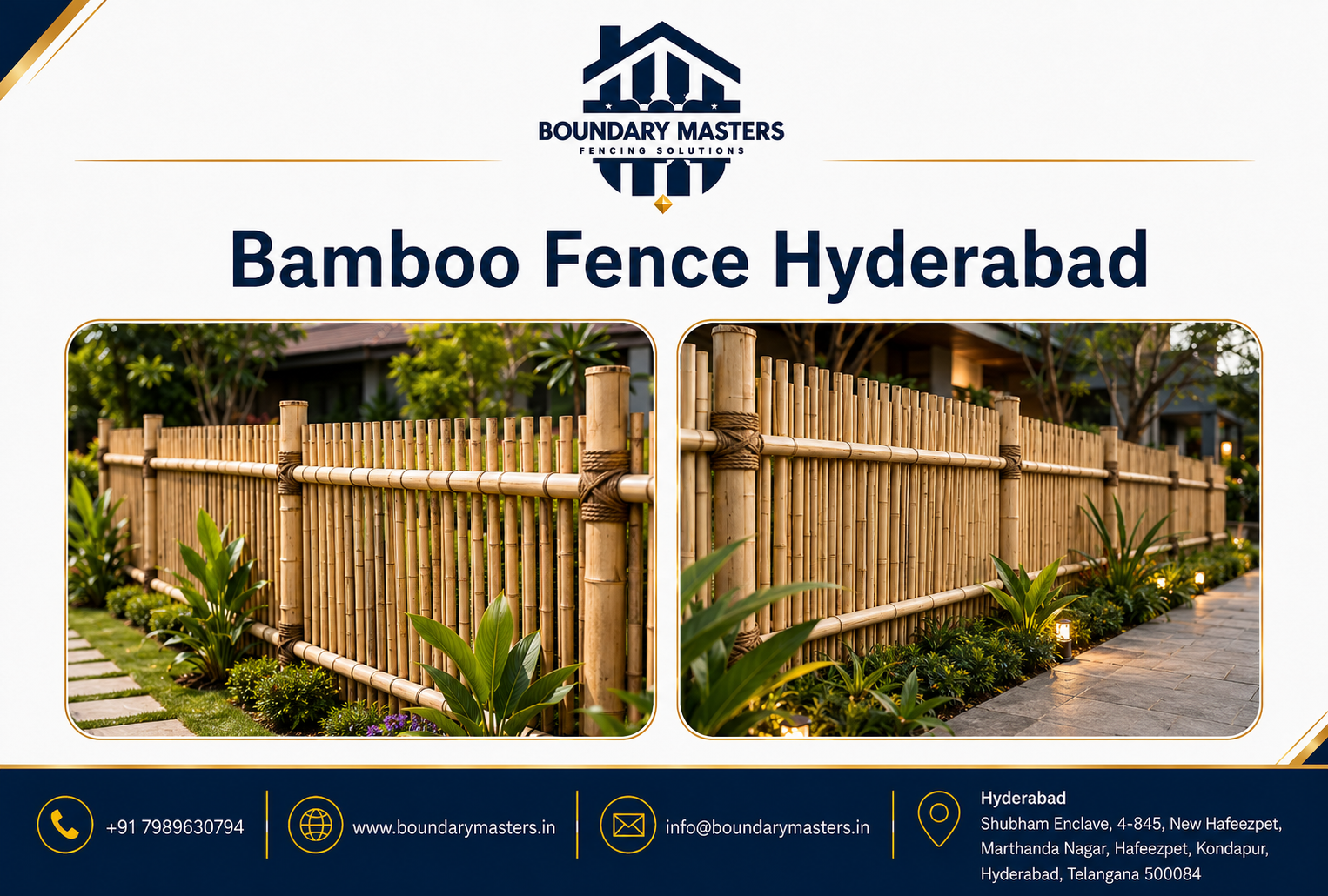
Why Bamboo Fencing Is Becoming Popular in Hyderabad
Property owners in Hyderabad are increasingly looking for boundary solutions that combine privacy, natural appearance, ventilation and visual warmth. Traditional masonry walls can feel heavy in gardens, cafés, resorts and farmhouses, while metal fencing may look too industrial for landscape-focused spaces. This is where Bamboo Fence Hyderabad offers a distinctive balance. It can soften a hard boundary, create separation between activity zones and support a more relaxed outdoor character without making the site feel closed in.
The strongest results come from treating bamboo fencing as a designed system rather than simply tying bamboo poles together. The contractor has to study the ground condition, fence height, wind exposure, post spacing, drainage, gate positions and the level of privacy expected by the client. A professional Bamboo Fence Hyderabad installation should also consider how the bamboo will be supported and protected from direct soil contact wherever possible. These details influence appearance, stability and service life.
For villas, restaurants, gardens, nurseries, event spaces, resorts and farm properties, Bamboo Fence Hyderabad can be adapted from rustic and traditional patterns to cleaner contemporary layouts. The important point is to choose the fence style for the actual site instead of copying a photograph without considering local conditions.
What Makes a Bamboo Fence Contractor Truly Professional
A professional fencing contractor does much more than quote a rate per running foot. The contractor should inspect the site, understand the purpose of the boundary and recommend a build method that fits the expected performance. When evaluating Bamboo Fence Hyderabad, property owners should ask how the posts will be anchored, how corners will be strengthened, what treatment is used on the bamboo, how panels are joined and how future maintenance can be handled.
Experience also matters because natural material is less uniform than fabricated steel. Bamboo poles vary in diameter, straightness, node spacing and colour. A skilled team sorts and arranges the material so that the finished fence looks intentional. For premium Bamboo Fence Hyderabad, visual consistency is created through selection, spacing and alignment rather than expecting every pole to be identical.
Good contractors are also transparent about limitations. Bamboo Fence Hyderabad is an attractive landscape and privacy solution, but it should not be presented as if it were identical to a reinforced security wall. The right contractor explains where bamboo is suitable, where a hybrid bamboo-and-metal frame works better, and where another fencing system may be more appropriate.
Site Inspection Before Bamboo Fence Installation
A site visit is one of the most important steps before finalising a bamboo boundary. During inspection, the contractor should measure the total length, identify changes in level, locate existing walls or columns, study soil conditions and confirm entry points. A proper survey helps prevent surprise costs and installation delays. For Bamboo Fence Hyderabad, measurements should include corners, slopes, curved sections, service lines, tree roots and any location where a gate or opening must be integrated.
The survey should also establish the purpose of the fence. A decorative garden divider may need a lighter framework, while a six-foot privacy screen beside a road needs stronger supports. Wind can pass through small gaps, but very tightly packed bamboo can behave like a larger wind surface. That is why Bamboo Fence Hyderabad should be planned with suitable post spacing and bracing for the location.
Clients should use the site visit to discuss finish, colour, pattern and future access. A contractor who records these decisions can prepare a more accurate scope. With Bamboo Fence Hyderabad, clarity at the measurement stage usually produces a cleaner installation and reduces later changes.
Choosing the Right Bamboo for Fencing
Bamboo is a broad material category, and not every pole is equally suitable for every fence. Diameter, maturity, wall thickness, straightness, drying condition and treatment all influence performance. For Bamboo Fence Hyderabad, contractors should select material with enough consistency for the intended design while allowing the natural variation that gives bamboo its character.
Material should be checked for obvious splitting, severe insect damage, excessive softness and weak sections. Some surface checking can occur naturally as bamboo dries, but installation teams should reject pieces that would compromise the fence. The finished look of Bamboo Fence Hyderabad improves when poles are graded so that sudden changes in diameter or colour are distributed thoughtfully across the elevation.
Clients should also decide whether they want whole culms, split bamboo, woven screens or framed bamboo panels. Each approach gives a different texture and level of privacy. A reliable Bamboo Fence Hyderabad contractor should show samples or previous work so the client can understand how the chosen material will look after installation rather than relying only on a catalogue image.
Bamboo Treatment and Protection
Untreated natural material exposed outdoors can deteriorate faster than properly prepared material. Treatment, seasoning and protective finishing therefore deserve attention. A contractor working on Bamboo Fence Hyderabad should explain what preparation has been carried out and what coating or maintenance schedule is recommended after installation.
Protection is especially important near the bottom of the fence, where splashback and persistent moisture can increase deterioration. Good detailing keeps bamboo away from standing water and reduces unnecessary contact with wet soil. For Bamboo Fence Hyderabad, a metal, concrete or masonry base can sometimes improve durability while also creating a neat visual edge.
No coating makes natural bamboo maintenance-free forever. Sun, rain, dust and changing weather will gradually affect colour. Owners who choose Bamboo Fence Hyderabad should expect periodic inspection, cleaning and recoating when needed. This is not a disadvantage unique to bamboo; it is part of caring for an exposed natural finish and should be included in the ownership plan from the beginning.
Post, Frame and Foundation Options
The visible bamboo is only one part of the fence. The supporting structure determines whether the installation remains straight and stable. Depending on the design, Bamboo Fence Hyderabad may use steel posts, treated timber supports, masonry columns, concrete posts or another engineered frame. The right choice depends on fence height, soil, exposure, budget and appearance.
Steel frameworks are useful when clients want a slim structure with predictable strength. Masonry or concrete elements can provide a heavier architectural base. In decorative areas, the frame can be concealed behind bamboo so the natural material remains visually dominant. With Bamboo Fence Hyderabad, the best frame is not always the cheapest frame; it is the one matched to actual loading and site conditions.
Footings also matter. Posts should be anchored to resist movement rather than simply pushed into loose ground. Where existing concrete is available, appropriate base plates or fixing methods may be used. A professional Bamboo Fence Hyderabad contractor should select fixings for the substrate and avoid improvised connections that look acceptable on day one but loosen after repeated wind and movement.
Privacy Fence Designs for Homes and Villas
Residential clients commonly choose bamboo because it creates privacy without giving the garden an overly commercial appearance. A closely spaced vertical pattern can screen neighbouring views, service areas, outdoor seating and swimming pool zones. For residential Bamboo Fence Hyderabad, the design should maintain privacy while still complementing the architecture of the house.
Height is one of the first decisions. A low fence can define a landscape border, while taller screens are better for privacy. Local property requirements, visibility at driveways and neighbour considerations should be checked before final height is confirmed. Decorative top lines, alternating pole heights or framed panels can make Bamboo Fence Hyderabad look more architectural.
Lighting and planting can further improve the result. Warm landscape lighting highlights the natural texture of bamboo at night, while climbers or shrubs can soften the base. A carefully planned Bamboo Fence Hyderabad installation becomes part of the landscape design rather than appearing as a temporary screen added after the garden was completed.
Bamboo Fencing for Farmhouses and Agricultural Properties
Farmhouses often need long boundary runs, internal partitions and privacy around entertainment or residential zones. Bamboo can be particularly attractive near landscaped areas, cottages, pergolas and gathering spaces. For farmhouse Bamboo Fence Hyderabad, however, the contractor should distinguish between decorative/privacy fencing and fencing intended to restrain livestock or provide high security.
Long runs require careful line setting. Small alignment errors become obvious over distance, so string lines, level references and consistent post spacing are important. Changes in ground level should be handled deliberately rather than allowing the fence to rise and fall randomly. A well-installed Bamboo Fence Hyderabad boundary can follow terrain in steps or smooth transitions depending on the desired appearance.
Farmhouse projects may also combine systems. Bamboo screening can face a structural chain-link or welded-mesh fence, giving the landscape a natural look while the metal layer provides defined containment. This hybrid approach allows Bamboo Fence Hyderabad to serve the visual and privacy role without forcing bamboo alone to perform every security function.
Bamboo Fencing for Resorts, Cafés and Restaurants
Hospitality spaces use boundaries differently from residential properties. The fence may need to create atmosphere, separate dining zones, hide service areas and provide attractive backgrounds for photography. A thoughtfully designed Bamboo Fence Hyderabad installation can support a tropical, rustic, eco-themed or resort-style brand experience.
For commercial venues, finish quality is especially important because guests see the fence from close range. Exposed fasteners, uneven cuts and poorly finished corners can reduce the premium impression. Contractors should also plan for cleaning access and replacement of individual pieces. In busy hospitality settings, Bamboo Fence Hyderabad should be built so minor damage can be repaired without dismantling an entire wall of bamboo.
Fire-safety requirements, circulation routes and emergency access should never be compromised for aesthetics. Venue owners should coordinate the fence layout with relevant building and operational requirements. When those basics are respected, Bamboo Fence Hyderabad can become a functional design feature that helps define the customer experience.
Useful Boundary Masters Resources
If your project includes more than one type of boundary, these related guides can help you compare alternatives and plan different areas of the property:
- Barbed Wire Hyderabad
- Fencing for Ongoing Construction Sites
- Fencing Contractors in Hyderabad
- Boundary Masters – Fencing Solutions in Hyderabad
Bamboo Screens for Balconies, Terraces and Rooftops
Bamboo screening can be used on terraces and rooftop leisure areas, but elevated locations need additional caution because wind exposure may be higher than at ground level. A rooftop Bamboo Fence Hyderabad solution should be fixed to a suitable structural support, and the existing waterproofing system must not be damaged by careless drilling or anchoring.
Weight, height and wind pressure should be considered before installing large solid-looking screens. In some cases, controlled spacing between poles can reduce the sail effect while still providing visual privacy. A qualified professional should assess how the supporting frame connects to parapets or structural elements. This makes Bamboo Fence Hyderabad safer and more durable than attaching bamboo directly to weak railings.
Terrace applications also benefit from modular panels. Panels can simplify access to services and allow individual sections to be maintained or replaced. With coordinated planters, lighting and outdoor furniture, Bamboo Fence Hyderabad can turn an exposed terrace into a more private and comfortable outdoor room.
Cost Factors for Bamboo Fence Installation
The price of a bamboo fence cannot be judged fairly from length alone. Cost depends on height, bamboo grade, pole diameter, spacing, frame material, post foundation, access, site level, design pattern, treatment, finishing and transport. When requesting a quote for Bamboo Fence Hyderabad, clients should provide measurements and photographs, but a final site visit is still useful for an accurate scope.
A low initial quote may exclude important items such as structural posts, finishing, gates, removal of old fencing or surface preparation. Comparing only a single rate can therefore be misleading. A better comparison for Bamboo Fence Hyderabad is a written scope that lists what material, frame, treatment, fixing method and finish are included.
Clients should also think about lifecycle value. A better-supported fence that is easier to maintain may cost more initially but require fewer repairs. When budgeting for Bamboo Fence Hyderabad, reserve a modest amount for periodic maintenance so the natural appearance can be preserved rather than waiting until several neglected issues require major replacement.
Installation Process: From Measurement to Handover
A professional installation normally begins with final measurement and marking. The team establishes the fence line, confirms corner positions and locates posts. Foundations or anchors are then prepared, followed by the structural frame. Only after the support system is stable should the visible bamboo work proceed. This sequence helps Bamboo Fence Hyderabad remain straight and properly aligned.
Bamboo may be installed vertically, horizontally, woven or as prefabricated panels. Cuts should be neat, sharp edges removed and fasteners positioned consistently. The team should regularly check level and spacing because small errors accumulate across long runs. Quality-focused Bamboo Fence Hyderabad work looks controlled even though the material itself has natural variation.
Before handover, the contractor should inspect connections, trim or seal exposed ends as required, clean the area and explain basic care. Clients should walk the boundary and raise any concerns while the team is still on site. A clear handover makes Bamboo Fence Hyderabad easier to maintain and gives both parties a shared understanding of the finished scope.
How Bamboo Fencing in Hyderabad Compares with Chain Link
Chain-link fencing is widely used because it is practical, economical and suited to many boundary applications. Bamboo serves a different visual purpose. Bamboo Fence Hyderabad provides substantially more visual screening when poles or panels are closely spaced, while chain link is open and transparent unless screening is added.
For security-oriented industrial or large agricultural boundaries, chain link may be more appropriate as the primary system. For gardens, hospitality spaces and privacy zones, bamboo can offer a warmer appearance. Some projects combine both: chain link provides the structural boundary while Bamboo Fence Hyderabad is installed as a decorative screen on the visible side.
The decision should therefore be based on function. If the main need is visibility and perimeter definition, chain link has strong advantages. If the main need is privacy and landscape character, Bamboo Fence Hyderabad may be preferred. A contractor who supplies multiple fencing types can recommend the system instead of trying to force one product into every application.
How Bamboo Fencing Compares with Precast Boundary Walls
Precast concrete walls provide a solid, durable and high-privacy boundary. They are suitable where a substantial physical barrier is required. Bamboo is lighter and visually softer. Bamboo Fence Hyderabad is often chosen when clients want privacy while preserving a garden-oriented atmosphere rather than the appearance of a heavy wall.
Installation methods also differ. Precast walls require posts, panels, equipment access and more substantial foundation planning. Bamboo screens can often be adapted to existing walls or structural posts, depending on condition. This can make Bamboo Fence Hyderabad useful for upgrading the visual appearance of an existing boundary without replacing the entire structure.
The two systems can also work together. A lower masonry or precast base can handle ground-level exposure while bamboo screening adds height and warmth above it. Hybrid detailing allows Bamboo Fence Hyderabad to contribute aesthetics and privacy while the concrete component provides robust lower-level protection.
Quick Comparison of Common Boundary Options
| Boundary Type | Best For | Privacy | Visual Character | Key Consideration |
|---|---|---|---|---|
| Bamboo screening | Gardens, villas, cafés, resorts, farmhouses | Medium to high depending on spacing | Natural and warm | Needs good support and maintenance |
| Chain link | Large perimeters, farms, utility boundaries | Low without screen | Functional | Choose proper gauge, coating and posts |
| Precast wall | Solid privacy and substantial boundaries | High | Heavy, architectural | Foundation and access requirements |
| Welded mesh | Security-conscious visible boundaries | Low | Clean and modern | Panel quality and corrosion protection |
| Bamboo + metal hybrid | Privacy with stronger structural support | High | Natural with engineered backing | Design for additional wind load |
Maintenance Checklist for Long-Term Appearance
Routine maintenance begins with observation. Owners should periodically check for loose ties or fasteners, movement at posts, damaged poles, water accumulation and areas where plants trap moisture against the fence. Early correction is usually simpler than waiting for damage to spread. This approach helps Bamboo Fence Hyderabad retain a neat appearance.
Cleaning should be gentle and appropriate for the finish used. Harsh methods can damage coatings or fibres. If a protective exterior finish has been applied, follow the coating manufacturer's maintenance guidance. The colour of natural bamboo will change over time, so clients should decide whether they prefer graceful weathering or want to preserve a more uniform tone. Either approach can work for Bamboo Fence Hyderabad when managed intentionally.
Vegetation should also be controlled. Dense vines can look attractive but may add weight and hold moisture. Keep irrigation sprinklers from constantly soaking the fence. With sensible inspection and timely repairs, Bamboo Fence Hyderabad can remain an attractive landscape feature instead of becoming a neglected boundary element.
Common Mistakes to Avoid
One common mistake is choosing bamboo purely by appearance without checking whether the support structure is adequate. Tall, tightly packed panels can put substantial demand on weak posts during windy conditions. A reliable Bamboo Fence Hyderabad project starts with the frame and anchoring, not with the decorative surface.
Another mistake is allowing the bottom of the bamboo to sit continuously in wet soil or drainage paths. Poor trimming, unsealed exposed cuts where treatment is specified, irregular spacing and visible random fasteners can also reduce quality. Contractors experienced with Bamboo Fence Hyderabad plan these details before installation rather than trying to hide problems at the end.
Finally, do not assume natural means maintenance-free. Bamboo is a natural material exposed to outdoor weather, so inspection and upkeep are expected. Clients who understand this from the beginning are more satisfied with Bamboo Fence Hyderabad because they choose it for its real strengths—texture, privacy and visual warmth—rather than unrealistic promises.
Sustainability and Responsible Material Choices
Bamboo is widely discussed as a renewable non-wood forest resource. The Food and Agriculture Organization notes its many uses in housing, building, crafts and other applications, while international organizations also study bamboo for land restoration and sustainable development. These broader benefits are one reason some property owners are attracted to Bamboo Fence Hyderabad as a natural-looking boundary option.
Sustainability still depends on sourcing, treatment, transportation, service life and responsible use. A product should not be called environmentally friendly merely because it contains bamboo. For a more thoughtful Bamboo Fence Hyderabad project, ask suppliers about material origin, avoid unnecessary waste and design the fence so damaged pieces can be replaced individually instead of discarding large panels.
Durability is itself part of sustainability. A fence that lasts longer and can be repaired efficiently uses resources more responsibly than one that must be replaced frequently. Well-planned Bamboo Fence Hyderabad therefore combines material selection with proper installation, drainage, maintenance and realistic expectations about outdoor exposure.
Why Local Hyderabad Experience Matters
Hyderabad projects can vary greatly—from dense residential neighbourhoods and commercial terraces to open farmhouses on the outskirts. Access, soil, wall condition, drainage and exposure all change from site to site. A contractor familiar with local conditions can identify practical constraints earlier when planning Bamboo Fence Hyderabad.
Local execution also makes measurement and after-sales visits easier. If a gate needs adjustment, a panel is damaged or a client wants the fence extended, a nearby team can inspect the issue without complicated logistics. This practical service component is an important part of choosing a Bamboo Fence Hyderabad contractor, especially for commercial properties where appearance needs to be restored quickly.
However, locality alone is not enough. Clients should still review workmanship, ask for a clear scope and judge how well the contractor explains structural details. The best Bamboo Fence Hyderabad provider combines local availability with disciplined installation practices and honest recommendations.
How to Evaluate a Contractor’s Previous Work
Before selecting a contractor, ask to see completed projects that are similar in height, style and application to your own. A close-up photograph reveals more than a distant beauty shot. Look at corner joints, top lines, post alignment, fastener consistency and how gates meet the fence. These details show the workmanship behind Bamboo Fence Hyderabad.
Also ask how long ago the example was installed. Recent photos show finish quality, while older installations can indicate how the system ages. If possible, discuss what maintenance was performed. This gives a more realistic picture of what Bamboo Fence Hyderabad will require after handover.
References, reviews and project documentation can add confidence, but visual inspection remains important. A beautiful design cannot compensate for a weak support structure. When assessing Bamboo Fence Hyderabad, evaluate both the front-facing bamboo and the hidden construction behind it.
Why Boundary Masters Is a Practical Choice
Boundary Masters works across multiple fencing categories, which is useful because not every boundary should use the same material. A site may need bamboo screening near landscaped areas, chain link along a utility edge and stronger security fencing at another section. This wider perspective helps clients evaluate Bamboo Fence Hyderabad as part of the overall perimeter plan.
A fencing-focused contractor can also coordinate posts, frames, gates and transitions between different systems. That matters when bamboo is installed beside an existing wall or integrated with metal fencing. For a clean Bamboo Fence Hyderabad finish, these transitions should look planned rather than improvised.
If you are comparing contractors, request a site inspection and discuss the purpose of the fence, preferred design, approximate height and maintenance expectations. Boundary Masters can then recommend an approach for Bamboo Fence Hyderabad based on site conditions and the level of privacy or decorative impact required.
Detailed Planning Notes for Large and Complex Sites
A useful way to plan any boundary project is to separate decisions into function, structure, appearance and maintenance. Function defines what the fence must do: create privacy, guide movement, screen a view, mark a boundary or support a landscape concept. Structure determines the posts, foundations, frame and connections required to keep the fence stable. Appearance covers spacing, height, texture, finish, top profile and transitions at corners or gates. Maintenance addresses drainage, cleaning, inspection, recoating and replacement of individual components. When these four decisions are documented before work begins, clients can compare quotations more fairly and contractors can execute the project with fewer assumptions. This method is especially useful on mixed-use properties where one section faces a public road, another borders a garden and another surrounds a service area. Each zone may need a different degree of privacy or structural strength. A single visual style can still be maintained by repeating details such as post colour, panel rhythm or top alignment. Clear documentation also helps future repairs because the owner knows how the original fence was assembled and which finishes were used.
Large sites also benefit from dividing the work into measurable zones. Each zone can be assigned a length, height, frame type, finish and access condition. This avoids confusion when a quotation includes several boundary treatments. For example, a front landscape edge may need a highly finished privacy screen, while the rear service boundary may prioritise strength and economy. Gates should be documented separately because hinges, latches, frames and clearances add requirements that are different from a fixed fence panel. Corners should also be identified because they often require additional bracing. Where the ground slopes, the contractor and owner should agree whether the fence will step down in level sections or follow the gradient. Both approaches can look good when executed deliberately, but unplanned changes in height can make even premium material look uneven. Photographs of each zone, a simple sketch and written dimensions are often enough to make pre-installation communication much clearer.
Material storage before installation is another practical issue that is easy to overlook. Natural poles should be kept in a suitable dry and ventilated location and protected from unnecessary exposure before they are installed. The site team should have enough working space to sort, cut and prepare pieces without blocking vehicle movement or damaging landscaping. If work is taking place at an occupied home, resort or restaurant, the installation sequence should minimise disruption and maintain safe access. Waste pieces, packaging and offcuts should be removed regularly so the work area remains orderly. A professional-looking final result is usually supported by a professional installation process: measured preparation, clean cutting, consistent fasteners, organised storage and end-of-day housekeeping. These operational details do not appear in a finished photograph, but they strongly influence project quality and the client experience.
Another useful planning exercise is to decide how the fence should age visually. Some owners like the gradual weathered character of natural materials, while others want to preserve a warmer or more uniform tone with periodic finishing. The chosen appearance should influence the initial coating system and future maintenance plan. Replacement strategy matters as well. If the fence is built from independent panels or accessible individual poles, localised damage can often be repaired without removing long sections. That can be particularly valuable around parking areas, event spaces or service routes where accidental impact is possible. Owners should keep a record of the original finish and, where practical, a small quantity of matching material or supplier details for later repairs. Planning for maintenance from day one is usually more economical than treating maintenance as an unexpected problem years later.
Authoritative Resources on Bamboo and Sustainable Material Use
For readers who want to explore bamboo beyond fencing, the following organizations publish information on bamboo resources, cultivation, land restoration, forestry and sustainable development:
- FAO – Bamboo statistics and non-wood forest products
- FAO – Bamboo, restoration and green construction initiatives
- International Bamboo and Rattan Organization (INBAR)
- INBAR – Bamboo for land restoration
- ICAR – Bamboo nursery, plantation and value addition
- State Bamboo Development Agency, Assam – Characteristics of bamboo
Frequently Asked Questions
Is bamboo fencing suitable for Hyderabad weather?
Yes, it can be suitable when the material is properly selected, treated, installed and maintained. Outdoor exposure to sun, rain and moisture will affect any natural material, so details such as drainage, ground clearance, protective coatings and strong supports matter. For Bamboo Fence Hyderabad, ask the contractor to explain the proposed protection method and expected maintenance rather than relying on a generic claim that bamboo is weatherproof. A well-detailed fence is more likely to age evenly and remain visually appealing. When planning Bamboo Fence Hyderabad, ask for a written scope so the structural and finishing details are clear. A site-specific Bamboo Fence Hyderabad recommendation is more useful than a generic rate without inspection.
How long does a bamboo fence last?
There is no single lifespan that applies to every installation because service life depends on bamboo quality, treatment, climate exposure, ground contact, drainage, structural support and maintenance. Bamboo Fence Hyderabad installed on a robust frame and kept away from persistent moisture generally has better conditions than bamboo placed directly into wet soil. Regular inspection and replacement of individual damaged poles can extend the useful life of the overall fence. Ask for project-specific expectations based on the exact design. When planning Bamboo Fence Hyderabad, ask for a written scope so the structural and finishing details are clear. A site-specific Bamboo Fence Hyderabad recommendation is more useful than a generic rate without inspection.
Can bamboo fencing provide full privacy?
A closely spaced vertical or panel-style fence can provide strong visual screening. The exact privacy level depends on pole diameter, spacing, weaving pattern and viewing angle. If full screening is the goal, state that clearly during the quotation stage so Bamboo Fence Hyderabad is designed accordingly. Remember that natural poles are not perfectly uniform, so tiny gaps may remain. For maximum privacy, a backing layer or layered bamboo pattern can sometimes be considered where appropriate. When planning Bamboo Fence Hyderabad, ask for a written scope so the structural and finishing details are clear. A site-specific Bamboo Fence Hyderabad recommendation is more useful than a generic rate without inspection.
Can bamboo fencing be installed over an existing wall?
Often yes, provided the existing wall or structural elements are suitable for the additional load and fixings. The wall should be inspected before mounting a tall screen. A contractor may use posts, base plates or another support frame rather than attaching bamboo directly to weak masonry. For Bamboo Fence Hyderabad, structural stability and waterproofing details should be resolved before decorative bamboo is installed. Never assume an old parapet or boundary wall is automatically strong enough for added height. When planning Bamboo Fence Hyderabad, ask for a written scope so the structural and finishing details are clear. A site-specific Bamboo Fence Hyderabad recommendation is more useful than a generic rate without inspection.
What height is best for a bamboo privacy fence?
The right height depends on the purpose, site context, sightlines, local requirements and wind exposure. Low screens work for garden zoning, while taller screens are used for privacy. Bamboo Fence Hyderabad should be sized after considering neighbouring properties, driveway visibility and the strength of the support system. Extremely tall solid-looking screens may require more substantial posts and foundations. The contractor should recommend a height that balances privacy, appearance and stability rather than simply maximizing height. When planning Bamboo Fence Hyderabad, ask for a written scope so the structural and finishing details are clear. A site-specific Bamboo Fence Hyderabad recommendation is more useful than a generic rate without inspection.
Is bamboo fencing cheaper than a concrete boundary wall?
It can be less expensive in some applications, but direct comparisons are difficult because the systems serve different functions and use different foundations and structures. The cost of Bamboo Fence Hyderabad depends on material grade, frame, height, treatment, site access and finish. A concrete or precast wall may be better where a heavy security barrier is needed, while bamboo may be chosen for privacy and aesthetics. Compare complete scopes, not only the rate per foot. When planning Bamboo Fence Hyderabad, ask for a written scope so the structural and finishing details are clear. A site-specific Bamboo Fence Hyderabad recommendation is more useful than a generic rate without inspection.
Does bamboo fencing need maintenance?
Yes. Natural bamboo outdoors should be inspected periodically for movement, loose fixings, coating wear, moisture traps and damaged poles. Maintenance frequency varies with exposure and finish. Owners of Bamboo Fence Hyderabad should keep irrigation from constantly soaking the fence and should address damaged sections promptly. Where a protective coating is used, follow the product manufacturer's renewal guidance. Planned maintenance keeps the fence looking intentional and can reduce the need for larger repairs later. When planning Bamboo Fence Hyderabad, ask for a written scope so the structural and finishing details are clear. A site-specific Bamboo Fence Hyderabad recommendation is more useful than a generic rate without inspection.
Can bamboo be combined with chain link fencing?
Yes. This is a practical hybrid when the property needs the defined boundary of chain link but the owner wants greater privacy or a natural appearance on the visible side. The structural design still needs to account for the added wind load of screening. With Bamboo Fence Hyderabad, bamboo panels or poles can be positioned in front of a properly supported mesh system. The contractor should ensure the additional layer does not overload existing posts or create maintenance problems. When planning Bamboo Fence Hyderabad, ask for a written scope so the structural and finishing details are clear. A site-specific Bamboo Fence Hyderabad recommendation is more useful than a generic rate without inspection.
How should I compare quotations from bamboo fence contractors?
Ask every contractor to quote the same scope: total length, height, bamboo type or grade, frame material, post spacing, foundations, treatment, finishing, gates, transport, removal work and taxes where applicable. A low quote for Bamboo Fence Hyderabad may omit structural work or finishing that another contractor includes. Written specifications make comparisons fairer. Also review previous installations and ask how repairs or replacements are handled after completion instead of making the decision on price alone. When planning Bamboo Fence Hyderabad, ask for a written scope so the structural and finishing details are clear. A site-specific Bamboo Fence Hyderabad recommendation is more useful than a generic rate without inspection.
How can I get a quote from Boundary Masters?
You can contact Boundary Masters with the approximate location, fence length, required height, photographs and preferred style. A site inspection can then confirm measurements, ground conditions and support requirements. For Bamboo Fence Hyderabad, sharing the purpose—privacy, decoration, resort landscaping, farmhouse boundary or commercial screening—helps the team recommend a suitable approach. Final pricing should be based on the actual specification rather than an assumed generic bamboo fence rate. When planning Bamboo Fence Hyderabad, ask for a written scope so the structural and finishing details are clear. A site-specific Bamboo Fence Hyderabad recommendation is more useful than a generic rate without inspection.
Final Thoughts
The best bamboo fence is not simply the one with the most attractive poles. It is the one designed for the site, supported correctly, protected from avoidable moisture, installed with consistent workmanship and maintained with realistic expectations. Before selecting a contractor, compare complete specifications rather than only the lowest rate. Ask how the frame is built, how the material is prepared, how corners and gates are handled and what maintenance is recommended.
For Hyderabad homeowners, farmhouse owners, landscape designers, hospitality businesses and commercial property managers, bamboo can be an excellent way to create privacy and character when it is used for the right purpose. A site-specific approach will always deliver a better result than a one-size-fits-all quotation.
Contact Us :
Phone: +91 7989630794
Email: reach.us@boundarymasters.in
City: Hyderabad
Address: Shubham Enclave, 4-845, New Hafeezpet, Marthanda Nagar, Hafeezpet, Kondapur, Hyderabad, Telangana 500084
Website: https://boundarymasters.in/