
Solar Electric Fencing in Bangalore: A Complete Guide to Smart Property Protection
Learn how Solar Electric Fencing works, where it can be installed, what benefits it offers, and why homeowners, farms, commercial properties, warehouses, institutions and industrial facilities are increasingly choosing solar-powered perimeter security solutions.
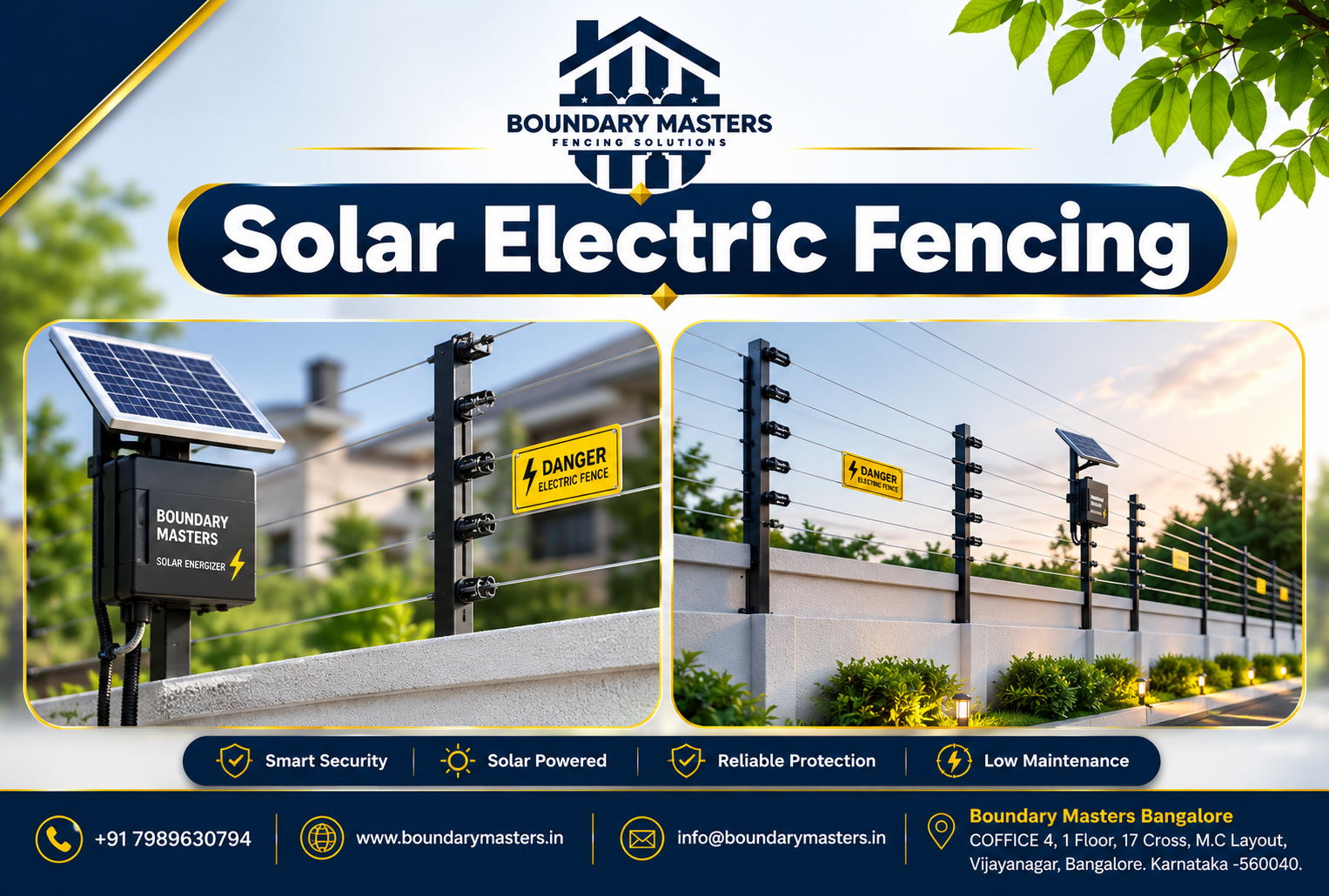
Introduction to Solar Electric Fencing
Securing the outer boundary of a property is one of the most important steps in preventing trespassing, theft, vandalism and unwanted animal movement. Conventional compound walls, chain-link fencing, barbed wire and security guards continue to serve important purposes, but many property owners now want an additional layer of intelligent protection. This is where Solar Electric Fencing has become a practical and increasingly preferred solution.
A properly planned Solar Electric Fencing system combines physical boundary protection with a controlled electrical deterrent. It can be installed above a compound wall, along an agricultural boundary, around a warehouse, beside an industrial property or across a large open site. Because it uses solar energy, the system can continue operating even in locations where grid electricity is unavailable, unstable or expensive to extend.
Bangalore has a wide variety of properties that require dependable perimeter protection. These include independent houses, villas, farmhouses, layouts, warehouses, factories, schools, commercial buildings, vacant plots, agricultural land and ongoing construction projects. Solar Electric Fencing can be designed according to the site dimensions, existing boundary structure, threat level, surrounding environment and expected usage.
Unlike ordinary fencing, Solar Electric Fencing is not installed merely as a visible boundary marker. It functions as an active deterrent. When an intruder or animal touches the live fence wire while making contact with the ground, the energizer delivers a brief, controlled pulse. This pulse is designed to create a strong warning sensation rather than a continuous flow of electricity.
The effectiveness of Solar Electric Fencing depends heavily on correct design and professional installation. Wire spacing, insulator quality, earthing, energizer capacity, battery selection, solar-panel positioning, warning signs and vegetation control all influence performance. Property owners should therefore avoid treating it as a basic do-it-yourself wiring project.
What Is Solar Electric Fencing?
Solar Electric Fencing is a perimeter-protection arrangement powered primarily through a solar panel. The panel converts sunlight into electrical energy, which is stored in a rechargeable battery. A fence energizer then converts that stored energy into short, high-voltage, low-current pulses and sends them through the installed fence wires.
The wires are mounted on insulated supports so that the electrical pulse does not leak into the posts, wall or surrounding structure. When properly installed, the pulse travels around the full fence line. If a person, animal or conductive object touches the live wire while completing a path to earth, the pulse passes momentarily through that path and creates a sharp deterrent sensation.
A Solar Electric Fencing installation generally includes both visible and functional security elements. The visible wires, posts, brackets and warning boards discourage casual trespassers before contact occurs. The active electrical pulse provides the second level of deterrence.
Solar Electric Fencing can be adapted to different site types. On residential properties, it may be mounted above a compound wall. On farms or open land, it can be installed using dedicated posts around the perimeter. For warehouses and industrial facilities, the system may be integrated with existing chain-link fencing, masonry walls or other security infrastructure.
How Solar Electric Fencing Works
The operating principle of Solar Electric Fencing is straightforward, but every component must work together correctly. The solar panel receives sunlight during the day and sends charging current to the battery through an appropriate controller or integrated charging arrangement. The battery supplies power to the fence energizer during both daytime and nighttime operation.
The energizer does not send ordinary household electricity directly into the fence. Instead, it produces brief electrical pulses at controlled intervals. These pulses travel through the live fence wires. Between pulses, there is no continuous power flow comparable to a normal electrical supply line.
Earthing is a critical part of Solar Electric Fencing. When contact occurs, the current must be able to return through the ground and earthing system to complete the circuit. Poor earthing is one of the most common causes of weak fence performance. Dry soil, loose connections, inadequate earth rods or corrosion can reduce effectiveness.
Vegetation touching the live wire can also divert energy into the ground. Grass, creepers, tree branches and wet leaves may reduce the voltage available across the rest of the fence. Routine vegetation clearance is therefore an essential part of maintaining Solar Electric Fencing.
Basic Operating Sequence
- The solar panel captures energy from sunlight.
- The generated power charges the battery.
- The battery supplies energy to the fence energizer.
- The energizer sends controlled pulses through the fence wires.
- The insulators prevent electrical leakage into posts or walls.
- The earthing system helps complete the circuit during contact.
- The pulse creates a strong deterrent warning.
The system should be selected according to the overall fence length, number of strands, environmental conditions and expected risk level. A small residential installation and a large agricultural boundary do not require identical equipment. Professional calculation helps ensure that the energizer has sufficient capacity for the complete fence line.
Main Components of a Solar Electric Fencing System
1. Solar Panel
The solar panel is the primary energy source. Its size must be selected according to the energizer load, battery capacity, expected sunlight and operating requirements. It should be mounted in an open position that receives adequate sunlight without regular shading from trees, buildings, water tanks or nearby structures.
2. Fence Energizer
The energizer is the control centre of Solar Electric Fencing. It takes low-voltage battery power and converts it into short fence pulses. Energizers are available in different power ratings, and the correct model depends on fence length, number of wires, vegetation pressure and installation type.
3. Rechargeable Battery
The battery stores solar energy so the Solar Electric Fencing system can continue working after sunset and during periods of reduced sunlight. Battery capacity should be adequate for expected backup duration and should be protected from direct rain, excessive heat, tampering and unauthorised access.
4. Fence Wires
Specially selected conductive wires carry the electrical pulses around the boundary. Material quality, tensile strength, corrosion resistance and installation tension all affect long-term reliability. Loose, rusted or damaged wires can reduce the performance and appearance of Solar Electric Fencing.
5. Insulators
Insulators separate live wires from conductive supports such as metal posts, brackets and wall-mounted frames. High-quality insulators reduce leakage and help maintain pulse strength. Cracked, damaged or low-grade insulators may allow energy to escape into the structure.
6. Posts and Brackets
Posts and brackets support the wire system. Their design depends on whether Solar Electric Fencing is being installed above a wall, along open farmland, around a vacant site or on an existing fence. Corner supports and end posts require additional strength because they carry greater wire tension.
7. Earthing System
Earth rods, clamps and connecting cables create the return path needed for the electric pulse. The number and depth of earth rods depend on soil type, energizer output and fence size. Correct earthing can make a major difference to the practical effectiveness of Solar Electric Fencing.
8. Warning Signboards
Clearly visible warning boards inform people that the boundary is electrified. These boards should be placed at suitable intervals, entrances, gates and locations where people may approach the fence. Warning signs are an important safety and awareness feature.
9. Lightning and Surge Protection
Outdoor fencing systems can be exposed to electrical surges and lightning-related risks. Appropriate protective devices, isolation methods and grounding arrangements should be considered based on site conditions.
Why Solar Electric Fencing Is Suitable for Bangalore Properties
Bangalore includes densely developed residential areas, industrial zones, technology campuses, agricultural outskirts, warehouses, plotted developments and rapidly expanding construction corridors. A single type of security system cannot suit every location. Solar Electric Fencing is valuable because it can be customised for both compact and large properties.
Many outskirts and developing areas experience inconsistent power availability or have boundaries located far from the main electrical connection. A solar-powered solution reduces dependence on long electrical cable routes. It can also continue charging independently during the day, making Solar Electric Fencing useful for remote or semi-remote sites.
The system is also suitable for properties that remain unattended for long periods, such as farmhouses, vacant plots, agricultural fields and construction sites. A visible active fence can discourage opportunistic entry, material theft and unwanted movement across the boundary.
Properties already protected with chain-link fencing, barbed wire or compound walls may not always need complete boundary replacement. In many cases, Solar Electric Fencing can be added as an additional top layer after inspecting the structural condition and available mounting space.
Property owners exploring conventional perimeter options can also review Boundary Masters’ guide on barbed wire fencing solutions . Comparing physical fencing with active Solar Electric Fencing can help determine whether a standalone system or combined security arrangement is more appropriate.
Common Applications of Solar Electric Fencing
Residential Houses and Villas
Solar Electric Fencing can be installed above compound walls to create a visible and active security barrier. Residential designs should maintain a neat appearance while providing appropriate wire spacing, warning boards and secure equipment placement.
Farmhouses and Agricultural Land
Large agricultural boundaries often require a cost-conscious security solution that does not depend entirely on grid electricity. Solar Electric Fencing can help deter animal entry, unauthorised access and movement through farm boundaries when the system is properly planned for the specific animal type and site conditions.
Warehouses and Storage Yards
Warehouses may store machinery, raw material, finished products or high-value inventory. Solar Electric Fencing can strengthen the outer perimeter and complement CCTV cameras, lighting, guards and access-control systems.
Factories and Industrial Properties
Industrial boundaries are often long and may include less visible rear or side sections. Installing Solar Electric Fencing around vulnerable areas can improve deterrence and reduce reliance on physical patrols alone.
Ongoing Construction Sites
Construction sites frequently contain cement, steel, electrical cables, tools and equipment that require protection after working hours. Readers planning temporary or permanent site boundaries can explore this detailed guide to fencing for an ongoing construction site . Solar Electric Fencing may be considered as an additional layer where site layout and safety conditions permit.
Schools, Institutions and Campuses
Educational campuses, hostels, training centres and institutional properties may have extensive boundaries. Any Solar Electric Fencing installation in such environments requires careful planning, clear warning signs, restricted access to equipment and proper separation from routine pedestrian areas.
Vacant Plots and Layouts
Unoccupied plots are vulnerable to encroachment, dumping and unauthorised entry. Solar Electric Fencing can provide an active deterrent, especially when combined with physical boundary posts, chain-link mesh or a compound wall.
Major Benefits of Solar Electric Fencing
Independent Solar Power
The ability to operate through solar energy is one of the biggest benefits of Solar Electric Fencing. It reduces reliance on continuous grid power and makes the system suitable for farms, layouts, remote boundaries and developing areas.
Active Perimeter Deterrence
A normal fence acts mainly as a physical obstacle. Solar Electric Fencing adds a controlled electrical deterrent, making it harder for an intruder to casually climb, cut or cross the boundary without receiving a warning pulse.
Visible Security Presence
The wire arrangement, energizer setup and warning signs communicate that the property has an active security system. This visibility can discourage attempted intrusion before physical contact takes place.
Suitable for Large Boundaries
Solar Electric Fencing can be planned for long perimeter lines when the energizer, wire, earthing and solar components are correctly selected. This makes it practical for farms, warehouses, factories and plotted developments.
Integration With Existing Fencing
In many cases, the system can be installed on top of a compound wall or integrated with an existing chain-link fence. This may reduce the need to replace the complete boundary structure.
Low Routine Energy Cost
Solar power helps minimise normal electricity consumption. However, batteries, insulators, wires and connectors still require periodic inspection and eventual replacement as part of responsible maintenance.
Solar Electric Fencing vs Traditional Fencing
| Feature | Solar Electric Fencing | Traditional Physical Fencing |
|---|---|---|
| Primary function | Active electrical deterrence with visible boundary security | Physical obstruction and boundary marking |
| Power requirement | Uses solar panel, battery and energizer | Generally does not require power |
| Remote-site suitability | Highly suitable when adequate sunlight is available | Suitable, but provides no active deterrent |
| Maintenance | Requires wire, battery, solar panel, vegetation and earthing checks | Requires rust, damage, post and tension checks |
| Security visibility | High, especially with warning boards | Depends on material and fence height |
| Installation planning | Requires electrical and structural assessment | Primarily requires structural and boundary assessment |
| Best use | Properties needing an additional active security layer | Properties needing basic separation and physical enclosure |
The strongest solution is not always a choice between Solar Electric Fencing and traditional fencing. Many properties benefit from a combined approach. A compound wall, chain-link mesh or other physical barrier can establish the boundary, while Solar Electric Fencing adds active deterrence above or alongside it.
Selection should depend on site risk, budget, boundary length, existing infrastructure, nearby pedestrian movement, surrounding vegetation and long-term maintenance capability. A professional site inspection is therefore recommended before finalising the design.
Choosing the Right Solar Electric Fencing Contractor
The performance of Solar Electric Fencing depends as much on installation quality as on the products used. A contractor should inspect the site, measure the boundary, identify gates and corners, evaluate existing structures and determine the most suitable energizer, battery, solar panel and earthing arrangement.
Property owners should ask whether the quotation includes posts, brackets, insulators, conductive wires, energizer, battery, solar panel, earthing components, warning signs, installation labour and testing. A clear scope helps prevent confusion and unexpected expenses later.
You can also read Boundary Masters’ guide on selecting experienced fencing contractors . Although the guide discusses Hyderabad, the contractor-selection principles are equally useful for Solar Electric Fencing projects in Bangalore.
To explore the company’s complete range of fencing solutions, visit the Boundary Masters official website .
Professional Solar Electric Fencing Installation Process
A reliable Solar Electric Fencing installation begins with proper site planning. Installing wires, a solar panel and an energizer without first studying the property can result in weak performance, voltage loss, unsafe placement or unnecessary expense. Every property has different boundary conditions, so the system should be customised rather than installed using a fixed design.
Step 1: Initial Site Inspection
During the first stage, the contractor inspects the full property perimeter. The inspection normally covers the total boundary length, existing walls, chain-link fencing, entry gates, corners, vegetation, nearby electrical lines and areas where people regularly move.
The installer also identifies whether the Solar Electric Fencing will be mounted above a compound wall, supported by independent posts or integrated with an existing physical fence. This assessment helps determine the required number of posts, brackets, insulators, fence-wire strands and warning boards.
Step 2: Boundary Measurement and Risk Assessment
Accurate measurement is necessary for preparing a realistic quotation. The contractor should calculate the complete running length instead of estimating the property size visually. Corners, slopes, gate openings, internal divisions and irregular boundary lines must also be included.
Risk assessment is equally important. A residential villa may need a different Solar Electric Fencing configuration than a warehouse, agricultural field, industrial unit or vacant layout. The number of strands, mounting height and energizer capacity should reflect the actual security requirement.
Step 3: Selecting the Energizer
The energizer must be suitable for the total fence length and expected electrical load. Choosing an undersized energizer can cause weak pulses, especially when the fence is long or when vegetation touches the wire.
A larger energizer is not automatically the right choice for every project. The contractor must balance fence length, number of wires, earthing conditions and intended application. The Solar Electric Fencing system should be designed to produce effective controlled pulses without relying on inappropriate or unsafe equipment.
Step 4: Solar Panel Placement
The solar panel should be installed where it receives sufficient direct sunlight. Trees, neighbouring buildings, overhead structures and water tanks should not create prolonged shade. Even a high-quality panel may produce insufficient charging if it remains shaded for much of the day.
The mounting angle and direction should support efficient energy generation while also keeping the panel secure from accidental damage and tampering. The frame must be strong enough to handle normal outdoor exposure.
Step 5: Battery and Energizer Housing
The battery and energizer should be installed in a protected, ventilated and secure enclosure. They should not be left exposed to direct rain, standing water, excessive heat or unauthorised handling.
For residential and commercial Solar Electric Fencing, the control unit is often positioned near a secure utility area, guard room or service section. For farms and remote properties, tamper-resistant housing may be necessary.
Step 6: Installing Posts and Brackets
Posts and brackets must be aligned properly to support consistent wire tension. Weak mounting points can bend or loosen over time, reducing the visual quality and effectiveness of the system.
Corner posts and end posts usually experience greater pulling force than intermediate supports. These points should therefore be reinforced appropriately. When Solar Electric Fencing is mounted above an existing wall, the installer should first check whether the wall and coping are structurally suitable.
Step 7: Fixing Insulators and Fence Wires
Insulators are fitted to each support before the conductive wires are installed. The wires are then passed through or attached to the insulators according to the selected system design.
Wire spacing should remain consistent throughout the boundary. Uneven spacing can create weak areas and make the installation look unprofessional. The wires must be tensioned carefully: excessively loose wires may sag, while excessive tension may damage posts and insulators.
Step 8: Installing the Earthing System
Earthing is one of the most important stages of Solar Electric Fencing installation. The installer places suitable earth rods into the ground and connects them to the energizer using appropriate cables and clamps.
Soil type influences earthing performance. Dry, rocky or highly resistant ground may require additional earth rods or a modified arrangement. The connections should be tight and protected against corrosion.
Step 9: Gate and Corner Connections
Gates create interruptions in the fence line, so insulated underground cable or another approved connection method may be required to continue the electrical circuit from one side to the other.
Corners also require careful wire routing. Poor connections at gates and corners can cause significant voltage loss. Every joint should be secure, corrosion-resistant and accessible for future inspection.
Step 10: Warning Sign Installation
Warning boards should be fitted at visible intervals along the Solar Electric Fencing. They should also be placed near gates, entrances, pathways and other areas where a person may approach the boundary.
The signs should remain clearly readable and should not be hidden behind vegetation, advertisements or construction material. Damaged or faded boards should be replaced during routine maintenance.
Step 11: Voltage Testing and Final Commissioning
Once the full system is connected, the contractor should test voltage at multiple points along the perimeter. Testing only near the energizer is not sufficient because voltage may drop at distant corners or across poor connections.
The solar charging system, battery, energizer, earthing, wires, gate connections and warning indicators should all be checked before the Solar Electric Fencing is handed over to the property owner.
Important Planning Factors Before Installation
Total Perimeter Length
Fence length directly affects material quantity and energizer selection. A 100-metre residential boundary and a multi-acre agricultural property require very different Solar Electric Fencing designs.
Existing Boundary Structure
The contractor should check whether the property already has a compound wall, chain-link mesh, welded mesh, barbed wire or independent boundary posts. Existing structures may be usable, but they must be strong enough to support the new installation.
Purpose of the Fence
The required design depends on whether the main concern is trespassing, theft, animal intrusion, unauthorised climbing or protection of stored material. The purpose should be explained clearly during the site survey.
Vegetation Around the Boundary
Thick grass, creepers, shrubs and tree branches may touch live wires and reduce fence performance. Properties with fast-growing vegetation should plan regular clearing around the Solar Electric Fencing.
Nearby Public Access
Boundaries located near public roads, schools, footpaths, common passages or neighbouring properties require careful design. The system must remain clearly identified, securely mounted and separated from areas where accidental contact may occur.
Sunlight Availability
Solar-powered systems need dependable sunlight. The proposed panel location should be checked at different times of the day where possible. Seasonal shadow from trees and nearby structures should also be considered.
Future Construction
Property owners should inform the installer about proposed gates, extensions, new buildings or boundary-wall modifications. Planning for future work can reduce the need to dismantle and reinstall sections later.
Factors That Influence Solar Electric Fencing Cost
The cost of Solar Electric Fencing cannot be determined accurately from property area alone. Contractors generally calculate the project according to running length, system configuration, material quality and site conditions.
| Cost Factor | How It Influences the Project |
|---|---|
| Total running length | Longer boundaries require more wire, insulators, supports and installation labour. |
| Number of wire strands | More strands increase material use and installation time. |
| Type of posts or brackets | Wall-mounted brackets and independent ground posts have different costs. |
| Energizer capacity | Larger or more demanding installations may need a higher-capacity energizer. |
| Solar panel and battery | Capacity, brand, backup requirement and product quality affect pricing. |
| Earthing requirements | Difficult soil conditions may require additional rods and installation work. |
| Gate crossings | Multiple gates may require insulated cable and additional connection work. |
| Site accessibility | Slopes, dense vegetation and restricted access may increase labour requirements. |
| Additional safety equipment | Warning boards, surge protection and secure equipment housing add to the scope. |
Property owners should compare quotations based on the complete specification rather than the lowest total price. A lower quotation may exclude the battery, solar panel, earthing components, warning signs, gate connections or after-installation testing.
Material quality also affects the long-term value of Solar Electric Fencing. Strong posts, durable insulators, corrosion-resistant wires and dependable electrical components may cost more initially but can reduce frequent repairs and voltage-loss problems.
Solar Electric Fencing for Residential Properties
Independent houses and villas often use compound walls as their main physical boundary. However, a wall alone may still be climbable, especially from quiet rear sections, vacant neighbouring plots or areas hidden from CCTV cameras.
Installing Solar Electric Fencing above the wall can create a stronger visible deterrent. The brackets should be aligned uniformly so that the final installation complements the appearance of the property.
Residential systems should be designed with special attention to balconies, terraces, children’s play areas, neighbouring buildings and common passages. The energizer and battery must be placed where they cannot be accessed casually.
Solar Electric Fencing can be combined with motion lights, CCTV cameras, video doorbells and alarm systems. The fence discourages perimeter crossing, while cameras and alarms help identify and record suspicious activity.
Residential Installation Checklist
- Inspect the complete wall for cracks or weak sections.
- Choose strong and corrosion-resistant wall brackets.
- Keep wire alignment neat and consistent.
- Provide clearly visible warning signs.
- Protect the energizer and battery from unauthorised access.
- Avoid unsafe proximity to balconies, terraces and common pathways.
- Test voltage at every corner and gate.
- Provide the property owner with basic operating instructions.
Solar Electric Fencing for Farms and Agricultural Land
Farms often face challenges such as cattle movement, wild-animal intrusion, crop damage, unauthorised entry and theft of agricultural equipment. Large boundaries can also be difficult to monitor continuously using guards alone.
Solar Electric Fencing is well suited to agricultural areas because it can operate without a nearby grid connection. The solar panel charges the battery during daylight, allowing the energizer to function at night when many intrusion incidents occur.
Agricultural installation should be customised according to the type of animals in the area. Wire height and spacing appropriate for cattle may not be suitable for smaller animals. The contractor should also inspect terrain changes, water channels, rocky ground and seasonal vegetation.
Farmers should not allow plants to grow against the live wires. Regular clearing is especially important during monsoon and rapid-growth periods. Wet vegetation can draw energy away from the remaining fence line.
Gateways used by tractors and farm vehicles require robust connections. The fence should be switched and handled according to the installer’s instructions before vehicles, workers or livestock move through controlled sections.
Solar Electric Fencing for Warehouses and Industrial Sites
Industrial properties may contain raw materials, machines, vehicles, finished products and valuable electrical equipment. These sites often have long boundaries and multiple entry points, making complete manual monitoring difficult.
Solar Electric Fencing can strengthen vulnerable perimeter sections, including rear walls, storage yards, utility zones and low-visibility corners. It should be integrated into a broader security plan rather than treated as the only protection measure.
A comprehensive industrial-security arrangement may include:
- Solar Electric Fencing around the outer boundary
- CCTV cameras covering gates and critical areas
- Security lighting around dark perimeter sections
- Access-control systems for employees and visitors
- Guard patrols during non-working hours
- Alarm integration where technically appropriate
- Regular inspection and maintenance records
Industrial installations should avoid interference with loading zones, overhead equipment, service passages and emergency exits. All staff who work near the perimeter should be informed about the system and instructed not to handle its components.
Solar Electric Fencing for Construction-Site Security
Construction projects frequently store steel, electrical cables, plumbing material, tools, generators and machinery on-site. These materials may remain unattended after working hours, creating a risk of theft and unauthorised access.
Temporary physical fencing can define the construction boundary, while Solar Electric Fencing may provide an additional deterrent in suitable locations. The system should never obstruct emergency access, worker movement or public pathways.
Construction sites change frequently as buildings, gates, access roads and storage areas are relocated. The fencing contractor should therefore coordinate with the project manager before finalising the layout.
For more information about physical protection during active development, read the Boundary Masters resource on fencing solutions for ongoing construction sites .
Solar Electric Fencing Maintenance Guide
A professionally installed Solar Electric Fencing system requires regular inspection to maintain dependable performance. Maintenance is generally straightforward, but ignoring small problems can lead to voltage loss or complete system failure.
Inspect the Fence Wires
Check the full fence line for loose, sagging, broken or corroded wires. Damaged sections should be repaired promptly. Wire joints must remain secure and should not rely on temporary twisting methods that may loosen.
Remove Vegetation
Grass, vines, leaves and branches touching live wires can drain energy from the Solar Electric Fencing. Vegetation should be cleared regularly, especially during rainy seasons.
Clean the Solar Panel
Dust, bird droppings, leaves and pollution deposits can reduce panel efficiency. Clean the panel periodically using a safe method recommended by the installer. Do not use abrasive tools that may damage the surface.
Check Battery Condition
Batteries have a limited service life and may gradually lose storage capacity. Reduced nighttime performance, frequent low-battery indications or inconsistent energizer operation may signal that the battery requires testing or replacement.
Inspect the Earthing Connections
Loose clamps, corrosion and disturbed earth rods can reduce fence effectiveness. The earthing system should be checked during professional maintenance visits, particularly if voltage has dropped without an obvious wire fault.
Examine Insulators
Broken, cracked or heavily contaminated insulators may allow electrical leakage. Inspectors should pay close attention to corner posts and points where the wire changes direction.
Test Fence Voltage
Voltage should be measured using a suitable fence tester rather than an ordinary improvised method. Testing should take place near the energizer, at distant corners and after major gate connections.
Replace Damaged Warning Boards
Warning boards should remain clean, visible and readable. Replace any sign that is faded, cracked, missing or covered by plants.
| Maintenance Item | Suggested Check |
|---|---|
| Fence wires | Inspect regularly for sagging, corrosion and breakage. |
| Vegetation | Clear whenever grass, vines or branches approach the wires. |
| Solar panel | Clean periodically and inspect for shading or physical damage. |
| Battery | Check backup performance and arrange testing when output becomes inconsistent. |
| Earthing | Inspect clamps, cables and earth rods during scheduled servicing. |
| Insulators | Replace cracked or damaged pieces immediately. |
| Warning signs | Keep visible and replace faded or missing boards. |
| Voltage level | Test at multiple points using suitable equipment. |
Common Solar Electric Fencing Problems and Their Causes
Low Fence Voltage
Low voltage may be caused by vegetation contact, poor earthing, broken insulators, loose wire joints, damaged cables or an undersized energizer. The full fence line should be inspected systematically rather than replacing components without diagnosis.
System Works During the Day but Fails at Night
This problem may indicate reduced battery capacity, poor charging, panel shading or a faulty connection. A technician should test the solar panel output, controller, battery and energizer.
Frequent Battery Discharge
Battery discharge can result from insufficient sunlight, an old battery, an incorrect panel size or excessive load. The charging system should be evaluated before installing a replacement battery.
Voltage Drops at the Far End
A major voltage difference between the energizer and the far end may indicate weak connections, excessive resistance, unsuitable wire, poor gate crossings or multiple leakage points.
Broken Insulators
Insulators may crack because of excessive wire tension, weather exposure, impact or poor product quality. A broken insulator should be replaced promptly because it may allow the live wire to contact a conductive post.
False Assumption That the Fence Is Off
People should never touch the fence to check whether it is operating. A proper tester and safe switching procedure must be used. Property owners should ensure that workers and visitors are aware of the warning signs.
Essential Safety Practices
Solar Electric Fencing should be treated as professional security equipment. It must not be improvised using ordinary household power or incorrectly connected electrical components.
- Use a purpose-built fence energizer from a dependable supplier.
- Do not connect fence wires directly to mains electricity.
- Install clear warning signs around the boundary.
- Keep the energizer, battery and controls inaccessible to children.
- Provide safe separation from public pathways and routine activity areas.
- Use suitable insulated cable for gate and underground crossings.
- Arrange professional inspection after storm or lightning damage.
- Switch off the system before authorised repair work begins.
- Do not allow untrained workers to modify fence connections.
- Follow all applicable local requirements and manufacturer instructions.
Property owners should request a clear operating demonstration after installation. Details about system switching, warning indicators, testing and emergency shutdown should be available to authorised personnel.
How to Choose the Right Solar Electric Fencing System
Choosing the correct Solar Electric Fencing system requires more than selecting a solar panel and energizer from a catalogue. The complete installation should be designed around the property’s boundary length, physical layout, security risks, existing fencing and maintenance conditions.
A system that performs well on a compact residential compound wall may not provide adequate protection for a large farm, warehouse or industrial facility. The following factors should be reviewed carefully before finalising a quotation.
1. Identify the Main Security Requirement
The installer should first understand why the property requires Solar Electric Fencing. Some owners want to discourage trespassing, while others need protection from animal intrusion, theft, climbing or unauthorised movement across an open boundary.
The objective affects wire spacing, fence height, support structure, energizer capacity and the number of strands required. Clearly explaining the security concern helps the contractor prepare a more practical design.
2. Calculate the Complete Fence Length
The boundary must be measured in running metres or feet. The measurement should include all corners, gate sections, offsets and irregular areas. A rough estimate based only on plot size can lead to incorrect material quantities and energizer selection.
Larger Solar Electric Fencing installations need careful voltage planning so that the pulse remains effective from the energizer to the farthest section of the perimeter.
3. Check the Existing Boundary
Properties with a strong compound wall may require wall-mounted brackets. Open agricultural land may need dedicated posts set into the ground. Chain-link boundaries may allow integration, but the existing posts and mesh must be inspected for stability.
The contractor should not mount Solar Electric Fencing on a cracked, leaning or structurally weak boundary without recommending suitable repairs first.
4. Select an Appropriate Number of Strands
The number of live wires depends on the purpose, mounting height, expected threat and type of boundary. More wires may provide closer spacing, but they also increase material, energizer load and maintenance requirements.
The system should be designed for effective deterrence rather than adding unnecessary strands merely to increase the quotation value.
5. Choose Suitable Wire Material
Conductive wire should offer good electrical performance, outdoor durability and adequate tensile strength. Low-quality wire may corrode, loosen or create resistance that reduces the effectiveness of Solar Electric Fencing.
The installer should explain the proposed wire type, thickness and expected performance under local weather conditions.
6. Confirm Solar Panel Capacity
The solar panel must generate enough energy to maintain the battery and support regular fence operation. Panel capacity should be selected after considering the energizer load, battery size, sunlight availability and expected backup requirement.
A panel that is too small may not recharge the battery fully, especially during cloudy conditions or when surrounding trees create partial shade.
7. Confirm Battery Backup
The battery allows Solar Electric Fencing to remain active at night and during low-sunlight periods. Ask the contractor about battery capacity, expected service life, replacement availability and approximate backup duration.
Battery performance gradually declines with age, so it should be installed where inspection and replacement can be carried out safely.
8. Evaluate the Earthing Arrangement
A powerful energizer cannot compensate for poor earthing. The quotation should mention earth rods, clamps, connecting cable and the proposed installation method.
Soil conditions vary across Bangalore. Dry or rocky areas may require a more extensive earthing arrangement than moist soil.
9. Review Safety and Warning Features
The proposed Solar Electric Fencing design should include visible warning signs, protected control equipment, secure wiring and safe separation from routine pedestrian areas. Safety features should not be treated as optional extras.
Solar Electric Fencing Material Quality Checklist
The long-term performance of Solar Electric Fencing depends on the quality of every component. A system may look satisfactory immediately after installation but develop problems later if low-grade wires, weak brackets or unsuitable insulators are used.
| Component | What to Check | Why It Matters |
|---|---|---|
| Energizer | Rated fence capacity, warranty, safety design and service support | Determines pulse strength and system reliability |
| Solar panel | Capacity, build quality, mounting frame and installation position | Supports dependable battery charging |
| Battery | Capacity, brand, manufacturing date, warranty and enclosure | Maintains operation at night and during low sunlight |
| Fence wire | Conductivity, thickness, tensile strength and corrosion resistance | Reduces voltage loss and frequent breakage |
| Insulators | Outdoor durability, secure fitting and crack resistance | Prevents energy leakage into posts and walls |
| Posts | Material thickness, anti-rust treatment and foundation strength | Supports long-term wire tension |
| Brackets | Alignment, welding quality, coating and fixing method | Improves stability and appearance |
| Earth rods | Material, depth, number and connection quality | Helps the electrical pulse complete its return path |
| Warning signs | Visibility, weather resistance and placement | Improves public awareness and safety |
| Connection cable | Insulation quality, outdoor suitability and secure joints | Reduces breakdowns and electrical leakage |
Property owners should request a written quotation that clearly lists major materials instead of accepting a single combined price without specifications. Transparent product information makes it easier to compare contractors fairly.
Solar Electric Fencing Compared With Other Fencing Options
Different fencing systems serve different purposes. Physical fencing defines the boundary and creates an obstacle, while Solar Electric Fencing provides an active warning deterrent. In many projects, combining systems creates stronger overall security.
Solar Electric Fencing vs Barbed Wire
Barbed wire is widely used for agricultural land, vacant plots, industrial boundaries and construction sites. It creates a visible physical obstacle and is generally economical for long distances.
However, ordinary barbed wire does not provide an active pulse. It may be cut, pushed down or crossed using protective material. Solar Electric Fencing adds an electrical deterrent that can make attempted crossing more difficult.
Barbed wire may still be useful as a supporting physical boundary. Property owners can learn more through Boundary Masters’ article about barbed wire fencing and installation .
Solar Electric Fencing vs Chain-Link Fencing
Chain-link fencing creates a continuous mesh boundary that is useful for plots, farms, sports areas, factories and institutions. It prevents easy movement through the boundary and provides clear property separation.
Standard chain-link mesh can still be climbed or cut. Adding Solar Electric Fencing above or alongside the mesh may improve deterrence, provided the structure is strong and the electrical wires are properly insulated.
Solar Electric Fencing vs Compound Walls
Compound walls provide privacy, visual separation and a strong physical barrier. Their construction cost can be significant, especially for large plots, but they remain an effective long-term boundary solution.
A wall can sometimes be climbed from hidden areas. Wall-mounted Solar Electric Fencing can strengthen the top perimeter without rebuilding the complete wall.
Solar Electric Fencing vs Security Guards
Security guards offer human observation, visitor management and emergency response. However, one person may not be able to watch every section of a large boundary continuously.
Solar Electric Fencing does not replace trained security personnel, but it can reduce easy access through unmonitored perimeter sections. Combining guards, CCTV and fencing often produces a more complete security plan.
| Fencing Option | Main Strength | Possible Limitation | Suitable Combination |
|---|---|---|---|
| Solar Electric Fencing | Active perimeter deterrence | Requires maintenance, power storage and correct installation | Compound wall, chain-link mesh, CCTV and alarms |
| Barbed wire | Affordable physical obstacle | Can potentially be cut or crossed | Electric fence and boundary posts |
| Chain-link fencing | Continuous mesh enclosure | May be climbed or cut | Electric top wires and security lighting |
| Compound wall | Privacy and strong separation | Higher construction cost and possible climbing risk | Wall-top electric fencing and CCTV |
| Security guards | Human monitoring and response | Limited visibility across long boundaries | Electric fencing, cameras and access control |
Questions to Ask a Solar Electric Fencing Contractor
Asking the right questions before awarding the project can help property owners avoid incomplete quotations, unsuitable equipment and future maintenance problems.
What Energizer Capacity Will Be Used?
Ask how the energizer was selected and whether it is suitable for the total fence length, number of strands and expected vegetation load.
Is the Solar Panel Included in the Price?
Confirm the panel capacity, mounting structure and installation location. Some quotations may show the energizer price separately from the solar-charging system.
What Battery Will Be Supplied?
Request information about battery type, capacity, warranty and expected backup performance. The battery should be new and appropriately sized for the system.
How Many Earth Rods Will Be Installed?
The contractor should explain the proposed earthing method based on the property’s soil conditions and fence size.
What Type of Fence Wire Will Be Used?
Ask about wire material, thickness, conductivity and resistance to corrosion. The answer should be included in the written specification.
Are Gate Connections Included?
Gate crossings may require insulated cable and additional labour. Confirm whether all gates and internal interruptions are covered in the quotation.
Are Warning Boards Included?
Warning signs are an essential part of Solar Electric Fencing. Ask how many will be installed and where they will be placed.
Will the System Be Tested After Installation?
The contractor should test multiple fence sections and demonstrate the system before completion. Ask whether a testing report or handover checklist will be provided.
What Warranty and Service Support Are Available?
Confirm the warranty coverage for the energizer, solar panel, battery and workmanship. Ask how service calls and replacement parts are handled.
Is Maintenance Available?
Periodic professional maintenance can identify damaged wires, weak batteries, poor earthing and voltage leakage before the system stops functioning.
Common Solar Electric Fencing Installation Mistakes
Using an Undersized Energizer
An energizer that is too small for the fence length may produce acceptable voltage near the control unit but weak performance at distant sections.
Installing the Solar Panel in Shade
Even partial daily shading can reduce battery charging. The panel location should be selected based on sunlight exposure rather than convenience alone.
Poor Earthing
Inadequate earth rods, loose connections and dry soil can seriously reduce the effectiveness of Solar Electric Fencing.
Allowing Wires to Touch Metal Supports
Live wires must remain properly insulated. Direct contact with posts, brackets or mesh can cause voltage leakage.
Uneven Wire Tension
Loose wires sag and may touch surrounding objects. Excessive tension can bend posts or break insulators.
Insufficient Warning Signage
A fence without visible warning signs can create avoidable safety concerns. Signage should be included from the beginning of the installation.
Unprotected Battery and Energizer
Control equipment exposed to rain, heat, dust or tampering may fail prematurely. A secure and weather-protected enclosure is necessary.
Ignoring Vegetation
Installing wires directly beside dense plants creates recurring leakage problems. Space should be available for regular vegetation clearance.
No Final Voltage Testing
Visual inspection alone cannot confirm correct performance. The fence must be tested using appropriate equipment after all connections are completed.
Integrating Solar Electric Fencing With Other Security Systems
Solar Electric Fencing provides perimeter deterrence, but the best security plans use multiple protective layers. Each layer should perform a different function, such as discouraging entry, detecting movement, recording evidence or controlling access.
CCTV Surveillance
Cameras can monitor gates, corners and vulnerable sections of the fence. Recorded footage may help identify suspicious behaviour and support investigation after an incident.
Security Lighting
Properly positioned lights improve visibility and make hidden boundary sections less attractive to intruders. Solar or conventional lights may be used based on site requirements.
Alarm Systems
Where compatible equipment and professional design are available, fence monitoring or alarm features may alert authorised personnel when abnormal conditions occur.
Access-Control Systems
Electronic gates, biometric devices, cards and visitor registers can manage authorised entry while the Solar Electric Fencing protects the remaining boundary.
Security Guards
Guards can respond to alarms, patrol critical areas and manage entry points. The fencing system makes it more difficult to bypass monitored gates.
Boundary Landscaping
Landscaping should not block cameras, warning signs or fence inspection routes. Trees and creepers must be maintained so that they do not touch the live wires.
How to Improve Long-Term Fence Performance
A well-designed Solar Electric Fencing system can provide dependable service when the property owner follows a consistent maintenance routine.
Schedule Regular Visual Inspections
Walk around the boundary and look for broken wires, bent posts, damaged warning boards, fallen branches and unauthorised modifications.
Maintain a Clear Fence Corridor
Keep sufficient space around the fence for inspection and vegetation removal. Storing material against the wires or posts can damage the system and create unsafe contact points.
Record Maintenance and Repairs
Commercial and industrial properties should maintain a basic log showing test dates, repairs, battery changes and technician visits. Records help identify recurring problems.
Replace Worn Components Promptly
A single broken insulator or loose connection can affect a larger fence section. Minor faults should not be postponed until the entire system becomes weak.
Arrange Testing After Severe Weather
Strong wind, heavy rain, falling branches and lightning activity can damage outdoor fencing. Inspection is recommended whenever visible damage or abnormal operation occurs.
Protect Against Unauthorised Modification
Workers should not attach cables, signs, metal sheets, decorations or temporary construction material to the fence. Only trained technicians should modify the installation.
Environmental and Operational Benefits of Solar Power
The use of solar energy allows Solar Electric Fencing to operate with reduced dependence on grid electricity. This can be especially valuable for large farms, remote boundaries and properties where extending a power cable would require significant excavation or infrastructure.
Solar panels generate electricity without direct fuel consumption during operation. The system can therefore support a broader approach to renewable-energy adoption while meeting a practical security requirement.
Solar-powered operation also helps reduce vulnerability to local electricity interruptions. When the panel, battery and energizer are correctly sized, the fence can continue operating at night and during temporary power failures.
Environmental benefits should still be considered alongside responsible component management. Batteries and damaged electrical equipment should be handled and disposed of through appropriate channels rather than discarded with ordinary waste.
Seasonal Maintenance for Bangalore Conditions
Summer Maintenance
Dry soil can reduce earthing performance. The system should be tested if fence voltage appears weaker during extended dry periods. Dust accumulation on the solar panel may also reduce charging efficiency.
Monsoon Maintenance
Vegetation grows quickly during rainy months and may contact the wires. Heavy rain and wind can also loosen branches, damage supports or expose weak connections.
The Solar Electric Fencing should be inspected after severe weather, but no one should approach or repair damaged live wires without safely switching off the energizer.
Post-Monsoon Maintenance
After the main rainy season, check for corrosion, cracked insulators, leaning posts, damaged warning signs and vegetation that has grown through the fence line.
Winter and Cloudy-Period Checks
Although Bangalore generally receives useful sunlight throughout the year, prolonged cloudy conditions may affect charging. Battery performance and solar-panel cleanliness should be reviewed if nighttime operation becomes inconsistent.
Solar Electric Fencing Buyer Checklist
- The complete boundary has been measured accurately.
- The security objective has been clearly explained.
- The quotation specifies the number of fence strands.
- The energizer brand and capacity are mentioned.
- The solar panel capacity is included.
- The battery specification and warranty are provided.
- The wire material and thickness are stated.
- The type of posts or brackets is explained.
- The number of earth rods is included.
- Gate crossings and insulated cables are covered.
- Warning boards are included in the quotation.
- The control equipment will receive protective housing.
- Testing and commissioning are part of the scope.
- Product and workmanship warranties are documented.
- After-sales maintenance support is available.
Why Choose Boundary Masters for Solar Electric Fencing?
Boundary Masters provides fencing solutions for residential, agricultural, commercial, industrial and construction properties. Every Solar Electric Fencing project should begin with a site assessment so that the recommended system matches the actual boundary and security requirement.
A professional approach includes accurate measurement, appropriate product selection, neat installation, proper earthing, secure solar-panel positioning and complete testing before handover.
Boundary Masters can also help property owners evaluate supporting physical fencing options. Depending on the site, Solar Electric Fencing may be installed with a compound wall, chain-link fence, barbed wire or dedicated boundary posts.
To explore related services and fencing information, visit Boundary Masters or review the guide to choosing professional fencing contractors .
Typical Project Process With Boundary Masters
- Initial enquiry: The customer shares the location, property type and approximate boundary requirement.
- Site inspection: The team reviews the boundary, gates, wall condition, sunlight and earthing possibilities.
- Measurement: The full running length and installation details are recorded.
- System recommendation: Appropriate components and wire configuration are proposed.
- Quotation: The scope, materials and installation charges are documented.
- Installation planning: Work timing, material delivery and site access are coordinated.
- Execution: Posts, brackets, wires, solar equipment, energizer and earthing are installed.
- Testing: Voltage and system operation are checked across the boundary.
- Handover: Basic operating and maintenance instructions are explained.
- Support: Future inspection and servicing can be arranged as required.
Is Solar Electric Fencing the Right Choice for Your Property?
Solar Electric Fencing can be a strong choice for property owners who need an active perimeter deterrent and want reduced dependence on grid electricity. It is suitable for many residential compounds, farms, warehouses, industrial sites, institutions, vacant plots and construction boundaries.
The system works best when supported by a strong physical boundary, professional installation and regular maintenance. Energizer capacity, battery backup, panel placement, earthing, wire quality and vegetation control all influence real-world performance.
Rather than purchasing components separately without planning, property owners should arrange a complete site assessment. This makes it possible to design Solar Electric Fencing according to the actual boundary, environment and risk level.
Frequently Asked Questions About Solar Electric Fencing
1. What is Solar Electric Fencing?
Solar Electric Fencing is a perimeter-security system that uses a solar panel, rechargeable battery and energizer to send controlled electrical pulses through specially installed fence wires. The system creates a strong warning sensation when the live wire is touched while contact with the ground completes the circuit.
2. Is Solar Electric Fencing suitable for homes in Bangalore?
Yes. Solar Electric Fencing can be installed above compound walls around independent houses, villas and gated properties. Residential installations should be planned carefully around balconies, terraces, neighbouring buildings, public pathways and areas used by children. Warning signs and secure control-equipment placement are essential.
3. Can Solar Electric Fencing work at night?
Yes. The solar panel charges a battery during the day, and the battery supplies power to the energizer after sunset. Nighttime performance depends on battery capacity, battery condition, solar-panel output and the total energy required by the fence.
4. Does Solar Electric Fencing work during cloudy weather?
A properly sized system can continue working during normal cloudy conditions because energy is stored in the battery. Prolonged low sunlight, panel shading, a weak battery or an undersized solar panel may reduce backup performance. The panel and battery should therefore be selected according to the site requirement.
5. Is Solar Electric Fencing dangerous?
A professionally designed Solar Electric Fencing system uses brief, controlled pulses from a purpose-built fence energizer. It must never be connected directly to ordinary mains electricity. Correct installation, warning signs, protected control equipment, suitable separation and regular maintenance are necessary for responsible operation.
6. Can Solar Electric Fencing be installed above a compound wall?
Yes. Wall-top installation is common for homes, warehouses, factories, institutions and commercial properties. The contractor should inspect the wall condition before mounting brackets. Cracked, unstable or weak walls may require repair before the Solar Electric Fencing is installed.
7. Can it be installed on chain-link fencing?
Solar Electric Fencing can often be integrated with chain-link fencing, particularly as an additional top layer. The mesh and posts must be structurally stable, and live wires must remain properly insulated from metal supports to avoid electrical leakage.
8. Is Solar Electric Fencing useful for farms?
Yes. Farms and agricultural land often benefit from Solar Electric Fencing because the system can operate in areas where a dependable grid connection is unavailable. Wire spacing, post design and energizer capacity should be selected according to the land size, terrain, vegetation and type of animal intrusion.
9. Can Solar Electric Fencing prevent animal entry?
It can help deter many types of animal intrusion when designed for the specific animal, terrain and property boundary. The number of wires and their height should not be selected using a general one-size-fits-all layout. A site assessment is recommended.
10. What happens if grass touches the electric fence?
Grass, creepers, wet leaves and branches can divert electrical energy into the ground, causing voltage loss across the Solar Electric Fencing. Vegetation should be cleared regularly so the wires remain free from contact.
11. How much does Solar Electric Fencing cost in Bangalore?
The cost depends on the total running length, number of strands, energizer capacity, battery, solar panel, wire type, posts, brackets, earthing requirements, number of gates and site accessibility. A site inspection provides a more accurate estimate than a fixed price based only on plot area.
12. How many wires are required?
The number of wires depends on the property type, mounting height, security objective and expected intrusion risk. A residential wall-top system may differ significantly from agricultural or industrial Solar Electric Fencing. The installer should recommend the configuration after inspecting the site.
13. How long does installation take?
Installation time depends on boundary length, wall condition, number of gates, terrain, vegetation and material availability. A compact residential project may be completed more quickly than a large farm or industrial property. The contractor should provide an estimated schedule after measurement.
14. Does Solar Electric Fencing require regular maintenance?
Yes. Maintenance includes checking wire tension, clearing vegetation, cleaning the solar panel, testing voltage, inspecting insulators, checking earthing connections and monitoring battery performance. Regular maintenance helps prevent sudden voltage loss.
15. How often should the solar panel be cleaned?
Cleaning frequency depends on dust, pollution, nearby trees and bird activity. The panel should be checked periodically and cleaned whenever visible dirt begins to block sunlight. Use a safe, non-abrasive cleaning method.
16. How long does the battery last?
Battery service life varies according to type, quality, charging conditions, depth of discharge, heat exposure and maintenance. Battery output should be tested when nighttime performance becomes weak or the system shows frequent low-power indications.
17. Can an existing electric fence be converted to solar power?
In some cases, an existing fence can be upgraded with a suitable solar panel, controller and battery. However, the energizer, wire condition, earthing and total load must be inspected first. Compatibility should be confirmed by a qualified installer.
18. What should I do if the fence voltage is low?
Check for vegetation touching the wires, broken insulators, loose connections, damaged gate cables and visible wire faults. If the cause is not obvious, arrange professional testing of the energizer, battery, solar charging and earthing system. Do not touch the live fence to test it.
19. Can Solar Electric Fencing be installed around a construction site?
It may be used as an additional security layer where the site layout and safety conditions permit. The design should not obstruct emergency routes, worker movement, public access or material handling. Because construction layouts change frequently, coordination with the project manager is important.
20. Is it suitable for warehouses and factories?
Yes. Solar Electric Fencing can strengthen the perimeter of warehouses, factories, storage yards and industrial facilities. It is most effective when combined with CCTV, lighting, access control, guards and a clear response procedure.
21. Can the fence be switched off when required?
Yes. Authorised personnel should be shown how to operate the system safely. The energizer must be switched off before approved maintenance, repair or work near the fence begins. Control access should be restricted to responsible persons.
22. What happens during a power cut?
Because Solar Electric Fencing uses a solar panel and battery, it is not fully dependent on the grid. A properly charged battery can continue powering the energizer during a local electricity interruption.
23. Are warning boards necessary?
Yes. Warning boards should be installed at visible intervals and near gates, entrances, pathways and other approach points. They help inform residents, workers, visitors and the public that the boundary is protected by Solar Electric Fencing.
24. Can the fence be installed near trees?
It can be installed near trees only when branches and leaves are kept away from the live wires and solar panel. Fast-growing branches can cause voltage leakage, physical damage and shading. Regular trimming is necessary.
25. What is the role of earthing in Solar Electric Fencing?
Earthing helps complete the electrical circuit when contact occurs. Poor earthing can make even a powerful energizer perform weakly. Earth rods, clamps and connecting cables should be selected and installed according to fence size and soil conditions.
26. Can ordinary electrical wire be used for electric fencing?
The installer should use conductive fencing wire and insulated connecting cables suitable for outdoor security applications. Improvised materials may corrode, create resistance or fail under tension. Product selection should follow the energizer manufacturer’s recommendations.
27. Can I install Solar Electric Fencing myself?
Professional installation is strongly recommended. The project involves structural mounting, electrical pulse equipment, solar charging, battery storage, earthing, gate crossings and safety planning. Incorrect installation can result in poor performance, damaged equipment or unsafe conditions.
28. How do I know whether the fence is working?
Use a suitable electric-fence tester or check the energizer indicators according to the manufacturer’s instructions. Never test Solar Electric Fencing by touching it. Professional voltage testing should also be included during servicing.
29. Can Solar Electric Fencing be connected to an alarm?
Some systems may support monitoring or alarm integration, depending on the energizer and controller used. This should be planned by a qualified installer so that the fence, monitoring equipment and response process work correctly together.
30. How can I get a quotation from Boundary Masters Bangalore?
Contact Boundary Masters with the property location, boundary type, approximate running length and intended application. A site inspection can then be arranged to determine the suitable Solar Electric Fencing configuration and prepare a detailed quotation.
Final Recommendations Before Installing Solar Electric Fencing
Before investing in Solar Electric Fencing, begin with a complete assessment of the boundary rather than purchasing components separately. The property’s size, existing wall or fence, number of gates, terrain, vegetation, sunlight availability and security concerns should all influence the design.
Request a written quotation that lists the energizer, solar panel, battery, wire, posts, brackets, insulators, earthing material, warning boards, gate connections, labour, testing and warranty. A detailed quotation makes it easier to understand what is included and compare service providers accurately.
Do not choose Solar Electric Fencing only on the basis of the lowest price. Low-grade wire, undersized solar equipment, weak brackets and inadequate earthing may result in repeated breakdowns, poor voltage and higher maintenance costs.
The location of the solar panel is especially important. It should receive adequate sunlight, remain accessible for cleaning and be secured against tampering. The battery and energizer should be placed inside a protected enclosure away from rain, standing water and unauthorised users.
Plan maintenance from the beginning. Vegetation clearance, voltage testing, panel cleaning, battery checks and insulator inspection should be treated as normal operating requirements. Regular maintenance allows the Solar Electric Fencing to provide more consistent protection.
For properties with high-value assets or complex risks, combine the fence with CCTV, security lighting, guards, access control and an incident-response plan. A layered security system is generally more effective than relying on one protective measure.
Conclusion
Solar Electric Fencing is a practical perimeter-security solution for homes, villas, farmhouses, agricultural land, warehouses, factories, educational institutions, vacant plots and construction sites. It combines a visible boundary with controlled electrical deterrence and uses solar energy to reduce dependence on a continuous grid connection.
Its performance depends on correct energizer capacity, reliable battery backup, sufficient solar-panel output, strong wires, durable insulators, secure posts and effective earthing. Even premium equipment can perform poorly when installed without a proper site survey and electrical testing.
Property owners should also consider the surrounding environment. Public pathways, neighbouring buildings, children’s activity areas, gates, trees and construction movement can all influence where and how Solar Electric Fencing should be installed.
A professionally designed system provides more than equipment installation. It includes boundary measurement, risk assessment, component selection, safe mounting, warning signage, final voltage testing and clear operating guidance.
Boundary Masters provides fencing solutions for different property categories and can help customers determine whether Solar Electric Fencing should be installed independently or combined with chain-link fencing, barbed wire, a compound wall or another physical boundary.
To explore more fencing services and related information, visit the Boundary Masters official website .
Contact Boundary Masters Bangalore
Looking for a professional Solar Electric Fencing installation for your home, farm, warehouse, factory, vacant plot or construction site? Contact Boundary Masters Bangalore to discuss your boundary-security requirement and arrange a site assessment.