
Solar-Powered Electric Perimeter Fencing in Hyderabad: Complete Planning, Safety and Maintenance Guide
Property security in Hyderabad requires more than a strong-looking boundary. Owners need a perimeter that is visible, dependable, maintainable, and suitable for the people who use the site. This detailed guide explains how an electrified solar-supported fence works, where it can be used, what components matter, which safety principles must be followed, how installation should be planned, and how owners can protect long-term performance.
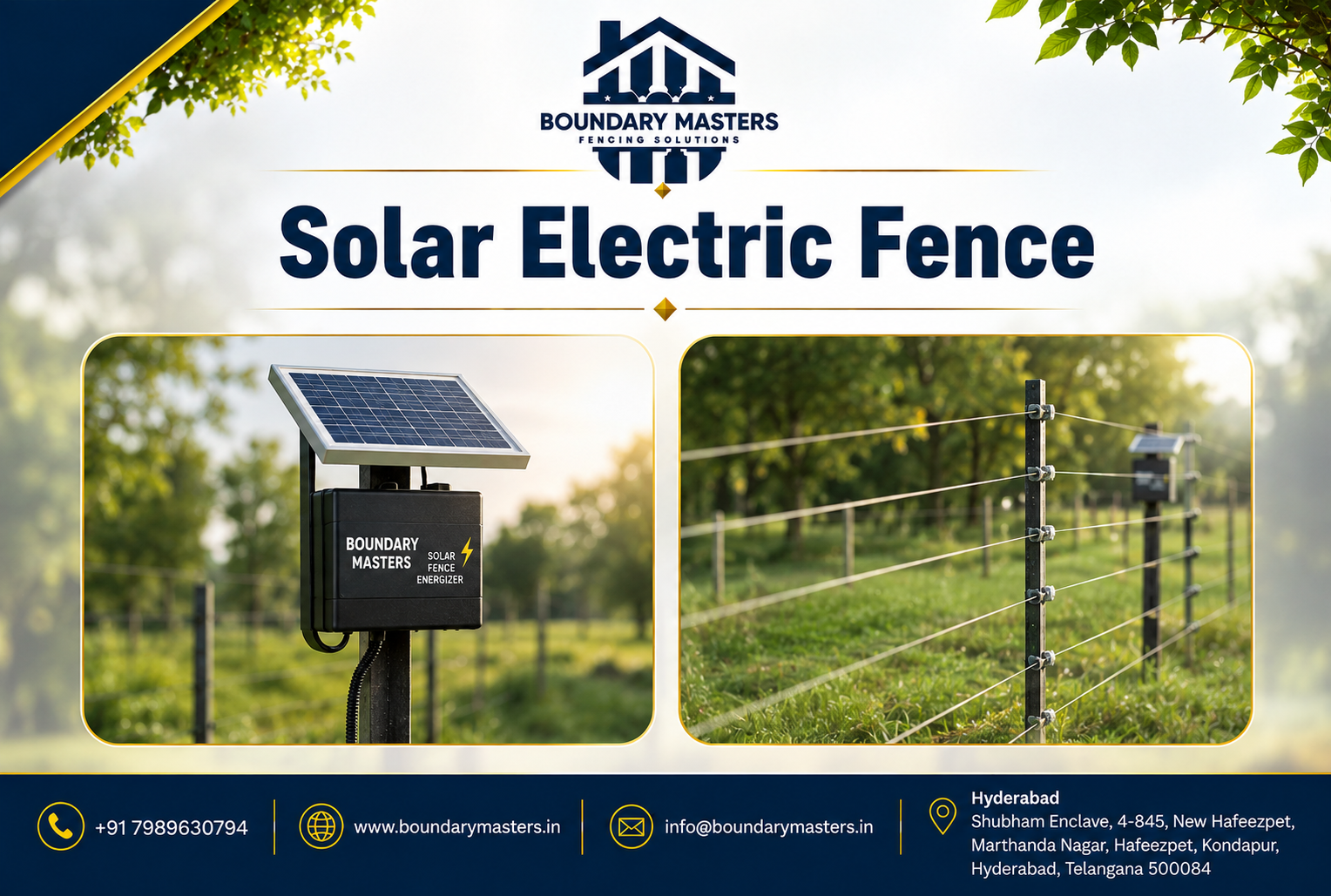
1. Understanding the System
A modern perimeter solution combines a fence energizer, conductive wires, insulators, earthing, warning signs, and a controlled power source. The energizer does not continuously push household current through the wire. Instead, it releases brief, regulated pulses intended to create a strong deterrent while allowing the system to be monitored and maintained. For property owners in Hyderabad, this approach is useful where a conventional wall, chain-link boundary, or barbed-wire line needs an added security layer. Design quality matters because the result depends on correct spacing, proper earthing, weather-resistant components, and professional commissioning rather than simply attaching a live wire to a boundary.
For this reason, a solar electric perimeter fence should be treated as an engineered security installation rather than a collection of separate parts. When Boundary Masters plans a solar electric perimeter fence, the recommendation can be adapted to the property layout, user access, environmental exposure, and maintenance capacity.
2. Why Hyderabad Properties Use It
Hyderabad has a broad mix of villas, warehouses, open plots, farmhouses, industrial sites, institutions, construction zones, and commercial compounds. Each property presents a different perimeter challenge. Some sites need protection against trespassing, while others need a visible deterrent around stored materials, machinery, landscaped areas, or livestock. A professionally planned system can follow irregular boundaries, work above existing fencing, and cover long distances without requiring a complete masonry wall. It can also support backup power and solar charging where reliable grid supply is unavailable or where the owner wants reduced dependence on mains electricity.
For this reason, a Solar Electric Fence should be treated as an engineered security installation rather than a collection of separate parts. When Boundary Masters plans a Solar Electric Fence, the recommendation can be adapted to the property layout, user access, environmental exposure, and maintenance capacity.
3. Deterrence Without Excessive Construction
Many owners want stronger boundary protection but do not want to rebuild an entire compound. An electrified pulse fence can often be installed on top of a wall, along a chain-link structure, or on dedicated posts. This reduces civil work and helps preserve usable space. The visible wires and warning signs communicate that the perimeter is actively protected. When designed correctly, the solution remains neat and does not make a premium residential or commercial property look like a temporary barricade. The key is to use aligned posts, durable brackets, appropriate wire tension, protected cabling, and a control unit placed in a secure, accessible location.
For this reason, a Solar Electric Fence should be treated as an engineered security installation rather than a collection of separate parts. When Boundary Masters plans a Solar Electric Fence, the recommendation can be adapted to the property layout, user access, environmental exposure, and maintenance capacity.
4. Core Components
The energizer is the control heart of the installation. It converts energy from the power source into controlled pulses. Conductive fence wires carry those pulses, while insulators prevent leakage into posts, walls, vegetation, or the ground. Earthing rods complete the circuit when contact occurs. Lightning protection, surge control, cutoff switches, batteries, solar panels, sirens, monitoring modules, and warning boards may be added depending on the site. Every part should be selected as part of one coordinated system. Mixing unsuitable accessories or using improvised electrical materials can weaken performance and increase risk.
For this reason, a Solar Electric Fence should be treated as an engineered security installation rather than a collection of separate parts. When Boundary Masters plans a Solar Electric Fence, the recommendation can be adapted to the property layout, user access, environmental exposure, and maintenance capacity.
5. Role of the Solar Panel
The solar panel charges a battery that supplies the fence energizer. During daylight, the panel converts sunlight into electrical energy; the charge controller manages battery charging; and the stored energy supports operation after sunset or during cloudy periods. Panel capacity should be selected according to energizer consumption, battery size, expected autonomy, local shading, orientation, and seasonal conditions. A panel should not be placed beneath trees, water tanks, parapets, signage, or structures that cast long shadows. Secure mounting is equally important because loose or poorly angled panels can reduce charging and become vulnerable during strong winds.
For this reason, a Solar Electric Fence should be treated as an engineered security installation rather than a collection of separate parts. When Boundary Masters plans a Solar Electric Fence, the recommendation can be adapted to the property layout, user access, environmental exposure, and maintenance capacity.
6. Battery Backup and Autonomy
Battery sizing is not simply a matter of choosing the largest available unit. The installer should calculate energy demand, expected hours of operation, reserve days, battery chemistry, charging current, and environmental exposure. A correctly matched battery allows the installation to continue through the night and during brief periods of poor sunlight. It should be housed in a ventilated, protected enclosure with suitable terminals and cables. Owners should be told how to check charge condition, identify aging, and arrange replacement. An undersized or deteriorated battery may cause weak pulses, frequent alarms, or complete shutdown at the time protection is most needed.
For this reason, a Solar Electric Fence should be treated as an engineered security installation rather than a collection of separate parts. When Boundary Masters plans a Solar Electric Fence, the recommendation can be adapted to the property layout, user access, environmental exposure, and maintenance capacity.
7. Energizer Selection
Energizers differ in output capability, supported fence length, monitoring features, power consumption, alarm options, and compatibility with solar charging. The correct model depends on the actual load, not merely the measured perimeter. Vegetation contact, multiple wire strands, soil conditions, joints, gate arrangements, and attached accessories all affect performance. A competent installer calculates the effective fence load and chooses a certified or compliant product for that application. Oversized, improvised, or direct-mains arrangements should never be used. The system must rely on a purpose-built fence energizer designed to generate controlled pulses.
For this reason, a Solar Electric Fence should be treated as an engineered security installation rather than a collection of separate parts. When Boundary Masters plans a Solar Electric Fence, the recommendation can be adapted to the property layout, user access, environmental exposure, and maintenance capacity.
8. Earthing Quality
Good earthing is essential for dependable operation. When a person or animal touches the live wire while standing on the ground, the pulse must travel through the body, soil, earth rods, and back to the energizer. Dry, rocky, paved, or poorly conductive ground can reduce this return path. The installer may need multiple earth rods, appropriate spacing, moisture management, or an earth-return wire configuration. Earthing for the fence should be planned carefully around other electrical systems, buried services, pipes, and structural metal. Periodic testing is necessary because corrosion, disturbed soil, construction activity, and seasonal dryness can change performance.
For this reason, a Solar Electric Fence should be treated as an engineered security installation rather than a collection of separate parts. When Boundary Masters plans a Solar Electric Fence, the recommendation can be adapted to the property layout, user access, environmental exposure, and maintenance capacity.
9. Fence Wire and Conductor Options
High-tensile wire is commonly selected where strength and long runs are needed. Other conductive materials may be suitable for shorter or specialized installations. The conductor should resist corrosion, maintain tension, and match the energizer and accessories. Poor joints create resistance and voltage loss, so proper connectors are preferable to twisted wire. Corners and end points require stronger strain components because they carry mechanical load. Wire spacing should reflect the threat profile, boundary height, local access points, and the possibility of climbing, crawling, or reaching through. A neat, evenly tensioned line improves both function and appearance.
For this reason, a Solar Electric Fence should be treated as an engineered security installation rather than a collection of separate parts. When Boundary Masters plans a Solar Electric Fence, the recommendation can be adapted to the property layout, user access, environmental exposure, and maintenance capacity.
10. Insulators and Leakage Prevention
Insulators isolate live conductors from posts, brackets, walls, and other grounded surfaces. Cracked, low-quality, UV-damaged, dirty, or incorrectly installed insulators can cause energy leakage and reduce deterrence. Hyderabad heat, dust, rain, pollution, and construction debris make component quality especially important. The installer should use hardware suited to outdoor exposure and the selected post material. At corners, gates, and termination points, strain-rated insulators may be required. During maintenance, accumulated dust, bird nesting material, creepers, metal objects, and loose wire should be removed before they create hidden leakage paths.
For this reason, a Solar Electric Fence should be treated as an engineered security installation rather than a collection of separate parts. When Boundary Masters plans a Solar Electric Fence, the recommendation can be adapted to the property layout, user access, environmental exposure, and maintenance capacity.
11. Wall-Top Installation
For villas, apartments, offices, schools, and established compounds, a wall-top configuration is often the most practical. Brackets are anchored to the wall and positioned to discourage climbing without creating unnecessary projection into public space. The wall must be inspected for structural condition before drilling. Weak coping, loose masonry, waterproofing layers, concealed conduits, and decorative finishes require careful handling. Bracket design can be vertical, angled, or customized, but it must remain consistent around corners and elevation changes. Entry gates, adjoining terraces, trees, sheds, and neighboring structures also need to be considered because intruders may bypass a protected wall through a nearby access point.
For this reason, a Solar Electric Fence should be treated as an engineered security installation rather than a collection of separate parts. When Boundary Masters plans a Solar Electric Fence, the recommendation can be adapted to the property layout, user access, environmental exposure, and maintenance capacity.
12. Chain-Link Integration
An existing chain-link fence can provide a physical barrier while electrified strands create a psychological and active deterrent. The live wires must be isolated from the mesh, posts, and tie wires. If vegetation grows through the chain link and reaches the energized conductors, losses can occur. The chain-link structure should first be checked for rust, loose tension, broken mesh, and unstable posts. Where the base fence is weak, adding an energizer alone will not correct the underlying security problem. Repairs, additional bracing, concrete footings, or replacement sections may be needed before electrical components are added.
For this reason, a Solar Electric Fence should be treated as an engineered security installation rather than a collection of separate parts. When Boundary Masters plans a Solar Electric Fence, the recommendation can be adapted to the property layout, user access, environmental exposure, and maintenance capacity.
13. Open Plot Protection
Vacant plots are exposed to unauthorized entry, dumping, encroachment, material theft, and damage. A perimeter solution for an open site must account for missing power, limited supervision, vegetation growth, dust, and possible tampering. Solar charging and battery backup can make remote operation practical, but the equipment enclosure and panel must be secured. The fence line should remain visible, warning signs should be installed at appropriate points, and gates should be lockable. Regular visits are still necessary. No electronic deterrent can replace inspection of posts, corners, earthing, batteries, panel condition, and nearby activity.
For this reason, a Solar Electric Fence should be treated as an engineered security installation rather than a collection of separate parts. When Boundary Masters plans a Solar Electric Fence, the recommendation can be adapted to the property layout, user access, environmental exposure, and maintenance capacity.
14. Construction Site Applications
Construction sites change continuously. Excavation, temporary roads, scaffolding, material stacks, cranes, labor movement, and new structures can affect the perimeter. The fence layout should be coordinated with the site manager and updated when access points move. Temporary cabling must be protected from vehicles and machinery. Workers should receive clear instructions about isolation procedures before maintenance or modifications. Warning signs must remain visible even when banners, sheets, or stored materials are placed along the boundary. For additional guidance on temporary site boundaries, readers can review the Boundary Masters article on fencing for ongoing construction sites linked later in this guide.
For this reason, a Solar Electric Fence should be treated as an engineered security installation rather than a collection of separate parts. When Boundary Masters plans a Solar Electric Fence, the recommendation can be adapted to the property layout, user access, environmental exposure, and maintenance capacity.
15. Warehouse and Industrial Security
Warehouses and industrial yards often have long perimeters, loading gates, transformer zones, service lanes, utility corridors, and isolated rear boundaries. Security planning should begin with a perimeter risk survey. Sections hidden from guards or cameras may need stronger monitoring, while busy gate areas require safe switching and clear signage. Fence alarms can be integrated with sirens or other systems when compatible. The installation should avoid interference with firefighting access, maintenance routes, overhead lines, pipelines, and emergency exits. Documentation should identify isolation points, energizer location, battery details, fence zones, and contact information for service support.
For this reason, a Solar Electric Fence should be treated as an engineered security installation rather than a collection of separate parts. When Boundary Masters plans a Solar Electric Fence, the recommendation can be adapted to the property layout, user access, environmental exposure, and maintenance capacity.
16. Farm and Agricultural Use
Agricultural properties may use electrified fencing to guide livestock, protect crops, or deter wildlife, but the design should match the intended species and local legal requirements. Temporary grazing arrangements differ from security fences around an industrial compound. Vegetation is a major maintenance issue because grass and branches can drain energy. Water sources, animal handling areas, public paths, children, and neighboring farms need careful consideration. The Food and Agriculture Organization has published material discussing temporary electric fencing in agricultural contexts, while site-specific installation should still be planned by experienced professionals familiar with local conditions.
For this reason, a Solar Electric Fence should be treated as an engineered security installation rather than a collection of separate parts. When Boundary Masters plans a Solar Electric Fence, the recommendation can be adapted to the property layout, user access, environmental exposure, and maintenance capacity.
17. Residential Villas
Villa owners usually prioritize security, appearance, family safety, and easy control. A residential design should avoid sharp, untidy projections and should integrate with the architecture. The energizer and controls need to be inaccessible to children and visitors while remaining convenient for authorized adults. Gates may include insulated underground or overhead connections so the circuit continues without creating contact hazards. Clear operating instructions should cover switching, alarms, service visits, landscaping, and emergency isolation. Residents should never hang clothes, lights, decorations, cables, or metal objects on an energized boundary.
For this reason, a Solar Electric Fence should be treated as an engineered security installation rather than a collection of separate parts. When Boundary Masters plans a Solar Electric Fence, the recommendation can be adapted to the property layout, user access, environmental exposure, and maintenance capacity.
18. Schools and Institutions
Schools, hostels, hospitals, places of worship, and institutions require a higher level of safeguarding because many people may approach the boundary without understanding the system. Risk assessment, permission, signage, restricted controls, documented maintenance, and separation from normal pedestrian activity are essential. The design should consider children, maintenance workers, delivery personnel, gardeners, emergency responders, and neighboring residents. In some environments, a different security solution may be more appropriate. A responsible contractor should recommend electrified fencing only after reviewing exposure, access patterns, applicable rules, and the client’s ability to maintain the system safely.
For this reason, a Solar Electric Fence should be treated as an engineered security installation rather than a collection of separate parts. When Boundary Masters plans a Solar Electric Fence, the recommendation can be adapted to the property layout, user access, environmental exposure, and maintenance capacity.
19. Gates and Entry Points
Gates are frequently the weakest part of a perimeter. Hinges, sliding tracks, gaps below leaves, adjacent pillars, gate motors, intercom wiring, and manual latches complicate continuity. A good design allows the fence circuit to pass the opening through insulated underground cable or another approved method. Switching arrangements should allow authorized entry without exposing users to live conductors. Vehicle gates need protection from impact and cable crushing. Service technicians should test the gate section independently because loose connections and repeated movement can create intermittent faults that are difficult to detect during a casual visual inspection.
For this reason, a Solar Electric Fence should be treated as an engineered security installation rather than a collection of separate parts. When Boundary Masters plans a Solar Electric Fence, the recommendation can be adapted to the property layout, user access, environmental exposure, and maintenance capacity.
20. Alarm and Monitoring Options
Some energizers can detect significant voltage loss, short circuits, wire cutting, or tampering and trigger an alarm output. The alarm may connect to a siren, strobe, security panel, or communication device, depending on compatibility. Monitoring adds value only when someone is responsible for responding. Frequent false alarms caused by vegetation, loose wires, animals, poor joints, or low batteries can lead users to ignore genuine events. During commissioning, thresholds should be tested under realistic conditions. The owner should understand which faults are detected, how alerts are reset, and what information must be shared with the service team.
For this reason, a Solar Electric Fence should be treated as an engineered security installation rather than a collection of separate parts. When Boundary Masters plans a Solar Electric Fence, the recommendation can be adapted to the property layout, user access, environmental exposure, and maintenance capacity.
21. Integration With CCTV and Lighting
Perimeter fencing works best as part of layered security. Cameras provide verification, lighting improves visibility, gates control authorized movement, and guards or monitoring teams respond to alerts. The electrified boundary acts as a deterrent and may indicate interference, but it does not identify every person or event by itself. Cameras should cover likely approach paths, vulnerable corners, gates, and energizer equipment. Lighting should avoid glare that blinds cameras. Power supplies and cables for different systems should be planned separately where required, with suitable surge protection and maintenance access.
For this reason, a Solar Electric Fence should be treated as an engineered security installation rather than a collection of separate parts. When Boundary Masters plans a Solar Electric Fence, the recommendation can be adapted to the property layout, user access, environmental exposure, and maintenance capacity.
22. Safety Standards and Compliance
Electric fence energizers are regulated products, and owners should select equipment that conforms to applicable Indian requirements. The Bureau of Indian Standards lists IS 302-2-76 for the safety of electric fence energizers and references the Electric Fence Energizers Quality Control Order. The Central Electricity Authority also publishes regulations relating to safety and electric supply. Compliance involves more than buying a labeled device: installation method, earthing, separation, signage, wiring, access control, and maintenance all matter. Local permissions, property rules, society rules, land use, and utility clearances should be verified before work begins.
For this reason, a Solar Electric Fence should be treated as an engineered security installation rather than a collection of separate parts. When Boundary Masters plans a Solar Electric Fence, the recommendation can be adapted to the property layout, user access, environmental exposure, and maintenance capacity.
23. Never Connect Direct Mains Power
A perimeter wire must never be connected directly to household or industrial mains electricity. A dedicated fence energizer is designed to limit pulse duration and energy. Direct connections can cause fatal shock, fire, legal liability, and danger to occupants, workers, animals, neighbors, and emergency responders. Improvised transformers and homemade energizers are also unacceptable. The installer should show the owner the equipment rating, isolation switch, earthing arrangement, and shutdown procedure. Any suspicious modification, damaged enclosure, water ingress, or exposed cable should lead to immediate isolation and professional inspection.
For this reason, a Solar Electric Fence should be treated as an engineered security installation rather than a collection of separate parts. When Boundary Masters plans a Solar Electric Fence, the recommendation can be adapted to the property layout, user access, environmental exposure, and maintenance capacity.
24. Overhead Line Awareness
Metal fences and long conductors can become extremely dangerous if they contact overhead power lines. Installation teams must survey nearby electrical infrastructure before raising posts, stretching wires, or using ladders and machinery. OSHA accident records illustrate the severe consequences when fencing becomes energized by high-voltage lines, even though those records arise from a different regulatory jurisdiction. The practical lesson is universal: maintain safe clearance, coordinate with utilities where needed, control lifting operations, and stop work when conductors, poles, cranes, branches, or tools could approach an overhead line.
For this reason, a Solar Electric Fence should be treated as an engineered security installation rather than a collection of separate parts. When Boundary Masters plans a Solar Electric Fence, the recommendation can be adapted to the property layout, user access, environmental exposure, and maintenance capacity.
25. Warning Signs
Warning signs make the hazard visible to residents, workers, visitors, neighboring property users, and emergency personnel. Signs should be durable, legible, securely fixed, and repeated along accessible sections and entry points. They should not be hidden by plants, advertisements, shade cloth, or construction materials. In multilingual or high-footfall environments, symbols and locally understood wording improve communication. Signage does not replace safe design, but missing or faded signs increase risk. The maintenance checklist should include sign condition, placement, readability, and replacement after weather damage or vandalism.
For this reason, a Solar Electric Fence should be treated as an engineered security installation rather than a collection of separate parts. When Boundary Masters plans a Solar Electric Fence, the recommendation can be adapted to the property layout, user access, environmental exposure, and maintenance capacity.
26. Vegetation Management
Leaves, branches, creepers, wet grass, and accumulated organic matter can touch live wires and leak energy into the ground. The result may be weak voltage, battery drain, alarm activation, and reduced deterrence. Landscaping teams should know the fence location and isolation process before trimming. Herbicides, burning, or careless cutting near electrical equipment should not be used without proper assessment. Owners should create a clear strip along the boundary where practical. During Hyderabad’s rainy season, inspections may need to be more frequent because plant growth and moisture can expose weaknesses that were not visible during dry months.
For this reason, a Solar Electric Fence should be treated as an engineered security installation rather than a collection of separate parts. When Boundary Masters plans a Solar Electric Fence, the recommendation can be adapted to the property layout, user access, environmental exposure, and maintenance capacity.
27. Monsoon Preparation
Before heavy rain, inspect outdoor enclosures, cable entries, earthing connections, panel mounts, drainage, wall cracks, and vegetation. Water should not collect around the energizer, battery, or buried connections. Lightning and surge protection should be reviewed by the installer, especially in exposed or elevated locations. Rain can improve soil conductivity but can also reveal damaged insulation and loose fittings. After storms, check fallen branches, displaced wires, panel damage, and alarm history before re-energizing a system that has been switched off. Never approach a damaged fence until it has been safely isolated.
For this reason, a Solar Electric Fence should be treated as an engineered security installation rather than a collection of separate parts. When Boundary Masters plans a Solar Electric Fence, the recommendation can be adapted to the property layout, user access, environmental exposure, and maintenance capacity.
28. Summer Performance
High temperatures can affect batteries, plastic components, enclosures, cable insulation, and solar charging efficiency. Equipment should be shaded or ventilated as required without blocking the panel. Battery housing must not trap excessive heat. Dust on the solar panel reduces energy collection, so cleaning intervals should reflect local conditions. Cleaning should be performed only after following safe shutdown instructions and using non-abrasive methods. Wire tension may also change with temperature. A seasonal service visit can identify cracked insulators, loose brackets, corroded joints, faded signs, and other problems before they cause failure.
For this reason, a Solar Electric Fence should be treated as an engineered security installation rather than a collection of separate parts. When Boundary Masters plans a Solar Electric Fence, the recommendation can be adapted to the property layout, user access, environmental exposure, and maintenance capacity.
29. Routine Inspection
A useful inspection routine combines visual checks with voltage testing. Walk the boundary and look for broken wires, leaning posts, loose brackets, damaged insulators, vegetation contact, unauthorized attachments, gate problems, missing signs, and evidence of tampering. Check the energizer indicators, battery status, solar charging, alarm history, and enclosure condition. Record the date and findings. Testing should use equipment intended for electric fencing, not improvised tools. Any repair requiring contact with conductors must begin with isolation, verification that the system is off, and control of accidental re-energization.
For this reason, a Solar Electric Fence should be treated as an engineered security installation rather than a collection of separate parts. When Boundary Masters plans a Solar Electric Fence, the recommendation can be adapted to the property layout, user access, environmental exposure, and maintenance capacity.
30. Professional Maintenance
Scheduled maintenance protects the investment and reduces false alarms. A technician can measure fence voltage at multiple points, test earthing, inspect joints, review energizer performance, check battery health, clean the solar panel, verify alarm outputs, and tighten mechanical components. Long perimeters may benefit from sectional testing to locate leakage. Maintenance records help identify recurring problems such as one wet corner, a tree that repeatedly touches the wire, or a gate cable that fails under movement. The service agreement should define visit frequency, emergency response, excluded civil work, replacement parts, and customer responsibilities.
For this reason, a Solar Electric Fence should be treated as an engineered security installation rather than a collection of separate parts. When Boundary Masters plans a Solar Electric Fence, the recommendation can be adapted to the property layout, user access, environmental exposure, and maintenance capacity.
31. Troubleshooting Weak Voltage
Low voltage can result from heavy vegetation, broken insulators, wire touching metal, poor joints, inadequate earthing, a low battery, a shaded panel, excessive fence load, damaged underground cable, or energizer failure. Troubleshooting should proceed systematically. First isolate the fence from the energizer and test the unit. Then reconnect sections one at a time to locate the fault. Randomly increasing power or adding another energizer is not a safe solution. Technicians should document readings at the energizer, beginning of the fence, distant points, gates, and earth system.
For this reason, a Solar Electric Fence should be treated as an engineered security installation rather than a collection of separate parts. When Boundary Masters plans a Solar Electric Fence, the recommendation can be adapted to the property layout, user access, environmental exposure, and maintenance capacity.
32. Planning the Site Survey
A detailed survey measures the perimeter, wall heights, corners, slopes, gates, nearby buildings, public access, overhead services, underground utilities, vegetation, soil, and available equipment locations. The contractor should ask what the owner wants to deter, who uses the property, and how the boundary is maintained. Photos and a simple layout help prepare an accurate proposal. The survey should also identify sections where electrified fencing may be inappropriate or where civil repairs are needed first. A transparent quotation distinguishes posts, brackets, wires, energizer, battery, solar panel, earthing, cabling, alarms, taxes, installation, and maintenance.
For this reason, a Solar Electric Fence should be treated as an engineered security installation rather than a collection of separate parts. When Boundary Masters plans a Solar Electric Fence, the recommendation can be adapted to the property layout, user access, environmental exposure, and maintenance capacity.
33. Cost Factors
Pricing varies with perimeter length, number of strands, bracket type, wall condition, post spacing, conductor quality, energizer capacity, solar panel size, battery specification, earthing requirements, gates, alarm integration, access difficulty, height work, transport, and civil repairs. The cheapest quotation may omit essential components or use low-grade materials. Compare scope rather than only the total. Ask for model numbers, warranty terms, exclusions, expected maintenance, and a drawing or strand specification. A well-defined system usually costs less over time than an installation that repeatedly fails or produces false alarms.
For this reason, a Solar Electric Fence should be treated as an engineered security installation rather than a collection of separate parts. When Boundary Masters plans a Solar Electric Fence, the recommendation can be adapted to the property layout, user access, environmental exposure, and maintenance capacity.
34. Choosing a Contractor
Look for experience with similar properties, clear technical explanations, site-specific drawings, written scope, compliant energizers, proper testing equipment, warranty support, and maintenance capability. A professional should discuss risks and limitations rather than promising absolute security. They should refuse direct-mains connections and unsafe shortcuts. Ask to see how gates, corners, earthing, batteries, and solar panels will be handled. Confirm who will train the users and provide emergency isolation instructions. Boundary Masters can assess Hyderabad properties and recommend a configuration based on the actual perimeter rather than a generic package.
For this reason, a Solar Electric Fence should be treated as an engineered security installation rather than a collection of separate parts. When Boundary Masters plans a Solar Electric Fence, the recommendation can be adapted to the property layout, user access, environmental exposure, and maintenance capacity.
35. Comparison With Barbed Wire
Barbed wire is a passive physical deterrent, while an electrified pulse fence adds an active psychological and contact deterrent. Barbed wire can be useful for agricultural land, open plots, and boundaries where a low-maintenance mechanical barrier is suitable. An electric system needs an energizer, earthing, power, testing, vegetation control, and trained users. In some sites, both are combined; in others, one method is preferable. Readers comparing solutions can explore the Boundary Masters guide to barbed wire in Hyderabad through the internal link included below.
For this reason, a Solar Electric Fence should be treated as an engineered security installation rather than a collection of separate parts. When Boundary Masters plans a Solar Electric Fence, the recommendation can be adapted to the property layout, user access, environmental exposure, and maintenance capacity.
36. Comparison With Conventional Fencing
Chain link, welded mesh, palisade, compound walls, and other barriers physically define and resist entry. An energized wire system usually supplements rather than replaces structural security. A weak post, damaged mesh, open drain, or broken wall remains a vulnerability even when live strands are present. The right approach considers delay, detection, deterrence, response, appearance, budget, and maintenance. Boundary Masters provides broader information on fencing contractors in Hyderabad, helping owners compare physical fence types before deciding whether an electrified layer is appropriate.
For this reason, a Solar Electric Fence should be treated as an engineered security installation rather than a collection of separate parts. When Boundary Masters plans a Solar Electric Fence, the recommendation can be adapted to the property layout, user access, environmental exposure, and maintenance capacity.
37. Environmental and Operational Limits
Solar charging reduces dependence on grid electricity, but it does not make the installation maintenance-free. Extended shading, panel dirt, battery aging, theft, extreme weather, vegetation, corrosion, and accidental damage can interrupt operation. A fence also cannot guarantee that an intruder will not enter. It should be part of a wider security plan with secure gates, lighting, cameras, locks, procedures, and response arrangements. Owners should understand these limits at the quotation stage. Honest expectations lead to better system design and more consistent maintenance.
For this reason, a Solar Electric Fence should be treated as an engineered security installation rather than a collection of separate parts. When Boundary Masters plans a Solar Electric Fence, the recommendation can be adapted to the property layout, user access, environmental exposure, and maintenance capacity.
38. Commissioning and Handover
After installation, the contractor should test voltage around the entire boundary, verify earthing, check solar charging, confirm battery condition, operate alarms, test gates, and inspect all signs. The owner should receive operating instructions, isolation steps, equipment details, warranty documents, service contacts, and a maintenance schedule. Staff who control the system should be trained. Handover is also the right time to photograph the completed installation and record baseline readings. Future technicians can compare those readings when troubleshooting performance changes.
For this reason, a Solar Electric Fence should be treated as an engineered security installation rather than a collection of separate parts. When Boundary Masters plans a Solar Electric Fence, the recommendation can be adapted to the property layout, user access, environmental exposure, and maintenance capacity.
39. Emergency Isolation
Every responsible installation needs a clearly identified way to switch off the energizer. Authorized people should know where it is and how to use it. In an emergency involving fire, injury, storm damage, fallen power lines, construction impact, or a trapped person or animal, isolation should occur before anyone approaches the conductors. The site’s emergency plan should include contact details for the installer and relevant services. Never cut or handle energized wires with ordinary tools. After an incident, the fence should remain off until a competent person has inspected and declared it safe.
For this reason, a Solar Electric Fence should be treated as an engineered security installation rather than a collection of separate parts. When Boundary Masters plans a Solar Electric Fence, the recommendation can be adapted to the property layout, user access, environmental exposure, and maintenance capacity.
40. Long-Term Value
The value of a perimeter system depends on reliability, visibility, maintainability, and integration with the property’s security plan. Quality materials and correct installation reduce energy leakage, corrosion, false alarms, and repeated callouts. Solar support can be especially valuable at remote sites and during power interruptions, provided the battery and panel are properly sized. Owners should budget for periodic testing and eventual battery replacement. A maintained system delivers far more value than a neglected installation that only appears secure from a distance.
For this reason, a Solar Electric Fence should be treated as an engineered security installation rather than a collection of separate parts. When Boundary Masters plans a Solar Electric Fence, the recommendation can be adapted to the property layout, user access, environmental exposure, and maintenance capacity.
41. Getting a Site-Specific Recommendation
No two properties have identical wall profiles, gate arrangements, soil, vegetation, power access, public exposure, or security risks. A site visit allows the contractor to recommend strand count, bracket orientation, post spacing, energizer capacity, battery reserve, solar panel size, earth system, alarms, and maintenance frequency. Boundary Masters serves customers in Hyderabad and can prepare a solution for residential, commercial, industrial, agricultural, and construction boundaries. The final design should prioritize compliance, controlled operation, reliable deterrence, and straightforward upkeep.
For this reason, a Solar Electric Fence should be treated as an engineered security installation rather than a collection of separate parts. When Boundary Masters plans a Solar Electric Fence, the recommendation can be adapted to the property layout, user access, environmental exposure, and maintenance capacity.
Detailed Planning and Maintenance Checklist
- Confirm the exact property boundary, wall condition, gates, overhead lines, buried services, public access, trees, drains, and vulnerable approach points before installation.
- Repair weak masonry, loose posts, broken mesh, unstable gates, and damaged coping before electrical components are fixed.
- Select a secure, weather-protected equipment location with enough ventilation and safe maintenance access.
- Calculate energizer load, solar-panel capacity, battery reserve, earthing requirements, strand count, and gate connections from the site survey.
- Record equipment models, warranty details, baseline voltage readings, isolation instructions, and service contacts during handover.
- Inspect vegetation, wire tension, insulators, warning signs, panel cleanliness, battery condition, alarms, and gate cables regularly.
- Arrange professional testing after lightning, flooding, fire, vehicle impact, vandalism, major construction, landscaping changes, or repeated alarms.
- Never permit untrained workers to move conductors, alter earthing, attach objects, or work near the boundary without safe isolation.
Useful Boundary Masters Resources
Continue your perimeter-planning research with these related guides:
Authoritative Safety and Technical References
- Bureau of Indian Standards – Electric Fence Energizers and IS 302-2-76
- Central Electricity Authority – Measures Relating to Safety and Electric Supply
- FAO – Electric Fencing for Crop Protection
- FAO – Agricultural Fencing Types and Temporary Electric Fences
- OSHA – Agricultural Operations Hazards and Controls
- OSHA – Wiring Design, Protection and Grounding
Frequently Asked Questions
Is an electric perimeter fence safe?
A properly designed system uses a purpose-built energizer that releases controlled pulses. Safety depends on compliant equipment, professional installation, earthing, warning signs, separation from public access, and regular maintenance. Direct connection to mains power is dangerous and must never be used.
Can it work without grid electricity?
Yes. A correctly sized solar panel, charge controller, battery, and energizer can support operation without continuous grid supply. Performance depends on sunlight, shading, battery condition, system load, panel cleanliness, and correct sizing.
How long does the battery last?
Service life varies with battery type, temperature, depth of discharge, charging quality, maintenance, and system demand. The installer should recommend a suitable battery and explain testing and replacement intervals.
Can it be installed on an existing wall?
Often yes, provided the wall is structurally suitable and brackets can be anchored safely. The survey should check coping strength, waterproofing, concealed services, neighboring access, gates, trees, and public exposure.
Can it be combined with chain-link fencing?
Yes. Electrified strands can supplement chain link, but they must be insulated from the mesh and posts. The chain-link fence should first be repaired, tensioned, and stabilized.
Does rain stop the fence from working?
Rain does not automatically stop a correctly installed system, but water ingress, damaged insulation, vegetation, loose connections, and storm damage can cause faults. Weatherproofing and post-storm inspection are important.
How often should maintenance be done?
Frequency depends on vegetation, dust, property use, fence length, alarm history, weather, and component age. Owners should visually inspect regularly and arrange periodic professional testing.
Will it protect an open plot?
It can provide a visible and active deterrent for an open plot, especially with solar charging and battery backup. Secure equipment mounting, warning signs, strong posts, vegetation control, and scheduled inspection remain necessary.
Can it trigger an alarm?
Compatible energizers may provide alarm outputs for significant voltage loss, short circuits, wire cutting, or tampering. The exact capability depends on the model and installation.
Is it suitable for homes with children?
Residential use requires careful risk assessment, restricted controls, safe placement, clear signs, and user training. The contractor should evaluate whether the proposed layout is appropriate for the household and surrounding area.
What affects installation cost?
Perimeter length, strand count, brackets, posts, energizer, solar panel, battery, earthing, gates, alarms, wall repairs, access difficulty, and maintenance requirements all affect cost.
How do I know whether the fence is working?
Energizer indicators provide basic status, but proper verification requires an electric-fence tester and readings at several points. Visual appearance alone cannot confirm performance.
What happens when plants touch the wires?
Vegetation can leak energy to ground, reduce voltage, drain the battery, and create alarms. A clear maintenance strip and regular trimming help preserve performance.
Can CCTV be integrated?
The fence can form part of a layered security plan with CCTV, lighting, gates, alarms, and response procedures. Integration depends on equipment compatibility and should be designed by qualified technicians.
Why is a site survey important?
The survey identifies perimeter length, wall condition, gates, public access, soil, vegetation, shading, utilities, equipment locations, and security risks. These details determine the correct design and quotation.
Contact Us :
Phone: +91 7989630794
Email: reach.us@boundarymasters.in
Address: Shubham Enclave, 4-845, New Hafeezpet, Marthanda Nagar, Hafeezpet, Kondapur, Hyderabad, Telangana 500084